
Zhangjiajie National Forest Park
Hunan Sheng, China
Why visit Zhangjiajie National Forest Park?
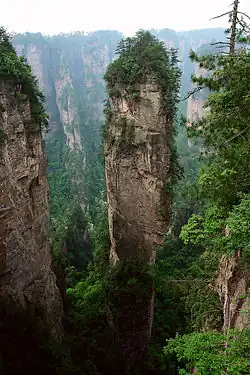
Zhangjiajie National Forest Park is the showpiece of the larger 397.5 km² Wulingyuan Scenic and Historic Interest Area, a labyrinth of more than 3,000 quartz-sandstone pillars rising sheer from forested ravines. The formations were carved over millions of years as rivers cut through uplifted sandstone, eroding the softer siltstone below until only the harder pillars remained — a process accelerated by heavy rains, frost, and the roots of plants that colonised the rock. Designated China's very first national forest park in 1982, the area became a UNESCO World Heritage Site in 1994 and a UNESCO Global Geopark in 2004. International fame arrived with Avatar (2009): the floating "Hallelujah Mountains" of Pandora were inspired by these peaks, and one column in the park was officially renamed Hallelujah Mountain in January 2010.
The park sits in the northwest of Hunan province, a subtropical region with hot, humid summers and cool, often misty winters. The signature "sea of clouds" effect — pillars piercing low-lying fog — is most reliable after rain in spring (April–May) and autumn (September–October), which are also the most pleasant months to visit. July and August bring crowds, heat, and afternoon thunderstorms; winter occasionally dusts the peaks with snow and is the quietest season, though some trails and lifts may close in icy conditions.
The park is best understood as four interconnected scenic zones linked by shuttle buses, cable cars, and the Bailong Elevator (the world's tallest outdoor lift at 326 m): Huangshi Village (Huangshizhai) in the south for classic panoramic ridgelines; Golden Whip Stream (Jinbianxi) along the valley floor for a flat riverside walk; Yuanjiajie for the Avatar Hallelujah Mountain and the highest cluster of pillars; and Yangjiajie in the northwest for steeper, less crowded scrambles. The neighbouring Tianzi Mountain and Suoxi Valley zones are accessed on the same multi-day ticket.
Planning Zhangjiajie National Forest Park? Tell us your dates and we’ll tailor the trip.
Ask on WhatsAppHow do you get there?
By Plane
The nearest airport is Zhangjiajie Hehua International Airport (DYG) in Yongding District, about 30 km from the park entrance and roughly 5 km southwest of Zhangjiajie city centre. It handles domestic flights from Beijing, Shanghai, Guangzhou, Chengdu, Xi'an and Chongqing, plus seasonal international routes from Seoul, Bangkok and Kuala Lumpur. From the airport, take city bus No. 4 to Zhangjiajie Central Bus Station (about ¥2, 30–40 min) and connect onward to the park by direct bus (about ¥15, 1–1.5 hours total). A metered taxi from the airport directly to the park gate at Wujiayu costs roughly ¥120–150.
By Train
The most useful station is Zhangjiajiexi (Zhangjiajie West) Railway Station, 21 km from the park, served by both high-speed and conventional trains; a direct bus from the station to the park takes about 40 minutes and costs ¥15. The older Zhangjiajie Railway Station, 40 km from the park, is served only by ordinary trains and is roughly an hour and ¥33 from the gate. High-speed services connect Zhangjiajiexi to Changsha (about 3 hours), Chongqing, and Guangzhou. Book seats on the 12306 app or via a third-party platform like Trip.com several days ahead in peak season.
By Car / Road
Driving is straightforward on the G5513 Changsha–Zhangjiajie Expressway. Approximate distances and times by road:
- Changsha — about 380 km, 4–5 hours by car; bus departs Changsha West Bus Station around 14:00, journey ~4 hours.
- Wuhan — about 600 km, 7 hours by car; bus from Wuhan Hongji Bus Station departs 08:50, ~6.5 hours.
- Changde — about 200 km, 2.5 hours; multiple daily coaches (11:10, 13:20, 14:30) from Changde Bus Terminal.
- Tongren (Guizhou) — about 220 km, 4–5 hours; frequent coaches between 10:30 and 17:40.
All long-distance coaches terminate at Zhangjiajie Central Bus Station, from which direct shuttles run to the park's main gates at Wujiayu, Zhangjiajie Forest Park, and Tianzi Mountain.
A single park ticket includes unlimited rides on the park's internal environmentally friendly shuttle buses, which run frequently between the scenic zones from roughly 07:00 to 19:00. Inside the park, expect long flights of stone steps; the Bailong Elevator (one-way ¥72) and the Huangshizhai, Tianzi Mountain and Yangjiajie cable cars (each ¥50–80 one-way) save hours of climbing.
Outside the park, city bus No. 1 links Zhangjiajie city, the train station, and the bus terminal for ¥1–2. Didi Chuxing (China's main ride-hailing app) works in town; expect ¥15–30 for in-city trips. Taxis start at ¥6; insist on the meter or agree the fare first. Touts at the train station, airport and park gate aggressively pitch overpriced "private tours" — politely decline and head straight to the official ticket office or bus stop. Carry small cash for park snack stalls; WeChat Pay and Alipay are accepted almost everywhere else, including the entrance gates.
What are the things to do?
Park entry: a four-day pass costs ¥225 (¥115 for students/seniors) and covers Zhangjiajie National Forest Park plus the adjoining Wulingyuan zones (Tianzi Mountain, Suoxi Valley, Yangjiajie). The pass is biometric — your fingerprint is scanned at the gate.
Viewpoints and rock formations
- Hallelujah Mountain (Qiankun Zhu / "Avatar Mountain") — the slender, top-heavy pillar made famous by Avatar, on the Yuanjiajie plateau. Reached via the Bailong Elevator and a short walk. Open 07:00–18:00 with park ticket.
- Yuanjiajie Scenic Area — high plateau with the densest cluster of pillars; loop walks pass First Bridge Under Heaven (a natural stone arch between two peaks) and the Mihun Platform overlook.
- Huangshi Village (Huangshizhai) — often called "you haven't been to Zhangjiajie if you haven't climbed Huangshizhai." Sweeping 360° views over the park's southern pillars. Reach by cable car (¥65 up, ¥50 down) or 2-hour climb.
- Tianzi Mountain — adjoining peak in the Wulingyuan zone with the iconic "Imperial Brush Peaks" view; cable car ¥72 one-way.
- Yangjiajie — the wildest and least crowded zone, with the heart-stopping Tianbo Mansion ridge walk.
Walks
- Golden Whip Stream (Jinbianxi) — flat 7.5 km riverside trail through the canyon floor, framed by towering pillars and shaded forest. Macaques along the path; do not feed them.
- Ten-Mile Natural Gallery (Shili Hualang) — gentle valley walk past sandstone formations; a small monorail (¥38 one-way) shuttles those who prefer not to walk.
Engineering wonders
Bailong Elevator — the world's tallest outdoor lift at 326 m, glass-fronted, three two-storey cars; ¥72 one-way. Open roughly 07:00–19:00.
Zhangjiajie Grand Canyon Glass Bridge — 430 m long, 300 m above the canyon floor, in the adjacent Zhangjiajie Grand Canyon (separate ticket, about ¥259 including the bridge and canyon walk). Located outside the national forest park proper, around 30 km east.
Hike the full Yuanjiajie–Tianzi loop over two days, overnighting at one of the in-park guesthouses near Ding Xiang Rong village to catch sunrise above the cloud sea.
Photograph the sea of clouds from Mihun Platform or Tianzi Pavilion at dawn after a rainy night — the park's most coveted shot.
Cross the Glass Bridge in Zhangjiajie Grand Canyon; visitors are issued shoe covers and the bridge sways gently — not for vertigo sufferers.
Tianmen Mountain day trip — a separate massif south of Zhangjiajie city famous for its 999-step staircase to Heaven's Door cave, the world's longest passenger cable car (7.5 km), and a cliffside glass skywalk. Day ticket about ¥258 including cable car.
Watch the Charming Xiangxi show (魅力湘西) in Wulingyuan town — a 90-minute Tujia and Miao ethnic-culture performance with folk music, fire dance, and a wedding reenactment. Tickets ¥228–328.
Drift down the Maoyan River — gentle 7-km bamboo-raft or rubber-dinghy float through karst scenery; seasonal, roughly April to October, around ¥118.
Explore Yellow Dragon Cave (Huanglong Dong) — a vast limestone cave in Wulingyuan with subterranean rivers, electric-boat sections, and the world's tallest stalagmite. Ticket about ¥100.
Planning Zhangjiajie National Forest Park? Want these on a customised itinerary?
Ask on WhatsAppWhere to eat?
Hunan cuisine is famously spicy — hotter and more sour than Sichuan, leaning on smoked chilli, garlic, and pickled vegetables. The Tujia local style adds preserved pork and corn-based dishes. Signature plates to try: Tujia three-cup chicken (sanxia guo), smoked bacon stir-fried with dried radish, Zhangjiajie iron-pot beef, glutinous rice cakes (ciba) grilled over coals, and sour-soup fish.
- Budget — Wulingyuan Pedestrian Street food stalls, near the park's south gate. Skewers of grilled tofu, stinky tofu, rice noodles, and Tujia ciba from ¥5–25. Open from late afternoon until midnight.
- Budget — Mifan Xiansheng (米饭先生) chain branches in Zhangjiajie city. Set meals with rice, a meat, and two vegetables for ¥25–40; reliable for solo hikers.
- Mid-range — Hu Shi Hui Wei (胡师汇味), Wulingyuan town. Bustling Hunanese restaurant strong on iron-pot dishes and smoked bacon; mains ¥38–98.
- Mid-range — Lao Wuling Restaurant (è€?武陵酒家), Zhangjiajie city centre. Tujia and Xiangxi specialities including sour-soup fish and three-cup chicken; expect ¥80–150 per person.
- Upscale — Tujia Family Banquet (土家風情園) dinner show, near the Tujia Folk Customs Park. Multi-course set menu with folk performances; around ¥180–280 per person.
Vegetarians can manage with stir-fried seasonal greens, mapo tofu, dry-fried green beans, and noodle soups — say "wÇ’ chÄ« sù" (I eat vegetarian) and "bú yào ròu" (no meat); be aware lard and pork stock are common. Halal options are limited but a small cluster of Lanzhou lamian noodle shops near Zhangjiajie train station serve halal beef noodles.
Where to drink?
The local drink of note is mijiu (rice wine) and kiwi-fruit wine — both produced in the Wuling region, sweet-sour and around 10–14% ABV. Stronger baijiu (sorghum spirit) flows at any Tujia banquet, with the host pressing toasts; pace yourself. Tea culture leans on Wuling Maojian green tea and Gushui Liu dark tea, both grown in the surrounding mountains and sold loose-leaf in town.
After-hike beers and cocktail bars cluster on Wulingyuan pedestrian street and around Ziwu Road in Zhangjiajie city; expect ¥20–35 for a draft local Baisha or Tsingtao, ¥40–60 for a cocktail. Most park entrance villages also have basic karaoke bars (KTV) open until 02:00.
Tap water is not safe to drink. Stick to bottled water (¥2–5 per bottle at park kiosks, ¥1–2 in town supermarkets) or boiled water from your hotel's flask. Ice in mid-range and upscale venues is fine; avoid it from street stalls.
Planning Zhangjiajie National Forest Park? We’ll book the stays and dining for you.
Ask on WhatsAppWhere to stay?
The two natural bases are Wulingyuan town (south gate, biggest selection, easy access to most zones) and Zhangjiajie city (cheaper, useful if combining with Tianmen Mountain). A handful of guesthouses sit inside the park itself near Yuanjiajie — convenient for sunrise but pricier and basic.
Budget
- Zhangjiajie Lotus International Youth Hostel, Wulingyuan town. Dorm beds from ¥60, private doubles from ¥160. English-speaking staff, useful for trip planning.
- Mountain Inn near Ding Xiang Rong village, inside the park on the Yuanjiajie plateau. Simple twin rooms from around ¥200; book through Ctrip/Trip.com in advance, as walk-up prices spike.
Mid-range
- Pullman Zhangjiajie, Wulingyuan, near the park's south gate. Doubles from about ¥700 with breakfast; large rooms, spa, and shuttle to the gate.
- Crowne Plaza Zhangjiajie Wulingyuan, Wulingyuan. Doubles from about ¥800; one of the most reliable international-brand options near the park.
Upscale / heritage
- Hilton Zhangjiajie Wulingyuan, Wulingyuan. Doubles from about ¥1,300; modern resort with valley views, indoor pool, and the most polished service in the area.
- Fuyuan Resort Wulingyuan, near Suoxi Valley. Villa-style rooms from about ¥1,500, with Tujia-inspired architecture set against the pillars; the closest thing to a heritage-styled stay in the region.
What should you buy?
Zhangjiajie city and Wulingyuan town both have night markets geared to visitors. The cluster around Wulingyuan's pedestrian street is the most useful for souvenirs and after-hike snacks.
Local crafts to look for:
- Tujia brocade (xilankapu) — handwoven cotton fabric in geometric patterns, the signature craft of the local Tujia minority.
- Tujia silver jewellery — chunky neck pieces and bracelets, sold from ¥80 upwards.
- Wild mushrooms and tea — dried songrong (matsutake) and local Maojian green tea from the Wuling mountains.
- Kiwi-fruit wine and rice liquor — sold in decorative ceramic bottles.
- Ginger candy and walnut sweets — cheap, light, and good for the hike.
Bargain at street stalls (start at roughly half the asking price); supermarkets and official park shops have fixed prices. Be sceptical of "ancient" jade or carved bone — most is resin.
Where to go next?
- Zhangjiajie city & Tianmen Mountain (30 km, ~45 min) — Heaven's Door cave, the world's longest passenger cable car, and the cliffside glass skywalk.
- Fenghuang Ancient Town (220 km, ~4 hr by bus) — riverside Ming/Qing stilt-house town in the Xiangxi Miao prefecture; an essential second stop on any Hunan trip.
- Furong Ancient Town (Furongzhen) (110 km, ~2 hr) — Tujia waterfall-town used as a Chinese film location, often combined with Fenghuang.
- Dehang Miao Village (200 km, ~3.5 hr) — quieter alternative to Fenghuang in a steep karst valley, with traditional Miao villages and waterfalls.
- Changsha (380 km, ~3 hr by high-speed rail) — Hunan's capital, base for Mao Zedong heritage sites and the spicy food capital of China.
- Wulong Karst (Chongqing) (~500 km, ~6 hr by train) — UNESCO karst landscape with the Three Natural Bridges; pairs naturally with Zhangjiajie for a "dramatic landforms of southern China" loop.
Nearby in Hunan Sheng
More places to explore around Zhangjiajie National Forest Park.
Guide content as of May 2026. Portions adapted from Wikivoyage, CC BY-SA 4.0.

Contact Us
Get in touch with us.
Get in touch
Contact Us
Tell us where you'd like to go and how you like to travel. A real Tripcuro planner — not a bot — will craft an itinerary around you.
- Personalised, hassle-free planning end-to-end
- Transparent pricing, no hidden costs
- 24/7 support for complete peace of mind