
Tianmen Mountain
Hunan Sheng, China
Why visit Tianmen Mountain?
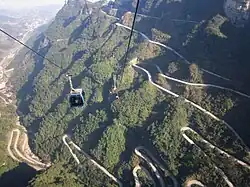
Tianmen Mountain (Chinese: 天门山, "Heaven's Gate Mountain") rises over 1,500 m above the city of Zhangjiajie in northwestern Hunan, a karst spire wrapped in cliff-edge boardwalks and capped by one of the most photographed natural arches in China. The mountain has been a place of pilgrimage and wonder for more than two thousand years; the great gate itself was originally a cave whose rear wall collapsed in antiquity, leaving a tall opening through which, on the right day, you can quite literally see sky on the other side of the mountain. A temple sits near the summit, and modern infrastructure — one of the world's longest passenger cable cars, a multi-stage underground escalator, and a spiralling switchback road — has only deepened the mountain's reputation as a place engineered to deliver awe.
For most visitors Tianmen is a long day trip from central Zhangjiajie rather than a destination unto itself: the cable-car base station sits beside the city's main rail and bus stations, and the entire mountain experience — gate, summit loop, glass walks — fits comfortably between breakfast and a late dinner. It is best treated as the urban-edge counterpart to Wulingyuan, the sandstone-pillar landscape an hour to the north that most travellers actually came to Hunan to see.
The best months are April–June and September–early November, when skies are most likely to be clear enough to make the cliff walks worthwhile. July and August are hot, humid, and crowded; winter brings ice that periodically closes the upper boardwalks and the switchback road, though a snow-dusted gate is spectacular if you catch it. Avoid the first week of October (National Day) and Chinese New Year, when waits at the cable car can stretch for hours.
Planning Tianmen Mountain? Tell us your dates and we’ll tailor the trip.
Ask on WhatsAppHow do you get there?
Tianmen Mountain is reached from the city of Zhangjiajie; the lower cable-car station is in the city centre, a few minutes' walk from the train and long-distance bus stations.
By Plane
Zhangjiajie Hehua International Airport lies a short distance west of the city centre. It has a limited but useful schedule of domestic flights (Changsha, Shanghai, Beijing, Guangzhou, Chengdu, Xi'an) plus a handful of seasonal regional international routes. A taxi to central Zhangjiajie or the cable-car station is quick and inexpensive; budget public buses also connect the airport to the city, and Didi ride-hailing works there too.
By Train
Zhangjiajie Railway Station is in the south of the city, a short walk from the Tianmen cable-car base, and handles conventional sleeper services from across China. Changsha to Zhangjiajie by conventional train takes roughly 4–5 hours, with frequent daily departures. Zhangjiajie West is a separate high-speed station some distance from the city; it serves the Zhangjiajie–Changsha–Yiyang HSR line, cutting the journey from Changsha South to a few hours. Confirm which station your ticket uses before booking onward transport. Book through 12306 or Trip.com; foreign passport holders should collect paper tickets or use e-ticket gates with the same passport used at booking.
By Car / Road
Zhangjiajie sits at the junction of two expressways, making road approaches from Changsha, Chongqing, and Yichang (Hubei) all feasible, if long. Long-distance buses arrive at Zhangjiajie Central Bus Station next to the train station. Self-driving the switchback road up to Tianmen Cave is not possible for private vehicles — the road is reserved for the park's official shuttle buses.
On the mountain itself, movement is governed by the ticketing system. The standard combined ticket entitles you to one of several routings combining the long cable car from the city, the express cable car partway up the mountain, and the shuttle bus along the switchback road, in different up/down combinations.
The long cable car from the city centre climbs several kilometres to the upper plateau and is itself a sight. The shorter express cable car connects the lower mountain to the base of the Tianmen Cave staircase. Between the cave and the upper plateau, a free multi-stage underground escalator does the vertical work; a parallel paid escalator and a long staircase are the alternatives. Around the summit, a network of cliff-edge boardwalks loops the rim, much of it pinned to vertical cliff faces hundreds of metres high, with a few short glass-floor sections that require disposable shoe covers.
Practical notes: buy tickets in advance via Alipay or WeChat, as cards are not accepted at the booth; queues at the city base often build up mid-morning, so an early start helps; and bring water, layers (the summit can be noticeably cooler than the city), and grippy shoes.
What are the things to do?
Tianmen Cave — the natural arch that gives the mountain its name, reached by climbing a long staircase from the base of the upper plateau, or via the free escalator if your knees object. The headline sight; allow at least an hour.
West Line Cliff Walk — a several-kilometre boardwalk pinned to the western cliffs, including a glass-floor section. Quietest in the early morning.
East Line Cliff Walk — slightly less crowded, with views back toward Zhangjiajie city and the cable-car cabins drifting overhead.
Coiling Dragon Cliff glass walkway — the most photographed of the glass sections.
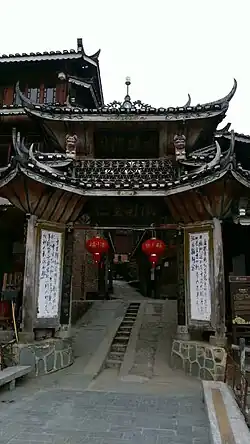
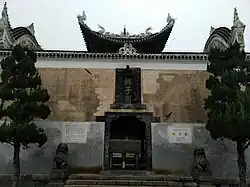
Tianmenshan Temple — a Buddhist temple on the upper plateau, rebuilt in the modern era; a working monastery, so be quiet inside the halls.
The switchback road ("99 Bends") — the road that climbs to Tianmen Cave in a long series of hairpin turns; you ride it on the park bus, but the views back down (especially from the cable car above) are part of the spectacle.
Guigu Plank Road — a narrow plank walkway bolted to the cliff face on the west loop, named after the legendary strategist Guiguzi who is said to have meditated nearby.
Walk the full summit loop (West Line + East Line) — a few unhurried hours, with the plank road and glass walkways as set pieces.
Climb down through Tianmen Cave on foot instead of taking the escalator — the angle on the arch from partway up is one of the best photos on the mountain.
Photograph from the cable car — the long cable car crosses directly over the switchback road; sit on the outside for the best view going up.
Catch a wingsuit event if timing allows — Tianmen Cave has hosted internationally known wingsuit competitions in past years; check locally for whether one is scheduled.
Day-trip combo with Wulingyuan — Tianmen on day one (urban-side, half-to-full day), Wulingyuan on day two and three.
Planning Tianmen Mountain? Want these on a customised itinerary?
Ask on WhatsAppWhere to eat?
Hunan cuisine is one of China's eight great regional cuisines and is reliably fiery — fresh chillies, smoked pork, fermented black beans, and a sour-spicy register quite different from Sichuan's numbing heat. On the mountain, food is functional (instant noodles, sausages on sticks, corn on the cob, boxed meals at the summit canteen). Eat properly down in the city, where budget noodle stalls, mid-range Hunanese and Tujia-style restaurants, and hotel dining rooms all serve the regional specialities — smoked pork, chopped-pepper fish head, Tujia-style hotpot, and sour-and-spicy rice noodles among them. Vegetarians can eat plain stir-fried greens and tofu dishes, but should flag "no meat" and "no chilli" clearly, since lard and chilli are near-defaults. Halal options exist around the train station — look for the green "qingzhen" sign, usually marking a Lanzhou-style hand-pulled noodle shop.
Where to drink?
Bottled water and soft drinks are sold at small shops along the boardwalks and at every transfer station. Hunan is a green-tea and dark-tea province; look for Junshan Yinzhen yellow tea and Anhua dark tea in city shops. Baijiu is the regional spirit of choice with meals — Jiuguijiu is a well-known Hunan brand. Tap water is not safe to drink anywhere in China; stick to bottled or boiled water. Hotel kettles and the ubiquitous hot-water dispensers are fine.
Planning Tianmen Mountain? We’ll book the stays and dining for you.
Ask on WhatsAppWhere to stay?
Stay in central Zhangjiajie for the cable car, or in Wulingyuan town an hour north if you're prioritising the national park. Get your hotel's phone number and a screenshot of its Chinese name and address before arrival — taxi drivers often don't recognise small hotels by their English names.
- Budget — hostels and small guesthouses cluster near the cable-car station, offering dorms and simple private rooms.
- Mid-range — national chains such as Hanting and Atour have branches within a short walk of the cable car.
- Upscale — international-brand hotels including a Pullman property serve the city, with a Hilton Garden Inn nearer the airport for travellers with their own transport.
What should you buy?
This is a national-park summit, not a shopping destination. Expect snacks, bottled water, and souvenirs at small kiosks along the cliff walks and at the cable-car transfer points, priced well above city rates. Tujia ethnic-minority handicrafts (embroidery, brocade pouches) are sold at the cable-car base in the city with better selection and prices than on the mountain. For real shopping, descend to Zhangjiajie city centre, where the streets around the train station have shops and a night market. Bargaining is normal at street stalls; fixed-price in shops and chains.
Where to go next?
- Wulingyuan Scenic Area — about an hour by bus or taxi; the UNESCO sandstone-pillar landscape that inspired the floating mountains in Avatar. Two to three days.
- Zhangjiajie Grand Canyon & Glass Bridge — around 1.5 hours away; a very long glass-bottom bridge, plus a dramatic canyon walk below.
- Fenghuang Ancient Town — several hours by bus; a stilted Miao/Tujia riverside town that is touristy but genuinely beautiful, especially after dark.
- Furong Ancient Town — a smaller, less-visited waterfall-side old town, good as a half-day stop en route to Fenghuang.
- Changsha — reachable by high-speed rail or a longer drive; Hunan's capital, for Mao-era history, the Hunan Provincial Museum's Mawangdui Han tombs, and a serious food scene.
- Mengdong River / Furong-Yongshun karst country — rafting and Tujia village hikes for travellers staying in the region longer.
Nearby in Hunan Sheng
More places to explore around Tianmen Mountain.
Guide content as of July 2026. Portions adapted from Wikivoyage, CC BY-SA 4.0.

Contact Us
Get in touch with us.
Get in touch
Contact Us
Tell us where you'd like to go and how you like to travel. A real Tripcuro planner — not a bot — will craft an itinerary around you.
- Personalised, hassle-free planning end-to-end
- Transparent pricing, no hidden costs
- 24/7 support for complete peace of mind