
Wulingyuan
Hunan Sheng, China
Why visit Wulingyuan?
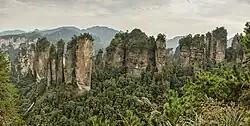
Wulingyuan (Chinese: 武陵源) is a UNESCO World Heritage Site in the prefecture-level city of Zhangjiajie in northwestern Hunan, famous for the surreal forest of quartz-sandstone pillars that rises from its sub-tropical valleys. The core protected area covers several hundred square kilometres and bundles together several adjoining scenic zones — Zhangjiajie National Forest Park (the original draw, established as China's first national forest park in 1982), Suoxi Valley, Tianzi Mountain, and Yangjiajie — under one ticket and one bus network. Thousands of narrow stone columns, some over 200 m tall, stand wreathed in mist above gorges, streams, and dense broadleaf forest; James Cameron's production team cited the landscape as visual reference for Pandora in Avatar, and one peak has since been officially rebranded "Avatar Hallelujah Mountain."
Beyond the geology, the reserve is a living museum: hundreds of tree species (including dawn redwood, once presumed extinct), rhesus macaques that have learned to approach visitors carrying food, and giant salamanders in the streams. The surrounding villages are home to the Tujia and Miao minorities, whose music, embroidery, and stilt-house architecture you'll encounter at lake performances and in local restaurants. Fog is part of the experience — it makes the karsts look like a Song-dynasty ink scroll, but on a heavy day it can also blot out the view entirely. Best months are April–May and September–October (mild, drier, peak colour). Avoid Chinese national holidays (early May "Labour Day," early October "Golden Week") when crowds at the main lift and cable cars can mean long waits. Summer is hot, humid, and prone to thunderstorms; winter is cold but can be stunning under snow, with greatly thinned crowds and a cheaper ticket.
The settlement you'll likely base yourself in is Wulingyuan town (at the east gate), a compact tourist village with hotels, restaurants, and the bus station. The other main access point is Zhangjiajie city, some distance southwest, which has the airport, the main train station, and a second park entrance at its northern edge.
Planning Wulingyuan? Tell us your dates and we’ll tailor the trip.
Ask on WhatsAppHow do you get there?
By Plane
Zhangjiajie Hehua International Airport sits west of Zhangjiajie city centre and some distance southwest of Wulingyuan town. It has domestic links to major Chinese cities and occasional seasonal international flights. A taxi to Wulingyuan town takes about 50 minutes; a taxi to Zhangjiajie city centre is much quicker. An airport bus connects to Zhangjiajie city centre, from where you transfer to the Wulingyuan intercity bus. Didi ride-hailing works at the airport.
By Train
Two stations matter: Zhangjiajie Railway Station, in the south of the city, served by conventional trains from Changsha, Guangzhou (overnight sleeper), Beijing West, and Shanghai South; and Zhangjiajie West Railway Station, the newer high-speed station, with high-speed trains from Changsha South, Chongqing, and Guiyang. From either station, take a taxi or city bus to the Zhangjiajie Central Bus Station, beside the regular train station, and pick up the Wulingyuan bus from there. Book high-speed trains ahead through 12306 or via Trip.com if you don't have a Chinese mobile number — passports are accepted at the gate.
By Car / Road
Expressways connect the area to Changde and onward to Changsha, and to Chongqing via a separate route. Roads in the Wulingyuan area are well surfaced; the mountain segments are winding but engineered to expressway standard. Intercity buses from Zhangjiajie Central Bus Station to Wulingyuan town run frequently through the day and take about 45–60 minutes. A parallel route runs to the south "Forest Park" gate. Routes are unnumbered — walk to the outdoor platforms on the left side of the station and ask for "Wulingyuan." Direct buses also run from Changsha South Bus Station and from Fenghuang ancient town, though the train via Huaihua is usually faster.
Once you have a park ticket, the internal park shuttle bus network is free and is genuinely how everyone gets between scenic clusters — from the main lift base to Tianzi Mountain to Yangjiajie to Yuanjiajie. Queue properly; managers actively police the lines.
Inside the park, cable cars climb to the major plateaus at Tianzi Mountain (east), Huangshizhai (south, above the Forest Park gate), and Yangjiajie (west). A glass elevator bored into a sheer cliff, one of the tallest of its kind in the world, is the fastest way from the Golden Whip Stream valley floor up to the Yuanjiajie plateau, and is itself a sight — sit on the outside-facing side. A small monorail runs along the Ten-Mile Gallery in Suoxi Valley. It is worth buying a combined cable-car and elevator ticket at the gate if you plan to use more than two of them.
In Wulingyuan town, the village is walkable end to end in about 20 minutes. Local taxis are cheap within town. Didi works here but supply is thinner than in Zhangjiajie city. A local bus line runs from the Wulingyuan bus station to Baofeng Lake and Huanglong Cave roughly every half hour.
Scams to watch: unlicensed "guides" at the gates promising shortcuts or hidden viewpoints, drivers quoting flat rates much higher than the meter, and souvenir maps sold at the gate that are sometimes wildly out of scale — the official paper map sold inside is more reliable, and an offline map layer is the most accurate for which trails are actually open (many "official" trails are closed for maintenance for extended periods).
What are the things to do?
The pillar landscape (inside the core scenic area)
- Yuanjiajie — the plateau at the top of the glass elevator. Home to the "Avatar Hallelujah Mountain" viewpoint and a natural sandstone arch known as the First Bridge of the World, spanning a dramatic drop with safe guardrails. The easiest "wow" payoff in the park.
- Tianzi Mountain — northeastern plateau, reached by cable car from the Suoxi Valley side. Famous panoramas, often clearer of fog than Yuanjiajie.
- Yangjiajie — the wildest and least crowded of the four plateaus, with a spectacular ridge walk and dramatic viewpoints.
- Huangshizhai — the highest point on the south side, with 360-degree views. Reach it by a long stairway or the cable car; closest to the Forest Park south gate.
- Golden Whip Stream — a flat streamside walk between the south gate and the glass elevator base, threading through karst columns at valley floor. The single most beautiful easy walk in the park. Watch for macaques.
- Ten-Mile Gallery — a flat valley in Suoxi Valley lined with named pillars. Walk it or take the monorail.
Park hours are roughly 07:00–18:00 in the warmer months and shorter in winter, with last admission earlier than closing.
Just outside the core area
Baofeng Lake — a small, jewel-like artificial lake ringed by karsts, with boat cruises and brief Tujia folk-song performances from the cliffs. A short bus ride from Wulingyuan town.
Huanglong Cave — one of China's largest show caves, with an underground river boat ride and dramatic colour lighting. East of Wulingyuan town; allow a couple of hours.
Zhangjiajie Grand Canyon and Glass Bridge — a long suspension glass-floor bridge that was briefly the world's longest of its kind, plus a canyon walk with waterfalls and caves. Reserve ahead through your hotel, as tickets can sell out.
Tianmen Mountain — technically in Zhangjiajie city, not Wulingyuan, but unmissable while you're here — a cable car lifts you to a plateau with a glass skywalk and the famous Tianmen Cave arch. A full day.
Hike the Yangjiajie–Yuanjiajie traverse — start at the Yangjiajie cable car, walk the ridge, then continue along the plateau trails to the First Bridge of the World and down via the glass elevator. By far the best long walk in the park.
Climb Huangshizhai on foot — a hard but rewarding ascent from the Forest Park gate; take the cable car down to spare your knees.
Sunrise at Tianzi Mountain — overnight at one of the small guesthouses on the plateau and walk to a viewpoint for sunrise above a sea of cloud, weather permitting. The defining Wulingyuan experience if conditions cooperate.
Photograph the Avatar Hallelujah Mountain — best light is mid-morning when sun cuts under lingering fog. The named viewpoint is crowded; walk further along the rim for similar vistas with more space.
Glass-bottomed thrills — the Zhangjiajie Grand Canyon Glass Bridge, Tianmen Mountain skywalk, and the park's glass elevator together are a trifecta of vertigo. Do them on different days unless you want fear fatigue.
Watch a Tujia cultural performance — evening folk-culture shows are staged seasonally in Wulingyuan town; ask your hotel for current schedules and tickets.
Rafting — seasonal half-day rafting trips are arranged by some hotels on nearby rivers, typically May–October.
Planning Wulingyuan? Want these on a customised itinerary?
Ask on WhatsAppWhere to eat?
Hunan cooking is hot, oily, and smoky — the local Xiangxi style adds sour pickles and cured pork to the chilli base. Expect to encounter Tujia specialities here that you won't see elsewhere in China: hotpot-style dishes combining several meats, smoked bacon stir-fried with dried green peppers, sour-fish soup, glutinous rice cakes, and rice cooked inside bamboo tubes. Vegetarians can survive on stir-fried wild mountain ferns, dry-pot mushrooms, and tofu dishes — ask for no meat and not spicy if needed. Halal options are limited; the safe bet is a Lanzhou-style noodle shop, usually run by Hui Muslims.
Wulingyuan town has several restaurants along its main street serving the local three-meat hotpot dish and other Tujia and Hunanese home cooking at modest prices; park-gate noodle stalls sell bowls of rice noodles for a cheap breakfast before a hiking day; and a night market in town sells skewers, grilled fish, and stinky tofu into the evening.
Where to drink?
The local everyday drink is tea — green tea from the surrounding hills or dark tea from neighbouring provinces, brewed in glass tumblers at almost every restaurant. The alcoholic specialty is a slightly sweet rice wine, often served warm in winter, and a wine made from the wild kiwifruit that grows in the park. Baijiu brands you'll see locally include Jiugui, a Hunanese sorghum spirit.
Wulingyuan town is not a nightlife destination — most visitors are exhausted after a day of stairs — but a small strip of bars and karaoke places stays open late, and Tujia-style teahouses serve pots of local green tea with snacks. Tap water is not safe to drink. Bottled water is cheap in shops and somewhat more expensive inside the park. Most hotels provide a kettle and free bottled water in the room.
Planning Wulingyuan? We’ll book the stays and dining for you.
Ask on WhatsAppWhere to stay?
You have three viable bases: Wulingyuan town (east gate, most convenient for the glass elevator and Tianzi side, best food), Zhangjiajie city (cheaper, but a commute of 30–45 minutes), or on the plateau inside the park at one of the small mountain guesthouses (basic, no heat, but unbeatable for sunrise).
- Budget — a hostel on the Yuanjiajie plateau, inside the park itself, offers dorms and basic doubles with no heating but a location inside the scenery; in Wulingyuan town, several small inns offer clean private rooms and are helpful with park logistics.
- Mid-range — national chains such as Atour have a branch on the town's main street, and international mid-scale brands including Hilton Garden Inn operate near the bus station.
- Upscale — an international-brand Pullman property anchors the top end of the market in Wulingyuan town, alongside a design-led IHG property and a large resort near the east gate.
What should you buy?
Wulingyuan is not a shopping destination — most stalls inside the park sell tourist souvenirs at inflated prices compared to town. Worth buying: Tujia brocade, bright geometric weaving from the local minority, sold in shops in Wulingyuan town; dried wild mushrooms and bamboo shoots, local mountain produce of better quality than city supermarkets; locally grown green tea; and sandstone or root carvings from small artists' shops in town rather than gate hawkers. Bargaining is normal in markets and souvenir stalls; fixed-price in supermarkets, restaurants, and chain stores.
Where to go next?
- Zhangjiajie city — about an hour by bus — for Tianmen Mountain, its cable car, glass skywalk, and the switchback road to Tianmen Cave. One full day.
- Fenghuang Ancient Town — several hours by bus, or by train via Jishou — riverside Ming/Qing town of stilt houses, Miao culture, lantern-lit nights. The natural two-day add-on to any Zhangjiajie trip.
- Furong Ancient Town — smaller, dramatic waterfall-town built around a cascade, much less touristed than Fenghuang. Half a day or overnight.
- Mengdong River rafting and Hunan Xiangxi Grand Canyon — for active travellers continuing the karst landscape theme without the crowds.
- Changsha — a few hours by high-speed train from Zhangjiajie West — Hunan's capital, for the night-market food scene, Mao Zedong's former residence at Shaoshan, and onward HSR to anywhere in China.
- Wugang / Langshan Danxia — a UNESCO Danxia landform site in southern Hunan; different rock type, comparable drama, almost no foreign visitors.
Nearby in Hunan Sheng
More places to explore around Wulingyuan.
Guide content as of July 2026. Portions adapted from Wikivoyage, CC BY-SA 4.0.

Contact Us
Get in touch with us.
Get in touch
Contact Us
Tell us where you'd like to go and how you like to travel. A real Tripcuro planner — not a bot — will craft an itinerary around you.
- Personalised, hassle-free planning end-to-end
- Transparent pricing, no hidden costs
- 24/7 support for complete peace of mind