
Shaoyang
Hunan Sheng, China
Why visit Shaoyang?
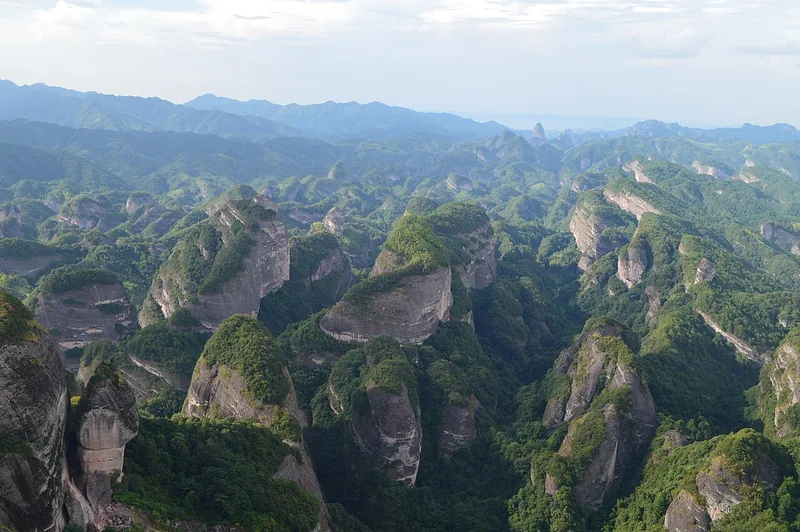
Shaoyang (Chinese: 邵阳), historically known as Baoqing, is a prefecture-level city in southwestern Hunan, set along the Zi River where it cuts between the Xuefeng and Nanling mountain ranges. It is one of Hunan's oldest settlements, with a prefecture history stretching back over two thousand years, and was the birthplace of the 19th-century reformist scholar Wei Yuan, whose writings introduced many Chinese readers to the wider world. Today it is one of Hunan's most populous prefectures but, by Chinese standards, decidedly off the international tourist track — travellers come less for the city itself than for the dramatic Danxia landforms, alpine pastures, and minority villages of its surrounding counties.
The character of the city is workaday and Hunanese — spicy, loud, river-rough — with pockets of older streetscape near the Zi River. The real prize is the prefecture's geography: Langshan in Xinning County, a UNESCO-listed China Danxia site of red-sandstone peaks and gorges; Nanshan Pasture in Chengbu, a high-altitude grassland that feels strikingly different from subtropical lowland China; and Miao, Yao, and Dong minority areas in the southwest, where traditional festivals and villages survive in working form.
Climate is humid subtropical. The best windows are April–May (comfortable in the city, good conditions at Langshan) and September–October (clear skies, cool evenings, good for the pastures). Summer brings sticky heat and the East Asian rainy season, when Langshan trails get slick and views can vanish; winter is damp, chilly, and rarely below freezing, with occasional snow in the highlands. The urban core straddles the Zi River, with an older district on the south bank and a newer commercial district on the north.
Planning Shaoyang? Tell us your dates and we’ll tailor the trip.
Ask on WhatsAppHow do you get there?
By Plane
The local airport, Shaoyang Wugang Airport, sits southwest of central Shaoyang in Wugang City and is a small regional field with limited domestic service. A taxi from the airport to Shaoyang city centre takes well over an hour. For more flight options, fly into Changsha Huanghua International (CSX), the larger hub to the northeast, and continue by high-speed rail — this is usually faster and cheaper than connecting through the local airport. Guilin Liangjiang International Airport is also viable for travellers heading first to Langshan.
By Train
Shaoyang has two stations. Shaoyang Railway Station in the city centre serves conventional trains on the Loudi–Shaoyang–Hengyang line. Shaoyang North Station is the high-speed rail stop on the Huaihua–Hengyang HSR line, some distance north of the centre, with shuttle buses running to the downtown bus terminal. High-speed connections run to Changsha South, Huaihua South (for onward travel to Zhangjiajie or Guizhou), Hengyang East (for Guangzhou), and a dedicated stop serving Wugang/Langshan. Book on the 12306 app or via Trip.com; bring your passport, which doubles as your ticket for foreigners.
By Car / Road
Shaoyang sits on the Shanghai–Kunming Expressway corridor, making road approaches from Changsha, Hengyang, Huaihua, and Guilin all straightforward, if long. Long-distance buses use the Shaoyang Long-Distance Bus Station on the north bank, with frequent departures to Changsha and to the county towns of Xinning (for Langshan) and Chengbu (for Nanshan). Smaller minibuses fill in the gaps to county towns; ask at the station window rather than relying on online schedules.
The city is compact enough to cross on foot in half an hour, and the riverside is genuinely pleasant for walking. There is no metro. City buses cost a low flat fare and cover the main routes, though route maps are Chinese-only. Didi ride-hailing works city-wide — a cross-town ride is inexpensive. Flagged taxis use meters; insist on the meter and avoid touts loitering outside the train stations.
For the surrounding counties, the practical options are a long-distance bus from the main terminal, a chartered car with driver for the day (arrangeable through your hotel), or Didi's inter-city service, which exists in Hunan and is convenient for runs to Wugang or Xinning. Self-drive rentals are possible but a Chinese driver's licence is required — international permits are not recognised.
What are the things to do?
Old town & city sights
- Shuangqing Pavilion — a Ming-era riverside pavilion at the confluence of the Zi and Shao rivers, the city's poetic symbol.
- Songpo Library and the Cai E former residence — early Republican-era buildings linked to General Cai E, who led resistance against Yuan Shikai's imperial ambitions.
- Wei Yuan Former Residence — in Longhui County, north of the city; the modest stone-walled compound where the reformist scholar grew up. Best as a half-day trip.
- Beita Pagoda — a Ming-dynasty seven-storey brick pagoda on the north bank that gives the district its name.
Around the prefecture — the real reasons to come
Langshan (Mount Lang) — a UNESCO China Danxia site in Xinning County. Several scenic clusters of red-sandstone peaks and gorges, including a famously narrow rock cleft, striking rock formations, and rafting on the river below. Allow two days to do it properly.
Nanshan National Pasture — high-altitude grassland in Chengbu Miao Autonomous County. Cool even in summer, with grazing livestock, windmills, and Miao villages.
Huangsang National Nature Reserve — old-growth subtropical forest in Suining County with waterfalls and Dong minority villages.
Yunshan — a Taoist sacred mountain just outside Wugang, with Ming-era temples and easy walking trails.
Hike the Langshan circuit over two days, sleeping in Xinning town or a village guesthouse at the park gate.
Raft the river below Langshan — a gentle drift past the red cliffs, running seasonally (roughly April–October).
Ride horseback across Nanshan Pasture in summer; small operators near the visitor centre rent by the hour.
Visit a Miao or Dong village festival in Chengbu or Suining — dates shift by the lunar calendar; ask locally for the current schedule.
Walk the Zi River embankment at dusk for the square dancers, badminton players, and grilled-skewer stalls — an authentic slice of Shaoyang street life.
Planning Shaoyang? Want these on a customised itinerary?
Ask on WhatsAppWhere to eat?
Shaoyang cooks the southern, sourer end of Hunan cuisine — heavy on smoked, fermented, and chili-pickled flavours. Three things to try without fail: Shaoyang rice noodles, a thick round noodle eaten at breakfast in a clear bone broth with offal, beef, or soybean toppings; blood duck, duck stir-fried with its own coagulated blood, garlic stems, and chillies, the unofficial city dish; and Wugang bronze goose, slow-braised in soy and spices, from neighbouring Wugang. Budget noodle counters around the old district serve breakfast noodles cheaply; mid-range Hunanese restaurants around town serve blood duck, smoked pork, and river fish; a night-market strip near the river is good for grilled tofu, skewers, and crayfish in season. Strict vegetarians struggle in Hunan — stocks are often pork-based even in "vegetable" dishes — so ask explicitly for no meat and no meat broth. A small Hui Muslim quarter near the old mosque area has halal noodle and beef shops.
Where to drink?
Hunanese rice wines and grain spirits dominate — a well-known local sorghum baijiu brand is sold in any supermarket. National beer brands (Tsingtao, Snow, Pearl River) are the default. Tea is the everyday social drink — order locally grown Xinhua black or Chengbu green tea at any teahouse. Old-school teahouses on the south-bank riverfront offer bamboo-armchair seating and mahjong; a small bar strip near the Wanda Plaza on the north bank caters to a younger crowd; riverside beer stalls appear along the Zi at night in summer. Tap water is not potable — boiled water is provided free at every hotel and most restaurants, and bottled water is cheap and widely available.
Planning Shaoyang? We’ll book the stays and dining for you.
Ask on WhatsAppWhere to stay?
- Budget — national budget chains such as 7 Days Inn and Hanting have branches on the south bank, walking distance to the old town, and near the long-distance bus station for early departures.
- Mid-range — Atour and Vienna International both operate branches in the city, offering more comfortable rooms and reliable Wi-Fi.
- Upscale — Hunan's home-grown Huatian chain has a long-standing flagship property in the city, and an international-standard Wanda-branded hotel serves the north bank.
For Langshan, stay in Xinning town (chain hotels or simple guesthouses) or at a family-run guesthouse at the park's east gate with home-cooked meals included. For Nanshan, pasture lodges near the visitor centre can book out during the summer peak — reserve ahead through a booking app.
What should you buy?
Shaoyang is not a shopping destination, but a few things are worth picking up: locally packed preserved fruits and plums, sold in any large supermarket; Xinhua black tea and Chengbu oolong, sold loose in tea markets in the older district; Miao silver and embroidery, better bought in the source villages around Chengbu and Suining than in city shops; and Wugang's regional bronze-goose cookware, sold in nearby markets. Bargaining is light in markets — a modest discount off the asking price is normal — and fixed-price in malls and supermarkets. The main commercial strip is on the south bank in the old district; a Wanda Plaza mall on the north bank handles brand-name and chain shopping.
Where to go next?
- Langshan / Xinning — the single best reason to be in this part of Hunan; two days minimum.
- Wugang & Yunshan — a walled old town, the bronze-goose dish at source, and an easy Taoist mountain.
- Chengbu & Nanshan Pasture — highland grasslands and Miao villages; pair with Langshan into a south-prefecture loop.
- Hengyang & Mount Heng — one of China's Five Great Mountains, a major Buddhist–Taoist pilgrimage site, reachable by high-speed rail.
- Changsha — Hunan's capital, reachable by high-speed rail — Mao's old stomping grounds, the Hunan Provincial Museum's Mawangdui tombs, and the country's loudest night-snack scene.
- Zhangjiajie — reachable via a transfer at Huaihua; the sandstone-pillar landscape that inspired Avatar's Hallelujah Mountains, the obvious next stop for landscape-chasers after Langshan.
Nearby in Hunan Sheng
More places to explore around Shaoyang.
Guide content as of July 2026. Portions adapted from Wikivoyage, CC BY-SA 4.0.

Contact Us
Get in touch with us.
Get in touch
Contact Us
Tell us where you'd like to go and how you like to travel. A real Tripcuro planner — not a bot — will craft an itinerary around you.
- Personalised, hassle-free planning end-to-end
- Transparent pricing, no hidden costs
- 24/7 support for complete peace of mind