
Jixi
Heilongjiang Sheng, China
Why visit Jixi?
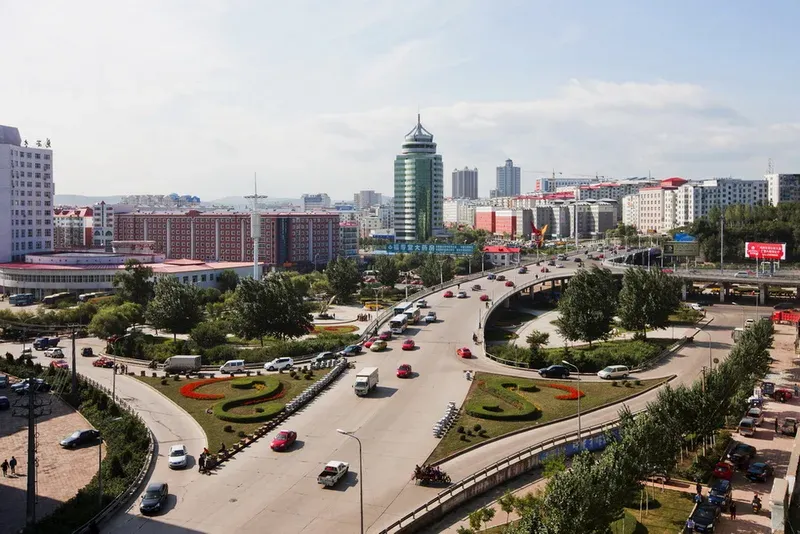
Jixi (鸡西) is a prefecture-level city tucked into the far southeast of Heilongjiang Province, hard against the Russian border in China's deep northeast. Built on coal — the seams here are among the largest in China and were heavily worked from the Japanese occupation through the post-war Soviet-assisted industrialisation push — it remains a working mining city rather than a polished tourist stop. What draws the occasional traveller is what surrounds it: the vast freshwater expanse of Khanka Lake (Xingkai Hu) shared with Russia, the Ussuri River basin, and Zhenbao Island, where Chinese and Soviet forces clashed in 1969 in a border incident that briefly looked like it might tip the Cold War over.
The city itself is functional and Soviet-influenced in feel — wide boulevards, blocky housing, a sizeable ethnic Korean (Chaoxianzu) population whose food culture is one of the real reasons to stop here. Jixi's signature dish, Jixi-style cold noodles (鸡西冷é?¢), is held up across Northeast China as the benchmark for the Korean-Chinese cold-noodle tradition.
Climate is severely continental: winters are brutally cold, regularly dropping below −20 °C in January, with snow lying from November to March. Summers (June–August) are warm, humid, and the only realistic window for Khanka Lake; daytime highs sit in the mid-20s °C. Late August into mid-September is the sweet spot — warm days, clear air, and the start of the autumn colours along the Wanda Shan foothills. Avoid mid-winter unless you specifically want the ice-and-cold experience.
Planning Jixi? Tell us your dates and we’ll tailor the trip.
Ask on WhatsAppHow do you get there?
By Plane
Jixi Xingkaihu Airport (IATA: JXA) sits about 25 km west of the city centre. It's a small regional airport with scheduled flights to Beijing, Shanghai, Qingdao, Harbin, and seasonally a handful of other domestic cities. There is no metro or rail link; a taxi to the centre runs roughly ¥60–80 and takes 30–40 minutes. A shuttle bus is timed to some flights and costs around ¥20, dropping at the CAAC office near the centre.
By Train
Jixi Railway Station (鸡西站) is the main station, in the central Jiguan District. Conventional sleeper trains from Harbin take 8–11 hours and cost roughly ¥38 (hard seat) to ¥215 (soft sleeper); overnight services are the practical option. There are also direct trains from Mudanjiang (around 3–4 hours), which is itself reachable by high-speed rail from Harbin, so the fastest combined route from Harbin is often HSR to Mudanjiang and a connecting train onward. Book through the 12306 app or at the station; popular sleeper berths to/from Harbin sell out in summer holiday season.
By Car / Road
The G10 Suifenhe–Manzhouli Expressway passes through Jixi, giving reasonable driving access from Harbin (around 480 km, 6–7 hours) and Mudanjiang (around 200 km, 2.5–3 hours). Roads are generally in good condition but expect heavy truck traffic on coal routes. Long-distance buses from Harbin's main bus station take about 6 hours; from Mudanjiang around 3 hours. The Jixi bus terminal is a short taxi ride from the railway station.
Within the urban core (Jiguan District), most things are walkable or a short taxi hop. Taxis start at ¥6 for the flag fall and almost any cross-town ride is ¥15–25; insist on the meter (打表 dÇŽbiÇŽo). Didi (æ»´æ»´) works reliably and is the easiest option for non-Chinese-speakers if your app is set up. City buses are ¥1–2 flat-rate, exact change or transit QR pay; routes are in Chinese only. For trips out to Khanka Lake or Zhenbao Island, you'll need a chartered car or a tour — public transport is sparse and the border-zone destinations require advance arrangement.
What are the things to do?
Khanka Lake (兴凯湖, XÄ«ngkÇŽi Hú) — the headline sight. A massive freshwater lake straddling the Chinese–Russian border, about 90 km southeast of Jixi. The Chinese side is a national nature reserve with sandy beaches, wetlands, and birdlife (especially during spring and autumn migration). Access via Dangbi (当å£?镇) on the southern shore; entrance to the scenic area is around ¥80. Open roughly 08:00–17:00; best visited May–September.
Ussuri River (乌è‹?里江) — forms the border with Russia east of Jixi. Quiet riverside viewpoints and small fishing settlements; the river is associated in Chinese popular culture with the song WÅ«sÅ«lÇ? Chuán GÄ“ ("Ussuri Boat Song").
Zhenbao Island (ç??å®?å²›) — site of the March 1969 Sino-Soviet border clash, now a patriotic-education site with a small memorial hall and military relics. Roughly 200 km east of Jixi in Hulin County; access requires a border permit and is easiest as a day trip arranged through a local guide. Modest entrance fee (around ¥50).
Jixi Coal Mining Museum (鸡西煤矿å?šç‰©é¦†) — small but genuinely interesting if you're curious about the industry that built the city, with exhibits on the Japanese-era mines and Soviet-era expansion. In the central district; check current hours locally.
Lake Berengsi / Berengsi Forest Park (北兴森林公园) area — pine and birch forest walks within easy reach of the city in summer.
Birdwatch at Khanka Lake in spring (April–May) and autumn (September–October) — the reserve is a major flyway stop for cranes, swans, and waterfowl.
Swim and beach day at Dangbi on the southern shore of Khanka Lake in July–August; the sand here is among the best on any inland body of water in China.
Eat your way through the Korean-Chinese food scene — a self-guided crawl through the cold-noodle shops of Jiguan District is the most quintessentially "Jixi" thing you can do.
Border-zone day trip to Hulin and Zhenbao Island, combining the war memorial with riverside views of Russia — best done with a Chinese-speaking guide who can handle the permit paperwork.
Winter ice fishing on Khanka Lake (December–February) is a genuine local pastime; tours are informal and arranged through Dangbi guesthouses.
Day trip to Mudanjiang for the volcanic crater lakes of Jingpo Hu, a couple of hours west.
Planning Jixi? Want these on a customised itinerary?
Ask on WhatsAppWhere to eat?
Jixi's food identity is overwhelmingly Korean-Chinese (æœ?鲜æ—? cuisine) layered onto the heavy, stew-and-dumpling base of Dongbei cooking. The city's signature is Jixi-style cold noodles (鸡西冷é?¢) — buckwheat noodles in a chilled, slightly sweet-sour beef broth, topped with sliced beef, cucumber, kimchi, pear, and a halved boiled egg. It is genuinely worth a detour. Other things to seek out: Korean-style barbecue (烤肉), dog-meat soup (狗肉汤) — still common locally though many travellers will skip it — and Dongbei staples like guÅ?bÄ?oròu (sweet-and-sour pork) and suÄ?ncài (fermented cabbage) stews.
- Budget — Yuán Jì LÄ›ngmiàn (元记冷é?¢): a long-running Jixi cold-noodle institution; a full bowl with sides runs around ¥15–25. Multiple branches; the original is in Jiguan District.
- Budget — Korean-Chinese street stalls around Hongjun Lu: grilled skewers, chuàn'r (串儿), and stuffed pancakes for ¥3–10 a piece.
- Mid-range — CháoxiÄ?nzú barbecue restaurants in Jiguan District: charcoal grills with marinated beef and pork belly, banchan-style sides; budget ¥80–150 per person.
- Mid-range — local Dongbei restaurant for dìsÄ?nxiÄ?n (地三鲜) (potato, aubergine, pepper stew) and xiÇŽojÄ«dùn mógu (chicken stewed with wild mushrooms); ¥60–100 per person.
- Upscale — hotel restaurant at the Longcheng Garden Hotel for banquet-style Northeastern Chinese cooking in a more formal setting; ¥150–250 per person.
Vegetarian options exist but require some negotiation — many "vegetable" dishes are cooked with meat stock or pork fat. Halal (清真 qÄ«ngzhÄ“n) restaurants are present but not common; look for the green crescent-and-Arabic signage near the railway station.
Where to drink?
Cold Harbin Beer (哈尔滨啤酒) is the default everywhere and goes for ¥3–8 a bottle in restaurants. Baijiu is poured aggressively at any business or social meal — local Heilongjiang brands like Beidacang (北大仓) are drinkable and considerably cheaper than national names. Russian-imported vodka shows up in shops and karaoke bars near the station.
For non-alcoholic options, Korean barley tea (大麦茶) is served free at most Korean-Chinese restaurants, and milky suÄ?nnÇŽi (drinking yoghurt) is sold cold in every convenience store. Coffee culture is thin — a couple of chain cafés (Luckin, occasionally Starbucks) in central malls cover the basics.
Tap water is not safe to drink — stick to bottled or boiled water. Hotels provide a kettle and water in the room as standard.
Planning Jixi? We’ll book the stays and dining for you.
Ask on WhatsAppWhere to stay?
- Budget — Hanting Hotel Jixi (汉庭酒店 鸡西店): reliable national chain, doubles around ¥180–230. Clean, central, English signage minimal but check-in is straightforward with passport.
- Budget — 7 Days Inn Jixi (7天连é”?酒店 鸡西店): another standard chain, ¥150–200 for a double; basic but functional.
- Mid-range — Jinjiang Inn Jixi (锦江之星 鸡西店): a step up in comfort, ¥220–300 a double, near the railway station.
- Mid-range — Vienna Hotel Jixi (维也纳酒店 鸡西店): ¥260–360 for a double, slightly more polished rooms and breakfast included on most rates.
- Upscale — Longcheng Garden Hotel (鸡西龙城花园饭店): the long-established four-star option, on Guodao 201 in Jiguan District. Listed rack rates for doubles from ¥998, but discounted rates around ¥480 are usually available — book through a Chinese OTA (Ctrip / Trip.com) rather than walk-in. Has a banquet restaurant, business centre, and is the standard choice for visiting officials and business travellers.
What should you buy?
Jixi is not a shopping destination, and you won't find polished tourist markets. What is worth picking up:
- Korean-Chinese pantry goods — kimchi, chilli paste (gochujang-style), dried wild mushrooms, and pine nuts from the surrounding forests. Look in the markets around Hongjun Lu in Jiguan District.
- Wild ginseng and forest products from the Wanda mountain area — sold at general agricultural markets; quality varies wildly, so buy from a vendor you trust rather than the highest-priced stall.
- Russian goods — chocolate, biscuits, vodka, and amber jewellery filter across the border and appear in shops near the railway station. Prices are reasonable; check seals on liquor.
Bargaining is normal in markets, mild in shops, and not done in restaurants or supermarkets. Cash is increasingly unusual — WeChat Pay and Alipay dominate.
Where to go next?
- Mudanjiang (牡丹江) — 200 km west, 2.5–3 hours by road or train. Gateway to Jingpo Lake (镜泊湖), a volcanic crater lake with waterfalls and basalt cliffs.
- Suifenhe (绥芬河) — 250 km south, around 4 hours. A border-trade town on the Russian frontier with bilingual signage, Russian markets, and onward rail to Vladivostok.
- Vladivostok, Russia — accessible via Suifenhe or, with the right paperwork, via the border crossing east of Jixi. A genuinely different world, with Pacific-facing Russian architecture and seafood.
- Khanka Lake / Dangbi (当å£?) — 90 km southeast, 1.5 hours by car. Worth a one or two-night stay in its own right rather than a day trip if you have time.
- Harbin (哈尔滨) — 480 km west, overnight by train or 6–7 hours by road. The provincial capital — Russian-era architecture, the Ice Festival (Dec–Feb), and a much larger food scene.
- Wudalianchi (五大连池) — about a day's travel northwest. A volcanic landscape of lava fields, mineral springs, and crater lakes, on the way back toward Heihe and the Russian border.
Nearby in Heilongjiang Sheng
More places to explore around Jixi.
Guide content as of May 2026. Portions adapted from Wikivoyage, CC BY-SA 4.0.

Contact Us
Get in touch with us.
Get in touch
Contact Us
Tell us where you'd like to go and how you like to travel. A real Tripcuro planner — not a bot — will craft an itinerary around you.
- Personalised, hassle-free planning end-to-end
- Transparent pricing, no hidden costs
- 24/7 support for complete peace of mind