
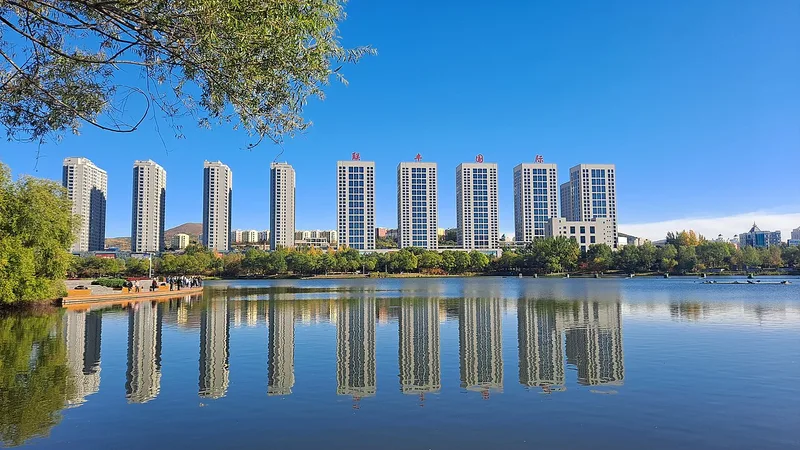
Shuangyashan
Heilongjiang Sheng, China
Why visit Shuangyashan?
Shuangyashan (å?Œé¸å±±, "Twin Duck Mountain") is a prefecture-level city in eastern Heilongjiang province, set on the Sanjiang Plain near the Russian border. The name comes from two duck-shaped peaks north of the urban core. The city grew up around coal — the surrounding basin holds some of the largest reserves in northeast China, and mining still shapes the local economy alongside grain farming on the surrounding black-soil plain. For travellers, Shuangyashan is less a destination in its own right than a gateway to the wetlands, forests, and border country of eastern Heilongjiang: it is the closest sizeable city to several nature reserves and to the Wusuli (Ussuri) River frontier with Russia.
The city itself is workaday and industrial, with broad Soviet-influenced avenues, blocks of mid-rise housing, and a compact commercial core in Jianshan District (尖山区), where most hotels, restaurants, and the long-distance bus station are clustered. Other administrative districts — Lingdong (岭东), Sifangtai (四方å?°), and Baoshan (å®?å±±) — are quieter mining suburbs. The wider prefecture takes in four counties: Jixian, Youyi, Baoqing, and Raohe, with Raohe sitting directly on the Russian border.
Climate is severe continental: long, dry, very cold winters (January daytime highs commonly around −15 °C, nights well below −20 °C) and short, warm, humid summers (July highs around 26–28 °C). Late May through early September is the comfortable window; the wetlands are at their best from June to August when migratory birds are present. Winter visits are bracing but feasible if you are equipped — snow cover is reliable from November to March.
Planning Shuangyashan? Tell us your dates and we’ll tailor the trip.
Ask on WhatsAppHow do you get there?
By Train
Shuangyashan Railway Station (å?Œé¸å±±ç«™) sits in Jianshan District and is the main rail gateway. It is on a branch of the network linking the city to Jiamusi (about 1.5–2 hours by regular service), which in turn connects to Harbin (the main hub for the province) and onward to the rest of China. There are no high-speed services into Shuangyashan itself at the time of writing; expect conventional K-, T-, or Z-class trains. Book through the official 12306 platform or trusted booking apps (Trip.com, Ctrip); buy at least a day or two ahead in peak summer and around Chinese New Year. Bring your passport — it doubles as your ticket on most services.
By Car / Road
The most common road approach is from Jiamusi (佳木斯), roughly 100 km west, about 1.5–2 hours on the G1011 Harbin–Tongjiang Expressway and connecting provincial highways. From Harbin, allow 5–6 hours and 450+ km via the G10 / G1011 corridor; the expressway is generally in good condition but watch for icy stretches November–April and for heavy truck traffic around mining areas. Qitaihe (七å?°æ²³) is about 100 km south on the G11 expressway, roughly 1.5 hours.
Long-distance buses run from Shuangyashan's main bus station to Jiamusi, Qitaihe, Jixi, Hegang, Harbin, and to county seats within the prefecture (Jixian, Youyi, Baoqing, Raohe). Services are frequent to Jiamusi and Harbin; less so to Raohe and the border, where one or two departures a day is typical.
The urban area is compact enough that most travellers stay within Jianshan District and rely on a mix of taxis, ride-hailing, and city buses. City buses (公交车) cover Jianshan and link the outer districts; flat fares are typically ¥1–2, cash or QR payment via Alipay/WeChat. Taxis are inexpensive — flagfall around ¥5–7 with short cross-town trips usually under ¥15–20. Didi (滴滴出行) works in Shuangyashan and is the easiest option if you don't speak Mandarin, since the destination is entered in-app.
There is no metro. The city is walkable in the centre but distances between districts (Jianshan to Lingdong, for example) are too great to walk. For trips out to the counties, nature reserves, or the border, you will need either a long-distance bus, a chartered car, or a rental — chartered cars (包车) arranged through your hotel are the most flexible and run roughly ¥500–800 per day depending on distance.
Scams are uncommon, but as anywhere in China watch for unmetered taxis at the train and bus stations; insist on the meter (打表) or agree a price up front.
What are the things to do?
Anbang River National Wetland Park (安邦河国家湿地公园) — A large protected wetland of reedbeds, oxbows, and waterbird habitat west of the city, on the Anbang River. Worth visiting in summer for birdlife and boardwalks through the reeds.
Qixing Peak Scenic Area (七星峰) — A forested ridge in Jixian County north-east of the city, with hiking paths, viewpoints, and a small Cold War-era radar installation at the summit. Best May–October.
Beixiushan Park (北秀山公园) — The city's main urban park in Jianshan, with the "twin duck" peaks that give Shuangyashan its name. Free, open daily, useful for an hour's stroll.
Raohe Dongbei Black Bee Nature Reserve (饶河东北黑蜂自然ä¿?护区) — In Raohe County on the Russian border, protecting the endemic Northeast Black Bee. Combines well with a trip to the Wusuli River frontier.
Zhenbao Island (Damansky) (ç??å®?å²›) — Small island in the Wusuli River in Raohe County, site of the 1969 Sino-Soviet border clash. There is a memorial and museum on the mainland side. Visiting the island itself requires a permit; the museum and viewpoint are accessible to most visitors.
Wusuli River frontier (Raohe) — The river marks the Russian border opposite Bikin. Raohe town has a port-of-entry, a riverside promenade, and views across to Russia; a worthwhile half-day from the county seat.
Birdwatching in the wetlands — Anbang River and the wider Sanjiang Plain are on a major East Asian–Australasian flyway; June to early September brings cranes, storks, herons, and waterfowl. Bring binoculars; serious birders should arrange a local guide through their hotel.
Hiking Qixing Peak — A half-day from the city; trails are well-marked and forested, with a steep final pitch to the summit ridge.
Border trip to Raohe — Drive or bus out to Raohe (3–4 hours) for the Wusuli River, the Zhenbao Island museum, and (in season) fresh river fish at riverside restaurants. With a Russian visa and the right port status, day crossings to Pokrovka have historically been possible — check current rules before counting on it.
Winter ice and snow — From December through March the rivers freeze hard; ice fishing, snowmobile rides, and Russian-style banya are part of local winter life, especially in the border counties.
Farm-stay on the Sanjiang Plain — The "Great Northern Wilderness" (北大è?’) farms around Youyi and Baoqing offer rural homestays and agritourism in summer; the scale of the rice and soybean fields is itself the attraction.
Planning Shuangyashan? Want these on a customised itinerary?
Ask on WhatsAppWhere to eat?
Food in Shuangyashan is firmly Northeastern Chinese (东北è?œ, dongbei cai): big portions, wheat as much as rice, hearty stews, abundant pork, river fish, pickled vegetables, and plenty of garlic. Signature dishes you should try at least once:
- Guo bao rou (锅包肉) — crisp-fried pork in a sweet-sour glaze, a Northeast classic.
- Di san xian (地三鲜) — stir-fried potato, eggplant, and green pepper.
- Xiao ji dun mogu (å°?鸡炖蘑è?‡) — chicken stewed with wild forest mushrooms; uses local yuan mo.
- Suancai bai rou (é…¸è?œç™½è‚‰) — pork belly with northeast-style pickled cabbage, especially good in winter.
- Wusuli river fish — out in Raohe, look for da ma ha (大马哈, chum salmon, in autumn) and white-flesh river fish steamed or braised.
Recommendations across price tiers:
- Budget — local dongbei canteens around the railway station and Yixing Road: ¥20–40 a head for a hearty plate plus rice and soup. Look for busy places with families eating.
- Budget — jiaozi (饺å?) houses are everywhere; ¥15–25 for a generous half-jin of dumplings (pork-and-fennel and pork-and-cabbage are local staples).
- Mid-range — Northeastern speciality restaurants in central Jianshan, ¥80–150 a head for a sit-down meal with cold dishes, a stew, and beer.
- Mid-range — Korean barbecue is popular across northeast China and well-represented in Shuangyashan; ¥80–120 per person.
Vegetarians can manage on stir-fried vegetables, di san xian, tofu dishes, mushroom stews, and jiaozi with vegetable fillings, but should be explicit that they don't eat meat or fish stock (我ä¸?å?ƒè‚‰ï¼Œä¹Ÿä¸?å?ƒè‚‰æ±¤). Halal food is available at Hui-Muslim qingzhen (清真) restaurants, identifiable by Arabic script and green signage; lamb skewers and hand-pulled noodles are typical. Strictly gluten-free dining is difficult — soy sauce, wheat noodles, and dumplings dominate.
Where to drink?
Local drinking culture revolves around beer and baijiu. Harbin Beer (哈尔滨啤酒) is the default lager — cheap, light, and ubiquitous; expect ¥4–8 a bottle in a restaurant. Baijiu brands from Heilongjiang and Jilin (such as Beidacang 北大仓) appear on most tables at celebratory meals; sip, don't shoot, unless you're toasting.
Non-alcoholic options include strong dou jiang (soy milk) at breakfast, suan mei tang (sour plum drink) in summer, and a growing café scene — Luckin Coffee, local independents, and chain milk-tea shops (Mixue, Heytea outlets) are present in central Jianshan.
Tap water is not safe to drink anywhere in mainland China without boiling or filtering. Hotels provide a kettle and bottled water; bottled water costs ¥2–3 for 500 ml at convenience stores. Ice in budget establishments is best avoided; in mid-range and upscale venues it is generally fine.
Planning Shuangyashan? We’ll book the stays and dining for you.
Ask on WhatsAppWhere to stay?
Hotel choice in Shuangyashan is dominated by Chinese mid-market chains; international brands are largely absent. Most travellers stay in Jianshan District for proximity to the station, restaurants, and buses. Foreign passport holders should check at booking that the hotel accepts overseas guests (涉外, shewai) — not all small properties are licensed to register them.
Mid-range
- Hanting Hotel (汉庭酒店), Jinjiang Inn (锦江之星), and GreenTree Inn (格林豪泰) all operate properties in Jianshan District, with reliable, no-frills rooms typically ¥180–280 per night. Book via Trip.com or the chain apps.
- Home Inn (如家酒店) offers similar standards at similar prices and is well represented in the centre.
What should you buy?
Shuangyashan is not a shopping destination, but a few local specialties are worth bringing home.
- Northeast Black Bee honey (东北黑蜂蜂蜜) from Raohe — a protected-origin product, sold in shops and at the Raohe reserve. Look for the GI ("地ç?†æ ‡å¿—") seal.
- Wild forest products — pine nuts, hazelnuts, dried mushrooms (especially yuan mo 元蘑 and hou tou gu 猴头è?‡), and wild muer fungus from the surrounding mountains. Sold in supermarkets and at the city's wet markets.
- Northeast rice — the Sanjiang Plain produces some of China's best japonica rice; small vacuum-packed bags travel well.
- Russian crossover goods — chocolate, vodka, and small souvenirs imported via the Raohe border crossing turn up in shops near the river.
The main commercial streets in Jianshan District around the railway station and Yixing Road (宜兴路) cover everything from department stores to small electronics and clothing shops. Bargaining is normal at markets and small stalls, not in supermarkets or chain stores; a 10–20 % discount off the first asking price is realistic at markets.
Where to go next?
- Jiamusi (佳木斯) — ~100 km west, 1.5–2 hours by train or road. The regional hub on the Songhua River, with better transport links, a bigger food scene, and the jumping-off point for Fuyuan and China's easternmost point.
- Fuyuan (抚远) — ~300 km north-east via Jiamusi, 5–6 hours by road. China's easternmost city, at the confluence of the Songhua, Heilong (Amur), and Wusuli rivers; famed for fresh-water fish and dawn-of-the-nation sunrises.
- Raohe (饶河) — ~250 km east, 3–4 hours by road. Wusuli River border town with the Zhenbao Island memorial, Black Bee reserve, and Russian-flavoured riverside.
- Qitaihe (七å?°æ²³) — ~100 km south, ~1.5 hours by expressway. Another Heilongjiang coal city, useful mainly as a transit point toward Jixi and the Russian border further south.
- Jixi & Xingkai Lake (鸡西 / 兴凯湖) — ~250 km south, 4–5 hours by road. Huge cross-border lake shared with Russia, good for summer beaches, birdwatching, and freshwater fish.
- Harbin (哈尔滨) — ~450 km west, 5–6 hours by road or train. Heilongjiang's capital, with Russian-era architecture, the Songhua riverfront, and (December–February) the world-famous Ice and Snow Festival.
Nearby in Heilongjiang Sheng
More places to explore around Shuangyashan.
Guide content as of May 2026. Portions adapted from Wikivoyage, CC BY-SA 4.0.

Contact Us
Get in touch with us.
Get in touch
Contact Us
Tell us where you'd like to go and how you like to travel. A real Tripcuro planner — not a bot — will craft an itinerary around you.
- Personalised, hassle-free planning end-to-end
- Transparent pricing, no hidden costs
- 24/7 support for complete peace of mind