
Yunlin
Taiwan · County · 14 destinations with guides
Photography coming soonWhy visit?
Yunlin (雲林, Yúnlín) is a county on the central-western coastal plain of Taiwan, lying between Changhua to the north and Chiayi to the south, with the Taiwan Strait to its west. It is one of Taiwan's most important agricultural regions — a broad expanse of flat, fertile farmland where vegetables, rice and other crops are grown on a large scale, and Xiluo Township in particular ranks among the country's leading vegetable-growing areas.
Yunlin is not one of Taiwan's headline tourist destinations, and it lacks the dramatic mountains or famous coastlines that draw crowds elsewhere. Its appeal is quieter and more authentic: historic temple towns, Japanese-era streets and buildings, traditional industries such as soy-sauce brewing, and a strong living folk-religion culture. For travellers willing to slow down, it offers an unhurried, less-touristed slice of Taiwanese life and one of the island's great pilgrimage destinations.
The county seat is Douliu, a modest city in the east near the foothills. Beigang, in the west, is a major Mazu pilgrimage centre; Huwei, home to one of Taiwan's largest sugar factories, holds the county's High Speed Rail station; and towns such as Xiluo and Gukeng add historic streetscapes and a noted coffee-growing area. Yunlin's character is defined by its farms, its temples and its everyday rhythms.
When is the best time to visit?
Yunlin sits on the warm, low-lying western plain and is best visited in the cooler, drier months from autumn through early spring (roughly October to March), when daytime temperatures are comfortable and rainfall is low. Summer is hot and humid, and the period from roughly July to October carries the risk of typhoons bringing heavy rain to this flat, exposed terrain.
The county's calendar is shaped by folk religion. The most significant period is the spring pilgrimage season around the lunar new year and the following months, when Mazu pilgrimages converge on Beigang's Chaotian Temple — visiting then means witnessing one of Taiwan's most vivid religious spectacles, though it also means crowds. The autumn-to-spring window otherwise offers the most pleasant weather for exploring temple towns and old streets.
Tell us your dates and we'll shape a Yunlin route around them.
WhatsAppHow do you get around?
Yunlin is served by both conventional and high-speed rail. The Taiwan Railways western line runs through the county with stations at Douliu, Dounan and others, giving frequent direct connections to Taichung, Chiayi, Tainan and Kaohsiung. The High Speed Rail's Yunlin Station sits in Huwei Township, somewhat removed from town centres but linked by a free shuttle bus to Douliu.
Distances between the county's main towns are short — Douliu, Huwei, Beigang and Xiluo are all within easy reach of one another — but public transport between them relies on county and intercity buses, which can be infrequent. Renting a scooter or car gives far more freedom for exploring the rural townships. Within towns, note that Yunlin's settlements are not always pedestrian-friendly: Douliu, for instance, has very few sidewalks, so walkers must use the road and stay alert to traffic. Cycling is a practical option in the flat county and is popular with students.
Where should you go?
- Douliu — The county seat; a small, low-key city with a Japanese-era old street and a soy-sauce brewing museum.
- Beigang — A major Mazu pilgrimage town built around the famous Chaotian Temple.
- Gukeng — A hillier eastern township known as a coffee-growing area and for green countryside.
- Xiluo — A historic township with a preserved old street, a landmark river bridge and traditional soy-sauce making.
- Huwei — Home to one of Taiwan's largest sugar factories, a hand-puppet museum and the county's High Speed Rail station.
Want the scenic legs and stays booked for you? Just ask.
WhatsAppWhat should you eat?
Yunlin's food culture is rooted in its farms. As one of Taiwan's main vegetable-growing areas, the county supplies fresh produce across the island, and local cooking makes the most of it. The county is also a centre of traditional soy-sauce brewing, with long-established makers in Douliu and Xiluo producing it by time-honoured black-bean methods — soy-sauce factories here welcome visitors and the product is a classic local buy.
Night markets are the best window onto everyday eating. Douliu's Ren Wen Night Market is one of the larger night markets in southern Taiwan, packed with local snacks and games, and Beigang and other towns have their own. Expect Taiwanese street-food staples — braised and rice dishes, snacks and sweets. Vegetarian food is straightforward to find across Taiwan, with Buddhist-style vegetarian eateries common, especially near temples.
What is the culture like?
Yunlin's cultural life revolves around folk religion. The county's signature event is connected to the Baishatun Mazu Pilgrimage, a major Taoist folk procession held since 1863: each year, usually between the first and fourth lunar months, the Mazu statue from Gongtian Temple at Baishatun in Miaoli County is carried in a palanquin on a roughly 400 km round-trip pilgrimage to visit Beigang's Chaotian Temple — one of Taiwan's most remarkable religious journeys.
The county also hosts the Beigang International Music Festival (北港國際音樂文化藝術節), run by the Beigang Philharmonic Association since 2006 and grown into the largest international music festival in Yunlin, with a programme centred on wind music plus an educational and intercultural element. Yunlin has strong traditional craft and performance roots too, notably glove (hand) puppetry, celebrated at Huwei's hand-puppet museum.
Travelling during a festival? We'll plan around the crowds.
WhatsAppWhat are the standout experiences?
- Joining the Mazu pilgrimage at Beigang — Witnessing pilgrims converge on Chaotian Temple, one of Taiwan's most important Mazu temples, drawing over a million visitors a year.
- Touring a traditional soy-sauce factory — Seeing black-bean soy sauce made by traditional methods at the visitor-friendly factories in Xiluo or Douliu.
- Walking the historic old streets — Strolling Douliu's Taiping Old Street or Xiluo's Yanping Old Street, both lined with Japanese-era and older buildings.
- Crossing the Xiluo Bridge — Experiencing the historic 2 km river bridge, begun in 1936 and completed after the Second World War, a longtime regional landmark.
- Discovering hand-puppet culture — Exploring Taiwan's glove-puppetry tradition at the Yunlin Hand Puppet Museum in Huwei.
Top Destinations
Every destination in Yunlin with a guide — tap a place for the full guide.
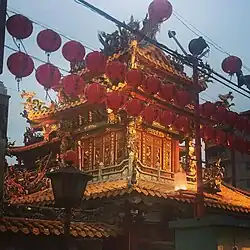
Beigang
Beigang (北港鎮, Běigǎng) is a township in the western part of Yunlin…
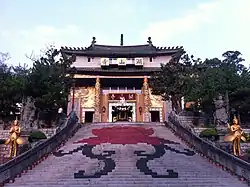
Douliu
Douliu (斗六, Dǒuliù) is a small city of around 108,000 people that…

Huwei
Huwei (虎尾鎮) is a township of around 70,000 people in Yunlin County…
Citong
Citong (莿桐) is a rural township in central Yunlin County, Taiwan…
Dounan
Dounan (斗南) is a town in southern Yunlin County, Taiwan, known for…
Erlun
Erlun (二崙) is a rural township in central Yunlin County, Taiwan…
Gukeng
Gukeng (古坑, Gǔkēng) is a rural township in the eastern part of Yunlin…
Kouhu
Kouhu (口湖) is a coastal township in southwestern Yunlin County…
Linnei
Linnei (林內) is a rural township in eastern Yunlin County, Taiwan, on…
Mailiao
Mailiao (麥寮) is a coastal township in western Yunlin County, Taiwan…
Shuilin
Shuilin (水林) is a rural township in southwestern Yunlin County…
Taixi
Taixi (台西) is a rural coastal township in western Yunlin County, at…
Tuku
Tuku (土庫) is a town in central Yunlin County, Taiwan, known for its…
Xiluo
Xiluo (西螺鎮) is a township in Yunlin County, in Southern Taiwan, set…
Pair the highlights of Yunlin into one easy trip — we'll plan the route.
WhatsApp
Contact Us
Get in touch with us.
Get in touch
Contact Us
Tell us where you'd like to go and how you like to travel. A real Tripcuro planner — not a bot — will craft an itinerary around you.
- Personalised, hassle-free planning end-to-end
- Transparent pricing, no hidden costs
- 24/7 support for complete peace of mind