
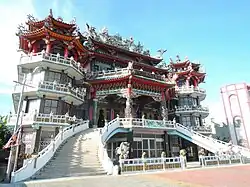
Xiyu
Penghu, Taiwan
Why visit Xiyu?
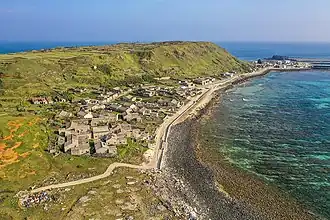
Xiyu Township (西嶼鄉, Xīyǔ Xiāng; Sai-sū-hiong in Minnan) is a rural township at the western edge of the Penghu archipelago (the Pescadores) in Taiwan. Long and narrow, the island runs north–south down the western flank of Penghu's main inner sea, ending at a cape where Taiwan's oldest lighthouse still stands. The township's name — "western islet" — captures its position, and historically Xiyu was also called Yuwengdao, "fisherman's island", a nod to the trade that still defines its harbours.
Xiyu rewards the curious traveller. It has a remarkable concentration of military and maritime history: 19th-century Qing forts thrown up after the Sino-French War, a lighthouse built by a British engineer in 1875, and traditional southern-Fujianese stone houses preserved in villages such as Erkan. Add dramatic columnar-basalt coastline, a sea-carved arch known as the Whale Cave, and a string of ornate village temples, and Xiyu becomes one of Penghu's most scenically and culturally varied islands.
The climate is subtropical and windy. April–June and September–October are the most pleasant months, with warm seas and manageable crowds; July–August is hot and at peak season; and winter (November–March) brings the strong northeast monsoon that buffets this exposed island and can disrupt ferries elsewhere in Penghu. The main villages — Erkan, Chuwan (Zhuwan), Hejie, Dachi, Nei'an, and Wai'an — string along the island's single main road.
Planning Xiyu? Tell us your dates and we’ll tailor the trip.
Ask on WhatsAppHow do you get there?
By Plane
The nearest airport is Penghu Airport (馬公機場 / MZG) near Magong, served by domestic flights from Taipei–Songshan, Kaohsiung, Taichung, Tainan, and Chiayi. From the airport, Xiyu is reached overland by driving west through Magong and Baisha and across the Penghu Great Bridge.
By Car / Road
Xiyu is connected to neighbouring Baisha by the Penghu Great Bridge (澎湖跨海大橋), the 2,494 m span built because the channel current between the two islands was too dangerous to cross by boat. From Magong, drive north and west through Baisha and over the bridge — the trip takes well under an hour. Car and scooter are the practical ways to arrive and explore.
A rented scooter or car is essentially required: Xiyu is a long island and its forts, basalt sites, temples, and lighthouse are spread out along the main road, too far apart to walk between. There is no metro and only limited public transport. Rentals are easiest arranged in Magong before crossing over. Helmets are legally required on motorbikes; ride carefully on the exposed coastal roads, where the wind can be strong.
What are the things to do?
History and culture
- Yuwengdao Lighthouse (漁翁島燈塔) — The oldest lighthouse in Taiwan, built in 1875 by British engineer David Marr Henderson on the site of an earlier 1778 stone "pagoda lighthouse". Originally black, it was repainted white in 1915; an old stone stele recording the earlier structure still stands in the grounds.
- Xiyu Western Fort (西嶼西臺) — A Qing-era fort built after the Sino-French War; it helped delay the Japanese advance during the 1895 invasion and bears an inscription from statesman Li Hongzhang.
- Xiyu Eastern Fort (西嶼東臺) — Constructed in 1889 during Qing rule, built alongside the Western Fort to defend the area following the Sino-French War.
- Erkan Chen Residence (二崁陳宅) — A 1910 residence in Erkan village built in classic southern-Fujianese style, with relief carvings and decorative windows, doors, and eaves; a rectangular complex of around 330 m² with three halls.
- Old Houses of Yang (合界永成楊家古厝群) — Similar Fujianese-style old houses to the Erkan Chen Residence, less restored and far quieter.
Museums
- Xiaomen Geology Gallery (小門地質館) — Exhibits on the geology, geomorphology, ecology, and culture of the Penghu islands and Xiaomen islet, arranged across eight themed sections.
- Chuwan Crab Museum (竹灣螃蟹博物館) — Displays of the many crab species found around the Penghu islands.
Nature
- Whale Cave (鯨魚洞) — A natural sea arch worn into the cliff face near Xiaomen; viewed side-on, the rock roughly takes the shape of a whale.
- Daguoye Columnar Basalt (大菓葉柱狀玄武岩) — A striking wall of hexagonal basalt columns formed by ancient volcanic activity and long erosion.
- Chixi Columnar Basalt (池西玄武岩) — Another basalt-column formation on the island's coast.
Temples
Nei'an Nei'qian Temple (內垵內塹宮) — A Wang Yeh temple in Nei'an village, built in 1701.
Wai'an Wenwang Temple (外垵溫王宮) — A Wang Yeh temple in Wai'an village.
Zuwan Dayi Temple (竹灣大義宮) — A Taoist temple in Zhuwan (Zuwan) village.
Dachi Xi Lin Temple (大池西林寺) — A combined Buddhist and Taoist temple in Dachi village.
Tour the Qing forts — Walk the ramparts and gun emplacements of the Western and Eastern Forts for both history and broad coastal views.
Wander Erkan village — Stroll the lanes of Erkan, where restored Fujianese stone houses, small craft shops, and the Erkan Chen Residence make for a slow, atmospheric visit.
Chi Ma Military Trail (赤馬五孔頂步道) — A hiking trail that threads through old, disused military tunnels.
Photograph the basalt and the Whale Cave — Time a visit to the Daguoye basalt columns and the Whale Cave around low tide and good light for the best of Xiyu's geology.
Planning Xiyu? Want these on a customised itinerary?
Ask on WhatsAppWhere to eat?
Dining in Xiyu is centred on seafood landed at the island's fishing harbours — fresh fish, squid, and shellfish, often served as simple home-style dishes or with Penghu vermicelli noodles. Options are modest and village-based:
- Xiaoping's Shop (小萍的店) — A small noodle and seafood eatery near the Xiaomen Geology Gallery. ☏ +886 6 998 3841; open 08:00–17:00. Budget.
- Fishing Village Sichuan Live Seafood (漁村川菜活海鮮) — A seafood restaurant serving the catch from a nearby fishing harbour. ☏ +886 6 998 3321; open 11:00–20:00. Mid-range.
Dedicated vegetarian food is limited; Buddhist-style vegetarian (素食) fare can usually be found near larger temples.
Where to drink?
Penghu's signature cactus-fruit (xian-ren-zhang) ice cream and juice are sold around the island, alongside herbal teas and fresh fruit drinks. Xiyu is rural and has little organised nightlife — for bars, head to Magong. Tap water should not be drunk straight; use bottled or boiled water.
Planning Xiyu? We’ll book the stays and dining for you.
Ask on WhatsAppWhere to stay?
Xiyu's lodging is small guesthouses (民宿), often quirky and family-run, scattered through the villages. Book ahead in summer.
- Budget / Mid-range: 23.5 Blue (23.5蔚藍民宿) — an eccentric guesthouse with a flamboyant, tack-opulent style. ☏ +886 937 392 288. Xiaolin Zhuwan Hometown B&B (小淋竹灣故鄉民宿) — a village guesthouse in the Zhuwan area. ☏ +886 989 012 397.
- Mid-range: Dreamsiyu 28.5 (夢幻西嶼28.5民宿) — a guesthouse on the island. ☏ +886 6 998 1912.
What should you buy?
Xiyu's edible souvenirs are products of the sea and the islands: dried fish and squid, seaweed, and Penghu's celebrated sun-dried vermicelli. Erkan village is also a good place to find small-scale local crafts and traditional herbal products. Packaged goods carry fixed prices, so bargaining is not expected; fresh seafood bought near a harbour is more negotiable.
Where to go next?
- Baisha — Just across the Penghu Great Bridge, 20–30 min by road; fishing harbours, the Penghu Aquarium, and ferries to Jibei.
- Magong — Roughly 40 min by road via Baisha; Penghu's only city, with historic temples and most of the islands' hotels and restaurants.
- Jibei Island — Reached by ferry from Baisha's harbours; a long sandbar beach and stone tidal weirs.
- Wang'an — Ferry from Magong's Nanhai Harbour; a quiet island of green sea turtles and old stone villages.
- Qimei — A southern Penghu island, ferry from Magong; famed for the Twin Hearts Stone Weir.
Nearby in Penghu
More places to explore around Xiyu.


Guide content as of May 2026. Portions adapted from Wikivoyage, CC BY-SA 4.0.

Contact Us
Get in touch with us.
Get in touch
Contact Us
Tell us where you'd like to go and how you like to travel. A real Tripcuro planner — not a bot — will craft an itinerary around you.
- Personalised, hassle-free planning end-to-end
- Transparent pricing, no hidden costs
- 24/7 support for complete peace of mind