
Makin
Gilbert Islands, Kiribati
Why visit Makin?
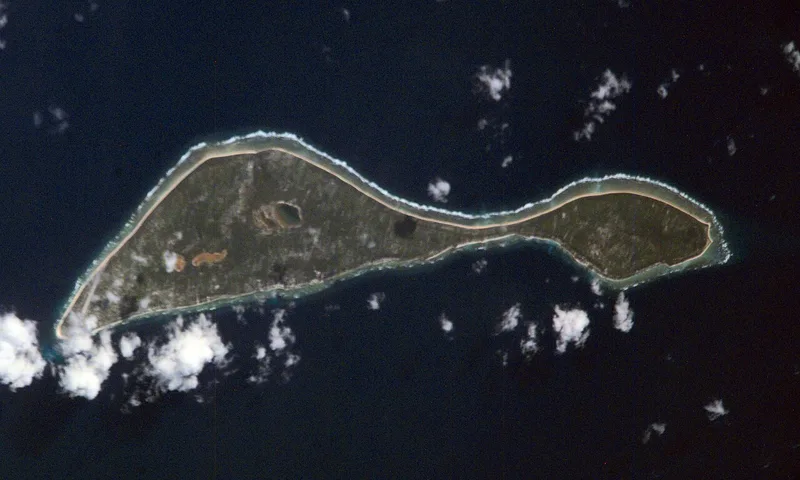
Makin is the northernmost inhabited island of the Gilbert Islands chain, a small reef island lying just north of the larger atoll of Butaritari in the central Pacific, a little over 3 degrees north of the equator. Unlike most Kiribati islands it is not a classic ring-shaped lagoon atoll but a compact reef island with a string of villages — Makin (the main settlement), Kiebu and others — strung along a single low coral platform. A few thousand I-Kiribati live here, in one of the most traditional and least-visited corners of an already remote country. There are no resorts, no tour operators and no organised sightseeing; people come, when they come at all, to experience outer-island Kiribati life at its most intact — fishing, copra, the church, the maneaba (community meeting house) and a culture in which land, lineage and custom still order daily life.
Makin holds a particular place in Kiribati's spiritual geography: in traditional belief it (together with neighbouring Butaritari) was associated with the ancestral homeland and the passage of spirits of the dead, and the island retains a reputation for deep customary knowledge and old genealogies. It is conservative even by Kiribati standards — modest dress is expected (shoulders and knees covered, swimming done clothed), Sunday is strictly observed with most activity stopping for church, and any visit is mediated by the Island Council and your host family. Expect no banks or ATMs, no hotels, intermittent solar/generator power, patchy phone signal, and prices on everything imported. Cash (Australian dollars), medicines, sunscreen and any specialist gear must all be carried in from Tarawa.
The climate is hot, humid and equatorial-maritime, with daytime temperatures around 28–32 °C year-round. Being in the wetter northern Gilberts, Makin is greener and rainier than the parched southern islands; rainfall is heaviest roughly November to April, while May to October is marginally drier and the more comfortable window to visit. There are no "neighbourhoods" in any urban sense — a single coastal track links the villages, with the airstrip, maneaba, council office, clinic and primary school all within walking distance of one another.
Planning Makin? Tell us your dates and we’ll tailor the trip.
Ask on WhatsAppHow do you get there?
By Plane
Makin is served by Makin Airport (IATA: MTK), an unsealed coral airstrip near the main village. Air Kiribati operates the only scheduled service, flying small turboprops (Twin Otter / Y-12 class) from Bonriki International Airport (TRW) in South Tarawa, usually in conjunction with neighbouring Butaritari on the northern Gilberts circuit — sometimes a single flight serves both islands. Frequency is typically one or two flights per week, weather and aircraft availability permitting, and flights are frequently delayed, consolidated or cancelled. Build generous slack into any itinerary and never plan a tight onward connection out of Tarawa.
There is no terminal, airport bus or taxi. Your host family or the Island Council clerk will normally meet the flight by truck or motorbike; arrange this before you fly, via the Ministry of Internal Affairs or your Tarawa contact, because there is no way to organise transport on arrival if no one is expecting you.
The island is small and flat enough to walk between villages in well under a day along the coastal track. Most locals get around on foot, by bicycle, or on small motorbikes; a handful of households own pickup trucks used for copra and to meet flights. There are no taxis, buses, ride-hailing apps or rental agencies. The normal arrangement is to ask your host family for a lift — to the airstrip, the maneaba or a particular village — usually given freely or for a small contribution toward fuel.
Walking is safe and pleasant; village dogs can be territorial, so carry a stick if walking after dark. There are no organised scams, but it is polite (and culturally expected) to give a small gift or cash contribution to your host and to the maneaba, and to ask permission before photographing people, the maneaba interior, or anyone at prayer.
What are the things to do?
The villages and maneaba — Makin's main settlement and the surrounding hamlets, centred on their large traditional maneaba (meeting house), the social and political heart of island life. Enter only when invited; sit cross-legged, do not stand taller than the elders, and remove your hat. Open during community gatherings — ask permission first.
Lagoon-side beaches and reef flats — long stretches of empty white-sand beach with shallow reef flats exposed at low tide, excellent for reef-walking and shell-spotting. Free, daylight only; wear reef shoes, as the coral is sharp.
Ocean-side reef and surf — the windward side has a pounding ocean reef, dramatic at high tide; swimming there is dangerous but it makes a striking walk.
Churches — both Catholic and Protestant (Kiribati Uniting) congregations are active; Sunday services, with full Kiribati hymn singing, are a memorable cultural experience. Modest dress required; arrive a few minutes early.
Sites of ancestral tradition — Makin features prominently in I-Kiribati oral tradition as part of the ancestral and spirit homeland; an elder or your host can point out places of customary significance and tell their stories. These are living sacred sites, not tourist attractions — visit respectfully and only with a local guide.
Hear the island's genealogies and legends from an elder — Makin's reputation for deep customary knowledge makes this its single most distinctive experience; arrange it slowly, over an afternoon, through your host or the Island Council.
Go fishing with local men in an outrigger canoe or small skiff — handline fishing for tuna, trevally and bonefish on the reef and in the channel. Offer fuel money or share the catch.
Sit in on a maneaba gathering or botaki (feast) if one coincides with your visit — traditional dancing (te mwaie), speech-making, and shared food on pandanus mats.
Reef-walk at low tide along the lagoon side, looking for octopus, giant clams, sea cucumbers and shells (take photos, not specimens — many species are protected and harvested sustainably by locals).
Visit a copra-cutting yard to see how dried coconut, the island's main cash crop, is split, dried and bagged for the inter-island ship.
Help with daily life — pounding pandanus, weaving mats, or climbing for toddy (the sweet sap tapped from coconut palms morning and evening). Visitors who pitch in are warmly welcomed.
Stargaze — with essentially zero light pollution, the Milky Way on a clear night is overwhelming.
Planning Makin? Want these on a customised itinerary?
Ask on WhatsAppWhere to eat?
Food on Makin is what the island produces plus what came on the last ship. Being in the wetter northern Gilberts, Makin and neighbouring Butaritari are unusually fertile by Kiribati standards, with good breadfruit (te mai), bananas, pandanus (te kaina) and giant swamp taro (te bwabwai) alongside the universal staples of fish (reef fish, tuna, bonefish, flying fish in season) and coconut in every form (flesh, milk, cream, toddy). Rice and flour are brought in by ship; pork and chicken appear on feast days. Meals are usually shared from communal platters on a mat in the maneaba or family cookhouse; eat with your right hand, accept what is offered, and finish what you take.
There are no restaurants, cafés or food stalls on Makin. Eating arrangements are made with your host family as part of your stay — typically three meals a day plus toddy, included in or added to the nightly homestay rate. If you have allergies or strict dietary requirements (gluten-free, vegan, strict vegetarian), bring your own supplies; the local diet is fish-and-coconut heavy and hosts will struggle to accommodate exclusions. Halal observance is not standard but pork is easily avoided on request. Do not drink tap or well water untreated; rainwater from a clean tank is safer but still best filtered or boiled.
Some things to ask for and try:
- Te ika raw — fresh reef fish or tuna marinated in lime and coconut cream, the Pacific cousin of poisson cru.
- Roasted breadfruit — split, charred over the fire, and eaten with grated coconut; especially good on fertile Makin.
- Te bwabwai — giant swamp taro slow-cooked with coconut cream, a special-occasion dish.
- Grilled flying fish in season.
- Pandanus paste (te tuae) — dried, sweet and intensely chewy; a traditional voyaging food.
Where to drink?
The signature local drink is karewe (sweet coconut toddy), tapped twice daily from the palms; drunk fresh it is delicious and non-alcoholic, but left to ferment a day or two it becomes kao (sour toddy), a mildly alcoholic homebrew. Sour toddy is restricted under Kiribati law and outer-island councils frequently impose local bans on its production and sale; do not seek it out, and do not bring or distribute commercial alcohol without checking the current rules with the Island Council. Coconut water straight from the nut is the everyday thirst-quencher and is safe.
There are no bars, pubs or cafés on Makin. Tea and instant coffee are drunk in homes, often very sweet. Imported soft drinks and bottled water turn up at village canteens but not reliably; bring a refillable bottle and a water filter or purification tablets. Treated rainwater from a household tank is the most practical drinking source. Do not drink from open wells.
Planning Makin? We’ll book the stays and dining for you.
Ask on WhatsAppWhere to stay?
Makin has no hotels, guesthouses or commercial accommodation of any kind. All visitors stay either in a homestay arranged with a local family or in the Island Council guesthouse / rest house if one is currently available — the latter a simple block with shared facilities, used by visiting officials and the occasional traveller. Both are arranged in advance, normally through the Ministry of Internal Affairs in Tarawa, the Air Kiribati office, or a contact on the island; do not arrive without a confirmed host.
- Budget / homestay — Stay with a local family in a traditional thatched buia or a small concrete/timber house. Sleeping is on a pandanus mat with a sheet and a mosquito net (bring your own if you can); washing is from a bucket at a rainwater tank; the toilet is usually a pit latrine or beach-edge facility. Roughly A$20–A$40 per person per night including all meals, paid in cash; a thank-you gift (school supplies, reading glasses, fishing line and hooks, T-shirts) is greatly appreciated on top.
- Mid-range — Island Council Rest House: a basic government guesthouse with a couple of rooms, shared bathroom and a simple kitchen, when not occupied by visiting officials. Roughly A$30–A$50 per night, meals extra and usually arranged with a nearby family.
What should you buy?
There is no market and no shopping district. A few small village kiosks ("canteens") sell basic goods — rice, flour, sugar, tinned fish, instant noodles, soap, batteries, kerosene, the occasional cold soft drink — at prices well above Tarawa due to shipping. Stock is whatever came on the last boat, and shelves can be bare for weeks between resupplies. Bring everything you actually need (medications, sunscreen, mosquito repellent, torch, snorkel gear, reef shoes, cash) from Tarawa or from home.
For souvenirs, the island's craft tradition produces fine woven pandanus mats, fans, hats and baskets, and occasionally shell necklaces and carved coconut-wood items. These are not sold in shops; ask your host whether anyone in the village has work for sale, and pay in cash. Bargaining is not the norm — handicraft prices are modest and asked once; pay what is requested or politely decline.
Where to go next?
- Butaritari (immediately south, ~30 min by air or a short local-boat hop) — Makin's larger, greener neighbour, the lushest island in Kiribati, with WWII history and a broad lagoon. The two are usually served on the same northern flight.
- Marakei (~south on the northern Gilberts circuit) — a near-circular atoll famous for its four guardian-spirit shrines that visitors traditionally circuit clockwise on arrival.
- Abaiang (further south) — the most easily accessed of the outer islands from Tarawa, with mission history and classic atoll scenery.
- South Tarawa (Bonriki / Bairiki / Betio) (~capital atoll, ~2–3 hr by air via the northern circuit) — the crowded, fascinating capital: the Battle of Tarawa sites on Betio, Parliament at Ambo, the markets at Bairiki, and the only place in Kiribati with hotels, restaurants and reliable connectivity. Mandatory transit point.
- Kiritimati (Christmas Island) (a very long way east, on Kiribati's separate Line Islands network via Fiji or Honolulu) — world-class bonefishing and vast seabird colonies; treat as an entirely separate trip.
Nearby in Gilbert Islands
More places to explore around Makin.
Guide content as of June 2026. Portions adapted from Wikivoyage, CC BY-SA 4.0.

Contact Us
Get in touch with us.
Get in touch
Contact Us
Tell us where you'd like to go and how you like to travel. A real Tripcuro planner — not a bot — will craft an itinerary around you.
- Personalised, hassle-free planning end-to-end
- Transparent pricing, no hidden costs
- 24/7 support for complete peace of mind