
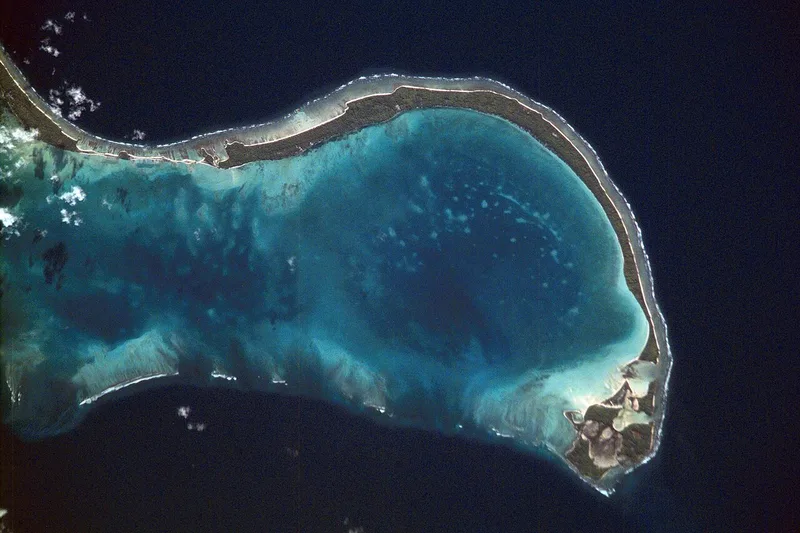
Onotoa
Gilbert Islands, Kiribati
Why visit Onotoa?
Onotoa is a small, low-lying coral atoll in the southern Gilbert Islands group of Kiribati, lying just south of the equator and a long way from anywhere. Roughly 14 km long and shaped like a slim, hooked sliver, it consists of a narrow chain of motu (islets) enclosing a shallow lagoon, with most of the population — under 2,000 people — living in a string of villages along the western (lagoon) side. This is one of the quietest, most traditional corners of Kiribati: subsistence fishing, copra cutting, babai (giant swamp taro) pits, and the rhythms of the maneaba (community meeting house) shape daily life far more than anything resembling a tourism economy. Robert Louis Stevenson called at Onotoa during his 1889 Pacific voyage aboard the Equator and wrote about it in In the South Seas; his impressions of strict village discipline and church-dominated life still ring partly true today.
You come here for the same reasons travellers came a century ago: extreme remoteness, unbroken traditional Gilbertese culture, lagoon and reef snorkelling with no other visitors, and the chance to live for a week at the pace of an outer-island village. There are no resorts, no ATMs, no cafés, no rental cars, and electricity is intermittent at best — most people travelling here are anthropologists, researchers, returning I-Kiribati, or determined Pacific completists. If you are not comfortable with very basic conditions, frequent schedule changes, and being a guest in someone's household, Onotoa is not for you.
The climate is hot and humid all year (daytime around 30 °C, nights barely cooler). The drier, slightly less humid period from roughly May to October is the most comfortable time to visit and gives the best chance of stable Air Kiribati flights; November to April brings heavier rain, occasional westerly squalls, and a higher chance of weather-related flight cancellations. Onotoa sits near the equator and is largely outside the cyclone belt, but king tides and storm surge can wash over the low motu in any season.
Planning Onotoa? Tell us your dates and we’ll tailor the trip.
Ask on WhatsAppHow do you get there?
A visit to Kiribati requires a valid passport and, for most nationalities, a visa or visa-on-arrival arranged through Tarawa; sort this out on the main island before attempting any outer-island travel. You will also typically need permission/awareness of the Island Council on Onotoa — ask the Ministry of Internal Affairs or your host on Tarawa to radio ahead.
By Plane
The only practical way in is by air. Onotoa Airport (IATA: ONO) is a single grass/coral airstrip on the atoll, served by Air Kiribati turboprop flights (typically a Twin Otter or similar) from Bonriki International Airport (TRW) on South Tarawa. Flights are infrequent — usually only one or two services a week, often combined with stops at neighbouring southern Gilberts atolls such as Tabiteuea, Beru, Nikunau, or Tamana — and they are routinely delayed, rescheduled, or cancelled because of weather, maintenance, or load. Always build several days of buffer at each end of your trip and never plan a tight onward international connection.
The airstrip is on the atoll itself, only a short distance from the main villages; arriving passengers are normally met by family, hosts, or an Island Council vehicle and taken to their lodging by truck or motorbike. There is no taxi rank, no car hire, and no scheduled airport bus.
By Car / Road
By boat: government and copra-trading vessels occasionally call at Onotoa from Tarawa and other southern Gilbert atolls, but voyages take several days each way, schedules are highly irregular, and conditions are basic (deck passage, no cabins on most ships). This is an option for the genuinely flexible traveller, not a tourist itinerary; enquire at the Kiribati Shipping Services Ltd (KSSL) office in Betio.
Onotoa is small enough to walk much of the inhabited western shore, and walking along the sandy lagoon-side paths between villages is the most pleasant way to see daily life. For longer hops the standard local transport is a motorbike or a pickup truck belonging to a household, the church, or the Island Council; ask your host to arrange a ride and offer to contribute fuel money (a few Australian dollars is appreciated). Bicycles are sometimes available to borrow from hosts and are well suited to the flat terrain.
There is no metro, no bus service, no taxis, and no ride-hailing apps on Onotoa, and there is no fuel station in the conventional sense — petrol is sold in jerrycans from a few stores. To cross the lagoon or reach uninhabited motu you will need to charter a small outrigger canoe or aluminium skiff with an outboard, again arranged through your host; agree on the fuel cost up front. Tides matter — much of the lagoon dries to shallow flats at low water, so plan boat trips around the tide.
Scams are essentially nonexistent in this kind of village setting, but standards of hospitality come with strong expectations: dress modestly (shoulders and knees covered, especially on Sundays and around the maneaba), never enter a maneaba without invitation and removing your shoes, and bring small gifts (rice, sugar, tea, school supplies, fishing tackle) for hosts rather than cash tips.
What are the things to do?
There are no ticketed sights, museums, or formal opening hours on Onotoa — "sightseeing" here means walking, watching, and being invited in.
The maneaba in each village. The huge thatched community meeting house, with its low eaves and open sides, is the social, political, and ceremonial heart of village life. Village elders allocate seating by clan (boti), and dances, debates, weddings, and feasts all happen here. Always ask permission before entering or photographing.
The lagoon shore and reef flats. A walk at low tide along the western lagoon side reveals starfish, sea cucumbers, octopus hiding under coral rubble, and women gleaning shellfish — a low-key but rewarding "wildlife" experience. The ocean (eastern) side is wilder, with surf breaking on the reef.
Uninhabited southern motu. The southern tip of the atoll thins into a chain of small, mostly uninhabited islets fringed by white sand and coconut palms. Charter a small boat and a knowledgeable local for a day trip; bring water, sun cover, and snorkelling gear.
The churches. Onotoa, like much of Kiribati, is overwhelmingly Christian (Kiribati Protestant Church and Catholic), and Sunday services with full-throated unaccompanied harmony singing are genuinely moving. Visitors are welcome; dress neatly and sit at the back unless invited forward.
Babai pits. Deep, mucky pits dug into the freshwater lens where giant swamp taro (te babai) is cultivated over many years — a living agricultural heritage unique to the Gilbert and Marshall Islands. Hosts are usually happy to walk you out to theirs.
Reef and lagoon snorkelling. The lagoon edge and the passes through the reef have healthy hard coral and reef fish; visibility is best on a rising tide on a calm day. Bring your own mask, snorkel, and fins — there is nothing to rent.
Hand-line and trolling fishing. Going out at dawn with a local fisherman in an outrigger or skiff for tuna, wahoo, or reef fish is one of the best things you can do here. Offer to share your catch with the household that night.
Coconut and copra work. Help (or watch) the daily cycle of husking coconuts, splitting them, drying the meat in the sun, and bagging copra for shipment — the backbone of the cash economy.
Te buki and te ruoia dancing. Traditional Gilbertese dance is alive and well in the southern Gilberts; if a wedding, church festival, or guest welcome is happening during your stay, you are likely to see it. Independence Day (12 July) and major church anniversaries are the biggest occasions.
Star-watching. With essentially no electric light pollution, Onotoa nights under a clear sky are spectacular, and Gilbertese traditional navigation and star-lore is part of the cultural fabric — ask elders.
Walk the atoll. A multi-hour walk linking several villages along the lagoon shore, stopping for green coconuts and conversations, is the quintessential outer-island day.
Planning Onotoa? Want these on a customised itinerary?
Ask on WhatsAppWhere to eat?
Food on Onotoa is overwhelmingly what comes out of the lagoon, off the reef, off the trees, and out of a few imported sacks. Expect daily meals of rice, reef fish, tuna, coconut, breadfruit (te mai), pandanus, papaya, and giant swamp taro (te babai), often eaten communally and seated on mats. Signature preparations include:
- Te ika-style raw fish marinated in coconut cream and lime — the Kiribati cousin of poisson cru.
- Grilled or boiled reef fish with rice and a coconut sauce.
- Te bua toro ni baukin, fermented coconut toddy used in cooking.
- Te babai roasted or pounded with coconut cream — a special-occasion dish.
- Pandanus fruit (te kaina) pressed and dried into a sweet, leathery cake.
- Drinking coconuts (te ben) on demand, all day, every day.
There are no restaurants, cafés, or formal eateries on Onotoa. Visitors eat with the household they are staying with; it is normal and expected to contribute groceries (a 25 kg sack of rice, sugar, tea, tinned mackerel) on arrival, and to thank cooks generously. Vegetarians can survive on rice, breadfruit, taro, and coconut but should be flexible — fish is in nearly everything, and refusing food offered by a host is awkward; explain dietary needs gently and in advance. Halal and gluten-free diets are not catered for in any organised way.
Where to drink?
The everyday drinks are green coconut water (free, ubiquitous, and the safest thing you can put in your body here) and black tea with a lot of sugar and powdered milk. The traditional drink of the Gilberts is te karewe, sweet sap tapped at dawn and dusk from the cut spathe of a coconut palm; left to ferment for a day or two it becomes te kaokioki, a mildly alcoholic toddy. Tasting fresh karewe straight from the bottle, still warm from the tree, is one of the small pleasures of an outer-island stay.
Alcohol is heavily restricted on Onotoa. Like several southern Gilbert atolls, the Island Council enforces strict rules on the sale and consumption of beer and spirits, and on Sundays in particular the atoll observes a quiet, church-centred day. Do not bring or drink alcohol publicly, and follow your host's lead. There are no bars, pubs, kava bars, or nightclubs.
Water safety: do not drink untreated rainwater-tank or well water without filtering and boiling or treating it. Bottled water is sometimes available in village stores but stocks are unreliable; bring a filter bottle or SteriPEN from Tarawa and ask hosts to boil drinking water. Coconuts are your friend.
Planning Onotoa? We’ll book the stays and dining for you.
Ask on WhatsAppWhere to stay?
There are no hotels, resorts, hostels, or commercial guesthouses with online booking on Onotoa. Accommodation is one of three things, all of which need to be arranged in advance through Tarawa contacts (Ministry of Internal Affairs Outer Islands division, Tourism Authority of Kiribati, or a personal introduction):
- Island Council guesthouse (te utu ni kaaina / council resthouse). Most outer islands maintain a basic guesthouse for visiting officials and the occasional traveller — a simple concrete or timber building with mosquito-netted beds, shared bathroom (bucket shower, pit or flush toilet), and a kitchen. Expect rates in the order of a modest nightly fee paid directly to the council.
- Village homestay, arranged through a local family. You sleep on a pandanus mat in a traditional kiakia (raised thatched sleeping house) or in a spare room, eat with the family, and contribute groceries and a daily cash amount agreed up front.
- Church or mission accommodation, occasionally available through the Kiribati Protestant Church or Catholic mission for visiting researchers and clergy.
What should you buy?
There is no tourist shopping on Onotoa. A handful of small village stores ("canteens") sell basics — rice, flour, sugar, tinned fish, instant noodles, soap, batteries, kerosene, and sometimes cold drinks when the generator is running — at prices noticeably higher than on Tarawa because of freight. Bring cash in Australian dollars in small denominations; there are no banks, no ATMs, and no card terminals on the atoll.
What is genuinely worth acquiring is handicraft: finely woven pandanus mats and sleeping mats, hats, fans, baskets, and shell or coconut-fibre necklaces, often made by women's church groups. There is no shop — ask your host or the Island Council to put the word out that you would like to buy, and people will come to you. Pay a fair price (compare with the handicraft stalls at the Bairiki cultural centre on Tarawa) rather than bargaining hard; this is supplementary income for households, not a tourist market. Bargaining is not a feature of Kiribati village life — quoted prices are usually already modest.
Customary gifts to bring in (rice, sugar, tea, fishing line and hooks, school exercise books, reading glasses, soap) are far more valued than money and will smooth your stay considerably.
Where to go next?
All onward travel from Onotoa is via Tarawa unless you catch a direct inter-island Air Kiribati flight on a multi-stop southern Gilberts run.
- Tabiteuea (Meang/Maiana) — northern Tabiteuea (TBF): ~95 km north; ~30-min flight (when scheduled together). The longest atoll in Kiribati and a southern Gilberts cultural heavyweight.
- Beru (BEZ): ~115 km north-northwest; short flight. Historic seat of the London Missionary Society in the Gilberts and home of the original Kiribati Protestant Church.
- Nikunau (NIG): ~110 km north; short flight. Quiet, traditional, similar in feel to Onotoa.
- Tamana (TMN): ~90 km west; short flight. One of the smallest inhabited Gilbert islands, with no lagoon — a fascinating contrast to Onotoa.
- Arorae (AIS): ~150 km southeast; short flight. The southernmost inhabited Gilbert island, famous for its mysterious "navigator stones" said to mark sailing directions to other islands.
- South Tarawa (TRW): ~620 km north; ~2-hour flight. The capital atoll — government offices, the Otintaai Hotel, restaurants, the Betio WWII battlefield sites, and your connection to Fiji and onward.
Nearby in Gilbert Islands
More places to explore around Onotoa.

Guide content as of May 2026. Portions adapted from Wikivoyage, CC BY-SA 4.0.

Contact Us
Get in touch with us.
Get in touch
Contact Us
Tell us where you'd like to go and how you like to travel. A real Tripcuro planner — not a bot — will craft an itinerary around you.
- Personalised, hassle-free planning end-to-end
- Transparent pricing, no hidden costs
- 24/7 support for complete peace of mind