
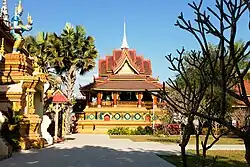
Jinghong
Yunnan Sheng, China
Why visit Jinghong?
Jinghong (景洪) is the capital of Xishuangbanna Dai Autonomous Prefecture in southern Yunnan, a tropical lowland city on the Lancang (Mekong) River that feels less like the rest of China and more like northern Thailand or northern Laos. Most of its inhabitants are Theravada Buddhist Dai people, whose language is closely related to Thai and Lao, and whose temples, stilted bamboo houses, and Songkran-style water festival shape the city's character. Founded as a Tai royal seat centuries ago, Jinghong today is a hub for domestic package tourists from cold northern China chasing palm trees, for backpackers on the Banana Pancake Trail, and for travellers crossing overland between China and Laos.
The climate is tropical monsoon: hot and very wet from May to September, and warm, dry, and pleasant from November through February with cool nights. October to April is the most comfortable window; the Dai New Year (Songkran / Water-Splashing Festival) in mid-April is the single most popular — and crowded — time to visit.
Jinghong is compact. The interesting parts cluster along the west bank of the Lancang: the old centre around Manting Road and Xishuangbanna Zongfo Temple in the southeast, the riverfront promenade, and across the river the Gaozhuang area with its big night markets and Thai-themed streets. The airport and railway station sit a few kilometres to the west.
Planning Jinghong? Tell us your dates and we’ll tailor the trip.
Ask on WhatsAppHow do you get there?
By Plane
Xishuangbanna Gasa Airport (JHG) is a few kilometres west of the city centre. It has multiple daily flights from Kunming and other Chinese cities, plus periodic international service toward Southeast Asia. Note that airport restaurants are markedly more expensive than food in town.
Airport bus services run into the city and past the night market and temple areas for a small flat fare. Taxis from the airport are metered.
By Train
Xishuangbanna Railway Station is on the western edge of town, close to the airport. City buses connect it to the centre. Frequent trains a day run from Kunming, taking roughly 3–4 hours on the high-speed line. There is also occasional cross-border rail service linking Kunming with Laos via the China–Laos Railway, which calls at Jinghong.
By Car / Road
By long-distance bus: Sleeper and seated buses leave Kunming daily; the trip takes around 8 hours and includes some bumpy stretches.
From Yuanyang (the rice terraces) there's no direct service; the common route is to backtrack to Jianshui or Luchun and pick up a long-distance sleeper bus toward Jinghong. The scenery — mountains, rice terraces, banana plantations, Dai and Hani villages — is spectacular, but roads are rough in places and prone to landslides; avoid in the rainy season.
From Laos, this is the first major Chinese city most overland travellers reach; buses run from border towns such as Mohan and Mengla.
The handful of interesting downtown districts (Manting Road, the riverfront, Gaozhuang across the river) are easy to cover on foot.
City buses are the cheapest option, covering most sights for a low flat fare; tourist routes reach specific attractions.
Taxis run on the meter for a modest flagfall. Didi (滴滴) ride-hailing works in Jinghong and is generally easier than flagging cabs.
Electric scooters and shared electric cars are everywhere — locals use them as their primary transport. You can rent an electric scooter in the Gaozhuang area; a motorbike licence is not required, but you'll need ID and a deposit. Check the brakes and battery range before you leave.
Boat: it is sometimes possible to hire a small boat for a short river cruise along the Lancang — negotiate at the riverfront.
A note on scams: tuk-tuk and unmarked-car drivers around the bus station and night market sometimes quote inflated flat rates to foreigners. Insist on the meter, or call a Didi.
What are the things to do?
Temples (Theravada Buddhist)
- Xishuangbanna Zongfo Temple — one of the earliest Pali-tradition monasteries in Xishuangbanna, said to date back many centuries and rebuilt as the headquarters temple of Dai Buddhism in the region.
- Mange Temple — among the oldest Buddhist temple buildings in Jinghong, a classic Theravada monastery in the Mange village quarter, just north of the Lancang River bridge.
- Manjinlan Temple — a large Dai Buddhist temple in the city.
- Mengle Temple — the biggest temple in Xishuangbanna, on the southern edge of Jinghong; a large hillside complex with city views, bicycle-accessible from the centre.
- Smaller neighbourhood wats such as Manduan and Manlei offer a quieter, less-touristed look at local Buddhist practice.
Parks and gardens
- Manting Imperial Garden — the royal pleasure garden of the former Dai kings, now divided into themed zones including a tropical orchid garden and a Dai cultural teahouse. Evening performances are sometimes staged for an extra fee.
- Tropical Flowers and Plant Garden — run by a regional tropical-crops research institute; large and popular with Chinese tour groups, though some foreign visitors find it underwhelming.
- Peacock Lake Park — a central artificial lake with a fountain, pleasant in the evening when locals gather to dance nearby.
- Xishuangbanna Tropical Botanical Garden — located in Menglun, Mengla county, roughly 75 km east of Jinghong. The largest botanical garden in China by collection size, run by the Chinese Academy of Sciences; worth a full day.
- Nannuo Mountain — a famous Pu'er tea–growing area in the hills west of Jinghong, with ancient tea trees and Hani/Aini villages.
Museums
- Xishuangbanna Nationalities Museum — covers the Dai, Hani, Bulang, Jinuo, Yao, Lahu, and other ethnic groups of Xishuangbanna.
Culture in the surroundings
Dai villages — traditional bamboo-stilt houses, village wats, and friendly locals in settlements around Jinghong such as Ganlanba (Olive Dam).
Local markets — the morning produce markets and the riverside night markets are themselves a sight.
Songkran / Water-Splashing Festival — the Dai New Year, mid-April. Dragon-boat races on the Lancang, sand-stupa building, and a full-day city-wide water fight on the closing day. Book accommodation weeks in advance.
Riverfront walks — the promenades along the Lancang River are wide, shaded, and excellent in the cool of the morning or after sunset.
Lancang River cruise — short cruises can be hired from the waterfront for an hour or two. Negotiate the price before boarding.
Cycle or scoot south to Mengle Temple — a pleasant half-day spin from the centre through suburban Dai neighbourhoods to the big hilltop temple.
Day trip to Ganlanba (Olive Dam) — a Dai cultural area southeast of the city with traditional villages and the chance to spend the night in a Dai-style guesthouse.
Tea-tasting day trip to Nannuo or Bulang Mountain — ancient Pu'er tea plantations in Menghai county; some plantations and tea houses welcome day visitors for tastings.
Night-market crawl in Gaozhuang — live music, street food, river views, and people-watching from early evening onwards.
Planning Jinghong? Want these on a customised itinerary?
Ask on WhatsAppWhere to eat?
Jinghong's food is essentially Dai (Tai Lue) cuisine — closer to northern Thai and Lao than to Han Chinese, with souring agents (tamarind, wild lime), strong herbs (mint, sawtooth coriander, Sichuan-style mountain pepper), grilling, and sticky rice as staples. Signature dishes include pineapple sticky rice, grilled tilapia stuffed with lemongrass, bamboo-tube rice, mashed grilled aubergine, green papaya salad, and banana-leaf grilled pork. Vegetarians can do well by ordering grilled aubergine, papaya salad (ask to omit dried shrimp), bamboo-shoot dishes, and tofu in banana leaf. Halal options exist around the small Hui Muslim quarter and in northern-Chinese chains; gluten-free is essentially possible if you stick to rice-based and grilled dishes and avoid soy sauce.
- The Gaozhuang and riverside night markets are the default budget dinner: pineapple rice, grilled tilapia, and skewers at low prices. Walk the whole loop before committing.
- Cafés and travellers' restaurants around Manting Road, near the Zongfo Temple end, offer English menus, Dai specialities, Yunnan coffee, and Western breakfasts — a reliable orientation stop on day one.
- General produce markets let you pick raw ingredients and pay a small fee to have them cooked on the spot — among the cheapest and most authentic Dai meals in town.
- Thailand Avenue restaurants serve Thai and Dai sit-down meals, often with live music in the evening.
Where to drink?
Tea is the great Yunnan drink — Pu'er above all, in both raw (sheng) and ripe (shou) forms, with tea houses around Manting Road and along Gaozhuang offering tastings. Yunnan also produces excellent Arabica coffee, and Jinghong has a growing third-wave café scene. Locally brewed rice spirits and Dai rice wine appear at festivals and village meals; mainstream Chinese beers are everywhere, and the Gaozhuang night-market bars line the riverfront with live cover bands into the small hours.
Water safety: Don't drink the tap water. Bottled water is sold everywhere; ice in upmarket bars and Western-style cafés is generally safe, and street-stall ice is best avoided if you have a sensitive stomach. Brushing teeth with tap water is fine.
Planning Jinghong? We’ll book the stays and dining for you.
Ask on WhatsAppWhere to stay?
Budget
- Backpacker guesthouses cluster around Manting Road near the Zongfo Temple, and in the Gaozhuang area, with dorms and basic private rooms.
Mid-range
- International-chain and Chinese business hotels are found on the south side of the city and around the main downtown avenues, clean and modern with pools at some properties.
Upscale / heritage
- A handful of riverside resort hotels with Dai-inspired architecture and large pool complexes operate near Gaozhuang and along the Lancang.
What should you buy?
The standard Chinese tourist trinkets are on offer in abundance — but Jinghong also has genuinely interesting local products: Pu'er tea (especially raw "sheng" cakes from Nannuo, Bulang, and Yiwu), silver jewellery, Dai handwoven cottons and tube skirts, bamboo and rattan crafts, and tropical fruit (mangosteen, durian, longan, rambutan, passion fruit).
- The big night markets in Gaozhuang, across the river — endless street food stalls, souvenirs, and riverfront bars, some with live music.
- The riverside night market on the Gaozhuang/Thai Street side — local-style clothing, snacks, and souvenirs at reasonable prices, active into the late evening.
- Thailand Avenue (Tai Guo Jie) — a pedestrianised Thai-themed strip of market stalls and shops with free live music some evenings.
- The city's general produce and wholesale markets — the best places to dive into local food culture and tropical fruit shopping at rock-bottom prices.
Bargaining: Expected at souvenir stalls and clothing stands — start at 40–50% of the opening price. Tea shops, sit-down restaurants, and fixed-price boutiques don't negotiate. Cooked food at the night markets is reasonably priced as posted.
Where to go next?
- Menglun & Xishuangbanna Tropical Botanical Garden — roughly 75 km / 1.5 hours east by bus. The largest botanical garden in China; a full day or overnight.
- Ganlanba (Olive Dam / Menghan) — roughly 40 km / 1 hour southeast. Riverside Dai cultural area, traditional villages, homestays.
- Menghai & Nannuo / Bulang Mountains — roughly 50–80 km / 1.5–2 hours west. Ancient Pu'er tea plantations and Hani villages; great for tea tourism.
- Mengla & rainforest areas — roughly 170 km / 3 hours southeast. Tropical rainforest reserves; gateway to the Laos border.
- Mohan / Boten (Laos border) — roughly 220 km / 3–4 hours south. Overland crossing into Laos by bus or the China–Laos Railway, continuing to Luang Namtha and Luang Prabang.
- Kunming — roughly 3–4 hours north by high-speed train, or 8 hours by sleeper bus. Yunnan's capital and the gateway to the rest of the province (Dali, Lijiang, Shangri-La).
Nearby in Yunnan Sheng
More places to explore around Jinghong.
Guide content as of July 2026. Portions adapted from Wikivoyage, CC BY-SA 4.0.

Contact Us
Get in touch with us.
Get in touch
Contact Us
Tell us where you'd like to go and how you like to travel. A real Tripcuro planner — not a bot — will craft an itinerary around you.
- Personalised, hassle-free planning end-to-end
- Transparent pricing, no hidden costs
- 24/7 support for complete peace of mind