
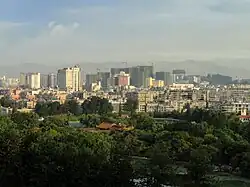
Kunming
Yunnan Sheng, China
Why visit Kunming?
Kunming (昆明), capital of Yunnan Province, is famously nicknamed the City of Eternal Spring — sitting at 1,900 m altitude near the Tropic of Cancer, it enjoys mild temperatures year-round, with average highs rarely exceeding 25°C in summer or dipping below 15°C in winter. The city has long been a crossroads: a southern terminus of the ancient Tea Horse Road, a French colonial railway hub from 1910, and the wartime end of the Burma Road when Kunming became a critical Allied supply base. Today it is a fast-modernising metropolis of several million in the wider prefecture, ringed by lakes, karst formations and the agricultural plateaus where much of China's cut-flower industry is grown.
The city's character is shaped as much by its ethnic diversity as by its climate. Yunnan has over two dozen recognised ethnic minorities, and Kunming is where Yi, Bai, Hui, Dai and Naxi cultures meet Han urban life — visible in temple architecture, market stalls, music, and food. Air quality is noticeably better than in most large Chinese cities, the pace is gentler than Shanghai or Chengdu, and the surrounding province (Dali, Lijiang, Shangri-La, Xishuangbanna, the Stone Forest) makes Kunming an indispensable launchpad for southwest China travel.
When to come: March to June and September to November are ideal — dry, sunny, with flowers in bloom. July and August bring the bulk of the annual rainfall. December to February are dry but chilly, especially after dark; pack a warm layer. The altitude makes UV intense year-round, so sun protection is essential even on cool days.
Layout: The historic core sits around Jinbi Square and the twin Golden Horse and Jade Rooster archways, with Cuihu (Green Lake) and Yunnan University defining the leafy northwest. Beijing Lu runs north–south as the main commercial spine, linking the railway station in the south to the North Station museum area. Newer business and high-speed-rail development clusters around Chenggong to the southeast, near Kunming South Station and Dianchi Lake.
Planning Kunming? Tell us your dates and we’ll tailor the trip.
Ask on WhatsAppHow do you get there?
By Plane
Kunming Changshui International Airport (KMG) sits about 25 km northeast of the city centre. It is one of China's busiest hubs, with extensive domestic service plus international flights to destinations across Southeast Asia and beyond.
- Metro Line 6 connects the airport to the East Bus Station area, where you transfer for downtown. Trains run roughly every 10 minutes during the day.
- Airport express buses run several numbered routes into the city until around midnight.
- Taxi to downtown is metered, taking 30–40 minutes in light traffic and considerably longer at rush hour. Use the official rank.
By Train
Kunming has three main stations, all on the metro network:
- Kunming Railway Station (south of downtown) — conventional trains plus some high-speed services within Yunnan.
- Kunming South Station (Chenggong, southeast of the centre) — the main high-speed hub, with trains to Shanghai, Beijing, Guangzhou, Chengdu and Guiyang. Also the terminus of the China–Laos Railway to Vientiane, with cross-border service running since 2023.
- Kunming North Station — the historic French-built metre-gauge terminus, now largely a railway museum with a handful of suburban services for rail enthusiasts.
Book via the 12306 app or Trip.com; high-speed services to Shanghai and Beijing sell out days in advance during Chinese holidays.
By Car / Road
Kunming sits at the junction of major national expressways linking it to Guangzhou, Chengdu and the rest of Yunnan. Approximate drive times: Dali around 4 hours; Lijiang around 6–7 hours; Jianshui around 3 hours; Guiyang 7–8 hours. Expressway quality is good; secondary roads in the mountains slow significantly in rain.
Long-distance buses have been pushed to four cardinal terminals — West (Dali, Lijiang, Shangri-La), South (Jinghong/Xishuangbanna, Jianshui, international services to Laos), East (Hekou for Vietnam, Qujing), and North (Dongchuan, Sichuan-bound). Match your destination to the correct station. Sleeper buses run cheap but are cold and bumpy; daytime express coaches are the better choice where available.
The Kunming Metro has multiple lines and is by far the easiest way to move around: clean, frequent, English signage throughout, operating roughly 06:30–22:30.
City buses are extensive and cost a flat low fare, running from early morning to about 22:00.
Taxis are metered with a modest flagfall. DiDi is the dominant ride-hailing app and works well if you have a Chinese phone number or have linked it through Alipay's mini-program — fares are typically below metered taxis. Drivers rarely speak English; have your destination written in Chinese or pinned on a map.
Kunming is reasonably walkable in the Cuihu / Wenlin Jie / Jinbi Square areas. Watch for electric scooters on sidewalks — they are silent and ubiquitous. Bike-share works through Alipay or WeChat mini-programs.
Scams to watch: the classic "tea ceremony" scam — friendly English-speaking "students" inviting solo travellers to a teahouse near Cuihu or Jinma Biji, where the bill arrives at several thousand yuan. Politely decline invitations from strangers to private venues, and agree on prices in advance at unmetered services.
What are the things to do?
Lakes & Parks
- Cuihu (Green Lake) Park — willow-lined lake in the historic centre, especially atmospheric November–February when thousands of gulls migrate from Siberia and locals feed them from the causeways. Free; northwest of downtown, adjacent to Yunnan University.
- Dianchi Lake — a large freshwater lake fringing Kunming's southwest. Best appreciated from the heights of Xishan rather than the often-polluted shoreline.
- Haigeng Park & Dianchi Greenway — flat lakeside promenade popular for cycling; also a wintering ground for the same migratory gulls.
Mountains & Viewpoints
- Xishan (Western Hills) & Dragon Gate (Longmen) — a cliff-side complex of Taoist temples and stone passages carved over decades in the Qing dynasty, with sweeping views over Dianchi Lake. Reachable by metro to its western terminus, then a chairlift or cable car.
- Stone Forest (Shilin) — UNESCO-listed karst formation about 90 km southeast of the city, best as a half-day or full day-trip reachable by high-speed train.
Temples & historic buildings
- Yuantong Temple — Kunming's largest and oldest Buddhist temple, dating to the Tang dynasty, distinctive for being built downward into a hollow. Near Yuantong Hill north of Cuihu.
- Jinma Biji Archways — twin gilded gateways at Jinbi Square, rebuilt symbols of old Kunming and a lively pedestrian shopping zone.
- Bamboo Temple (Qiongzhu Si) — northwest of the city, famed for its hundreds of strikingly individualistic painted clay arhat statues sculpted in the 1880s.
- Golden Temple (Jindian) — a 17th-century bronze Taoist temple, set in a hillside park north of the city.
Museums
Yunnan Provincial Museum — modern flagship with a strong Bronze Age Dian Kingdom collection; free with ID, closed Mondays.
Yunnan Railway Museum — at the old North Station, dedicated to the French-built metre-gauge Yunnan–Vietnam Railway.
Yunnan Nationalities Village — large open-air ethnographic park on Dianchi's shore showcasing the province's many minorities; touristy but useful as an introduction.
Walk Cuihu and Wenlin Jie at dusk — buskers, calligraphers, ballroom dancers and tea-sellers fill the lanes around Yunnan University; a lively café and student-life strip.
Feed the gulls (Nov–Feb) along the Cuihu causeways or at Haigeng Dam — bread is sold at the gates for a few yuan; it's a genuinely Kunming ritual.
Day-trip to the Stone Forest by bullet train — combine with the smaller, quieter Naigu Stone Forest next door for fewer crowds.
Dounan Flower Market — Asia's largest fresh-cut flower auction, held nightly in Chenggong. Even non-buyers can browse the daytime retail halls.
Take a Yunnanese cooking class — several operators around Wenlin Jie teach crossing-the-bridge noodles and wild-mushroom dishes.
Tea-tasting at the wholesale Pu'er tea markets on Jinshibo Lu, a low-pressure place to compare raw vs. ripe Pu'er from Xishuangbanna and Lincang.
Hike or paraglide off Xishan — paragliding clubs operate on weekends with tandem flights subject to weather.
Use Kunming as a Yunnan base — the classic loop is Kunming → Dali → Lijiang → Shangri-La, all rail-connected.
Planning Kunming? Want these on a customised itinerary?
Ask on WhatsAppWhere to eat?
Yunnanese cuisine is one of China's most distinctive: lighter on oil and Sichuan pepper than its neighbours, heavy on rice noodles, wild mushrooms, fresh herbs, fermented dairy from the Bai, and ingredients borrowed from Southeast Asia. Halal options are plentiful thanks to the Hui Muslim community; vegetarians fare well at Buddhist-influenced temple restaurants and the wild-vegetable repertoire, though pure-veg dishes still often contain a meat broth — clarify when ordering.
Signature dishes to seek out: crossing-the-bridge rice noodles (served in a scalding broth you assemble at the table), steam-pot chicken with herbs, Xuanwei cured ham, fried goat's-milk cheese sticks, Dali-style flatbread, and wild-mushroom hotpot in July–September.
- Budget — chains and small shops serving crossing-the-bridge noodles are found around Cuihu and Beijing Lu.
- Budget — Jianshui-style restaurants around Wenlin Jie offer grilled tofu, steam-pot chicken and rice-noodle dishes.
- Mid-range — restaurants around the old North Station area serve Yunnan-French fusion in atmospheric railway-era settings.
- Mid-range — Yunnanese banquet houses offer full tasting menus with steam-pot chicken, mushrooms and ham.
- Upscale — historic guildhall-style restaurants serve refined southern-Yunnanese dishes.
- Hotpot — wild-mushroom hotpot restaurants in mushroom season (Jul–Sep); staff time the cooking to avoid poisoning — do not improvise.
Where to drink?
Yunnan is China's coffee heartland — the Arabica beans grown around Pu'er and Baoshan supply most domestic specialty roasters, and Kunming has a serious third-wave café scene clustered around Wenlin Jie and Cuihu.
Tea is equally central: Pu'er (fermented dark tea from southern Yunnan) is the headline export, but Yunnan also produces fine black tea (dianhong) and white tea. Teahouses around Cuihu and inside Yuantong Temple grounds offer tastings.
For alcohol, the local rice spirit is baijiu. Craft beer has taken hold with several taprooms, and a long-running live-music bar scene clusters on Wenlin Jie and around Kundu Night Market street.
Water safety: tap water is not potable. Hotels provide kettles and bottled water. Ice in mid- and upper-tier venues is generally made from filtered water.
Planning Kunming? We’ll book the stays and dining for you.
Ask on WhatsAppWhere to stay?
Budget
- Long-running backpacker hostels cluster off Jinbi Square and near Cuihu, with dorms and simple private rooms plus a useful travel desk for onward Yunnan routes.
Mid-range
- A historic lakeside hotel overlooking Cuihu Park is one of the city's best-located mid-range options.
- Reliable contemporary chains sit near Cuihu with English-capable front desks.
Upscale / heritage
- International five-star towers near Cuihu and in the Dianchi business district offer the city's top amenities; the latter is useful for travellers connecting through Kunming South.
What should you buy?
Kunming is the gateway for the produce of Yunnan: Pu'er tea, wild mushrooms (dried matsutake, morels, porcini), Yunnan coffee (the country's largest growing region, centred on Pu'er and Baoshan), flowers (especially roses and lilies), silver jewellery in Bai and Miao styles, batik and tie-dye textiles, and traditional Yunnan medicinal powders.
- Jinma Biji / Nanping Jie — the central pedestrian shopping district, mainstream brands plus souvenir lanes.
- Wenlin Jie / Wenhua Xiang — the university quarter for indie boutiques, bookshops, ethnic-craft stalls.
- Dounan Flower Market (Chenggong) — bulk-bouquet prices that are a fraction of anywhere else in China; bring a bag.
- Wholesale teaware markets sell Pu'er tea cakes from a few yuan to several thousand, plus Yixing and Jianshui purple-clay ware.
Bargaining: expected at markets and souvenir stalls — counter-offer at 40–50% of the opening price. Department stores, supermarkets and most tea shops have fixed prices.
Where to go next?
- Stone Forest (Shilin) — 90 km / 20 min by high-speed rail. UNESCO karst pinnacles; a half-day excursion.
- Jianshui — around 220 km / ~2 hr 15 min by high-speed train. Ming-dynasty walled town with Confucian temple, purple-pottery kilns and the Tuanshan ancient village.
- Dali — around 330 km / 2 hr by high-speed rail. Lakeside Bai-minority old town below the Cangshan range; the obvious next stop on the Yunnan trail.
- Lijiang — around 510 km / ~3½ hr by high-speed rail. UNESCO Naxi old town, gateway to Tiger Leaping Gorge and Shangri-La.
- Xishuangbanna (Jinghong) — connected by the China–Laos Railway. Tropical Dai-minority region near the Lao and Myanmar borders.
- Dongchuan Red Land — around 250 km / ~3 hr by road. Striking iron-rich red soil farmland photographed best at sunrise; combine with an overnight village stay.
Nearby in Yunnan Sheng
More places to explore around Kunming.

Guide content as of July 2026. Portions adapted from Wikivoyage, CC BY-SA 4.0.

Contact Us
Get in touch with us.
Get in touch
Contact Us
Tell us where you'd like to go and how you like to travel. A real Tripcuro planner — not a bot — will craft an itinerary around you.
- Personalised, hassle-free planning end-to-end
- Transparent pricing, no hidden costs
- 24/7 support for complete peace of mind