
Fenghuang
Hunan Sheng, China
Why visit Fenghuang?
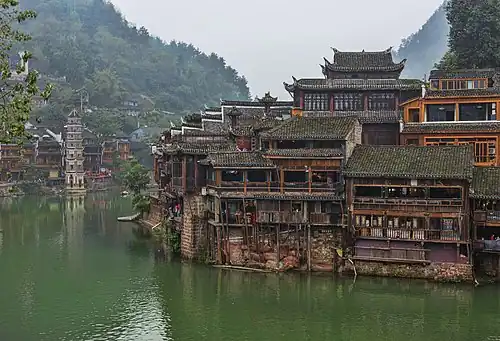
Fenghuang (凤凰, "Phoenix") is a remarkably well-preserved ancient town tucked into the mountains of western Hunan, where the Tuojiang River bends past a cluster of stilt houses, stone bridges and Ming- and Qing-era ramparts. Founded as a garrison outpost in the early 18th century, it long sat at the cultural frontier between Han China and the Miao and Tujia peoples whose villages still ring the surrounding hills. The town is the birthplace of the modernist author Shen Congwen, whose novella Border Town romanticised this corner of western Hunan, and of the painter Huang Yongyu. After decades of relative obscurity, Fenghuang has become one of China's most-photographed "ancient towns" — beautiful, undeniably touristy, and at its best after the day-trippers leave.
The riverside core is compact and almost entirely pedestrianised. Most of what visitors come for sits on the south bank along the Tuojiang, threaded by a covered stone bridge, stepping-stones across the river, and lanes of wooden inns, shops and snack vendors. Beyond the Old Town walls lies the modern city of Fenghuang, which is functional rather than scenic — useful mainly for bus stations and chain hotels.
Climate is humid subtropical: hot, sticky and frequently rainy in July–August, with mist hanging over the river at dawn. Spring (April–May) and autumn (late September to early November) are the most pleasant. Winters are short, damp and chilly, occasionally dusted with snow. Avoid the three "Golden Week" holidays (early May, early October, Chinese New Year) unless you genuinely enjoy crowds — accommodation prices rise sharply and the lanes are shoulder-to-shoulder.
Planning Fenghuang? Tell us your dates and we’ll tailor the trip.
Ask on WhatsAppHow do you get there?
By Plane
The closest airport is Tongren Fenghuang Airport (TEN), across the provincial border in neighbouring Guizhou. It has connections to Guiyang, Guangzhou, Beijing and a handful of other domestic hubs; flights are frequently thin in the off-season. From the airport, a taxi to Fenghuang can be negotiated, or a cheaper option is to take an intercity bus toward Tongren from Fenghuang's North Bus Station and ask the driver to drop you near the airport turn-off.
Huaihua Zhijiang Airport and Zhangjiajie Hehua Airport are larger alternatives, both several hours away by road, with onward bus connections.
By Train
Fenghuang Old Town Railway Station opened in the early 2020s on the Zhangjiajie–Jishou–Huaihua high-speed line and has dramatically reshaped access, with express buses connecting the station to the Old Town. Useful connections include Changsha South (a few hours), Zhangjiajie West (under an hour), Huaihua South (under an hour) and Jishou East (a short hop).
Book on the 12306 app or via Trip.com a few days ahead in peak season. Bring your passport — it's required to collect tickets and to enter the platform.
By Car / Road
An expressway corridor cut the Jishou–Fenghuang drive to well under an hour; expect heavy traffic on weekends and holidays. Bus connections run from Jishou (frequent, around half an hour to an hour), Huaihua (hourly, around an hour and a half), Zhangjiajie (several buses a day, four to five and a half hours), Changsha (several buses a day, a long haul best avoided in favour of the train), and occasionally Guilin.
A practical tip: when buying bus or train tickets in Hunan, the seller will often add a small "travel insurance" fee by default. Say "bú yào bǎoxiǎn" (不要保险) if you don't want it.
The Old Town is best — and almost exclusively — explored on foot. The pedestrianised core is roughly a kilometre end-to-end and the lanes are too narrow for vehicles. Taxis and ride-hailing via Didi are useful for hauling luggage from the bus stations or railway station to the Old Town gates. A local bus runs westbound from the Old Town to the main long-distance bus station.
The Old Town is largely not wheelchair accessible — expect stone steps, uneven flagstones, and stilt-house entries that step up over thresholds. The stepping-stones across the Tuojiang are an obligatory photo but can be slick after rain and crowded enough at midday to feel like a queue; the covered stone bridge and a footbridge a little upstream are easier alternatives.
Common annoyances: minivan drivers near the gates aggressively soliciting trips to nearby scenic areas and Miao villages — always agree the price before getting in, and confirm whether it's per-person or per-vehicle. Photographers in costume offering to "take your picture" along the river will quote a small fee then add charges for editing, prints and extra poses; clarify the total upfront or walk on.
What are the things to do?
Most paid sights are bundled into tiered "through tickets" sold at booths near the East Gate, typically ranging from a basic tier covering the town's core historic buildings up to a multi-day tier that adds the Southern Great Wall and a Miao village.
Inside the Old Town
- East Gate Tower — one of the surviving Ming-era gates and the most intact stretch of city wall, looking straight down onto the Tuojiang.
- The covered stone bridge (虹桥) — a Ming-dynasty span across the river; the iconic Fenghuang silhouette. Walking across is free.
- Yang Family Ancestral Hall — a Qing-era clan hall with finely carved timber and a small opera stage.
- Former Home of Shen Congwen — the modest courtyard house where the author of Border Town was born, with displays of manuscripts and photos.
- A local history museum covering the town's past and local Miao silver traditions.
- A converted guild hall on the south bank now functions as a cultural complex.
- Queen of Heaven Temple — a small Mazu shrine, a reminder of Fujianese merchants who once traded here.
Outside the Old Town
The Southern Great Wall — a Ming-dynasty defensive line built to control the Miao, a short drive west of town. Largely restored, with strenuous stair sections and views over rice terraces. Half a day with transport.
Miao villages — several villages within an hour's drive market themselves to visitors with song-and-dance shows. Quality varies; ask at your guesthouse for one currently considered less staged.
Walk the walls and the river at dawn. The Old Town genuinely empties in the early morning, mist sits on the Tuojiang, and fishermen come out for photographs. This is the Fenghuang of the postcards — don't skip it for a lie-in.
Take a wooden sampan along the Tuojiang from near the north end of town. Operators sell tickets riverside; prices vary by length of trip and time of day.
Stay for the night-lighting. From around dusk the bridges, riverside houses and stilt galleries light up in coloured floodlights — kitsch by daylight, genuinely striking after dark.
Day-trip to the Southern Great Wall for a couple of hours of stair-climbing and ridge views; combine with a Miao village stop.
Day-trip to Aizhai Bridge — one of the world's tallest suspension bridges, roughly an hour north toward Jishou, with a viewing platform.
See an outdoor evening show — Fenghuang stages a large-scale outdoor performance most nights on the river's edge; tickets are sold at booths around the Old Town.
Cormorant fishing and lantern-floating are both touristic but charmingly so; small paper lanterns are sold along the south bank for a few yuan to float downriver after dark.
Planning Fenghuang? Want these on a customised itinerary?
Ask on WhatsAppWhere to eat?
Fenghuang's food is Xiangxi (western Hunan) cuisine — sour, smoky, and chilli-heavy, leaning on river fish, preserved meats, glutinous rice and pickled greens. Signature dishes worth seeking out include blood duck (duck stir-fried with chunks of duck-blood rice cake, ginger and chillies), sour fish soup, cured smoked pork stir-fried with leeks or dried turnip greens, savoury rice "tofu" served cold with chilli oil and vinegar, and glutinous rice steamed with cured pork and peanuts.
After dark the lanes around the East Gate fill with street food: grilled river fish on skewers, mini-claypot rice, fried potato cubes in chilli, egg pancakes, rice-flour dumplings and charcoal-grilled tofu.
Cheap eats are easiest found at the street stalls, eaten standing up, and at small noodle-and-tofu shops a block or two back from the river. Mid-range hot-pot restaurants and family-run Xiangxi restaurants line the lanes further inland from the main drag, where a meal for two with rice and beer is inexpensive by international standards. Riverside restaurants with terrace seating on the south bank charge a real view premium; the food is rarely better than what you'll find inland, but it's a fair price for a slow dinner over the lit-up river.
Vegetarian options exist but require persistence — say "wǒ chī sù" (我吃素) and verify there's no minced pork or chicken stock; tofu, savoury rice tofu and stir-fried mountain vegetables are safe bets. Halal restaurants cluster in modern Fenghuang outside the walls rather than in the Old Town.
Where to drink?
- Mijiu (米酒) — sweet, mildly alcoholic rice wine, often served warm in small cups; many guesthouses make their own.
- Local yellow tea from nearby counties is sold loose in the silver-and-tea shops near the East Gate.
- Local rice wine and herbal spirits from surrounding counties, sometimes infused with roots; sample before you buy.
After dark, the south-bank lanes facing the river turn into a strip of karaoke bars and live-music pubs with neon signs and loud pop remixes. Drinks are heavily marked up compared to shop prices. The scene runs until around midnight, occasionally later on weekends. If you'd rather watch the river than dance, the quieter teahouses on the north bank keep candle-lit terraces open late.
Tap water is not drinkable. Use bottled water or the kettle of boiled water that every guesthouse provides for filling thermoses.
Planning Fenghuang? We’ll book the stays and dining for you.
Ask on WhatsAppWhere to stay?
Most travellers stay inside the Old Town, where wooden inns line the lanes running between the northern wall and the river, and the lanes off the east and south gates. Rooms over the water cost a premium and can be noisy on weekends; courtyard rooms set back a lane or two are quieter and often better value. Larger chain hotels cluster in the modern city near the bus stations — useful for late arrivals, less atmospheric.
Budget travellers will find hostels and small family-run inns inside the Old Town, some with a handful of riverside rooms. Mid-range options include family-run river-view inns (book ahead or expect to pay over the odds walking in) and predictable business hotels just outside the gates. Upscale choices include a reliable international-brand hotel in the modern city, and a handful of restored stilt-house boutique properties in the lanes near the covered bridge offering designer rooms with river-view soaking tubs.
What should you buy?
Fenghuang is famous for two things in particular:
- Ginger candy (姜糖) — vendors all along the Old Town lanes hand-pull and chop slabs of ginger-syrup candy in open windows; the entertainment is half the point. Try before you buy, since spiciness and softness vary widely.
- Miao silverwork — hand-hammered headdresses, neck rings, bracelets and tea ware. Reputable jewellers will weigh pieces in front of you and quote by the gram against the day's silver price. Beware shops selling suspiciously cheap "silver" trinkets — much of it is alloy or plate.
Other worthwhile buys include hand-stitched Miao batik and embroidery, smoked tofu and pickled vegetables, and locally distilled rice wine sold in clay jars.
Bargaining is expected in tourist shops and with minivan drivers, less so in restaurants and cafés where prices are posted. For silver weighed by the gram, focus on negotiating the per-gram markup rather than the metal itself.
Where to go next?
- Zhangjiajie & Wulingyuan — under an hour by high-speed train, then bus, or a direct (long) bus from Fenghuang. The pillar-karst landscape that inspired Avatar's floating mountains; at least two to three days.
- Jishou — a short hop by train or bus. The regional capital is functional rather than charming, but it's the launchpad for Dehang Miao village and the dizzying Aizhai suspension bridge.
- Furong Ancient Town — around two hours by car or bus. A smaller, less-mobbed riverside ancient town built around a waterfall, where parts of a well-known 1980s Chinese film were shot.
- Huaihua — under an hour by high-speed rail; a useful transfer hub for trains south to Guangxi and Guizhou.
- Tongren and Fanjingshan, in neighbouring Guizhou — around two hours' drive. The UNESCO-listed Fanjing Mountain, with its famous twin Buddhist temples balanced on a rock pinnacle, is one of southern China's great climbs.
- Changsha — a few hours by high-speed train. Hunan's capital, home to Mao Zedong sites, the Mawangdui Han tombs at Hunan Museum, and the country's most punishing chilli food.
Nearby in Hunan Sheng
More places to explore around Fenghuang.
Guide content as of July 2026. Portions adapted from Wikivoyage, CC BY-SA 4.0.

Contact Us
Get in touch with us.
Get in touch
Contact Us
Tell us where you'd like to go and how you like to travel. A real Tripcuro planner — not a bot — will craft an itinerary around you.
- Personalised, hassle-free planning end-to-end
- Transparent pricing, no hidden costs
- 24/7 support for complete peace of mind