
Wulai
New Taipei, Taiwan
Why visit Wulai?
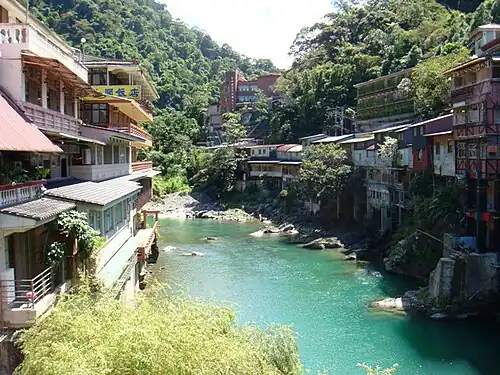
Wulai (烏來區) is a small mountain town in the southern reaches of New Taipei City, famous for its hot springs and its Atayal aboriginal culture. The name comes from the Atayal phrase kirofu ulai, usually translated as "hot and poisonous" — a reference to the steaming, sulphur-tinged water rather than any danger to visitors. Set in a forested river gorge, Wulai is one of the closest mountain escapes from Taipei and a long-standing favourite for a soak, a hike and a taste of indigenous Taiwan.
The town is built along the Nanshi River, where the main street, an open-air market and a cluster of hot-spring hotels lead toward the impressive Wulai Waterfall. Atayal heritage is central to Wulai's identity: it shows in the museum, the woven crafts sold on the main street, the millet wine, and a distinctive aboriginal cuisine built around wild boar, mountain vegetables and bamboo-tube rice. A scenic narrow-gauge train and a gondola add to the appeal, carrying visitors up the valley and to a hilltop garden park.
Wulai is best visited on a weekday, as it becomes very crowded at weekends. The mountain setting makes it pleasantly cool — in summer it runs a few degrees below Taipei, though the modest elevation does not give true relief from the heat — and the air is fresh and damp. Winter is the prime hot-spring season, when soaking away the cold and damp is at its most rewarding. Rain is common, so pack a waterproof layer.
Planning Wulai? Tell us your dates and we’ll tailor the trip.
Ask on WhatsAppHow do you get there?
By Plane
The nearest international airport is Taiwan Taoyuan International Airport (TPE), well over an hour away. Visitors reach Wulai via Taipei and the suburb of Xindian.
By Car / Road
By bus: Bus 849 to Wulai leaves from Xindian MRT Station, the terminus of the Green (Xindian) Line — the stop is in front of the station, behind the information counter. The journey takes about 40 minutes (longer at weekends), costs NT$15 as a single-section fare, and runs every 15–20 minutes from 05:30 to 21:30. Wulai is the last stop, so there is no risk of missing it; if using an EasyCard, tap on boarding and again on alighting. By taxi: a taxi from Xindian MRT takes about 30 minutes and costs NT$600 one way at the fixed-fare sign; the return fare can be negotiated lower.
Wulai is a compact town easily covered on foot, with a map posted by the bus stop showing the attractions clearly marked in English. Despite what some taxi drivers may claim, the Wulai Waterfall is an easy stroll of under half an hour from the town — the walk crosses the open-air market on Wulai Old Street and continues along the riverside "Lover's Path" with views of the gorge.
The Wulai Scenic Train (烏來台車), built in 1928 to carry logging materials and later repurposed for tourists, runs about 1.5 km up the valley to the foot of the gondola; it costs NT$50 each way. From the main street, cross the bridge and take the wooden staircase up to the left to reach the station. The gondola climbs from the base of the gorge to the top of the mountain, where there is a hotel, a conference centre and a garden park (雲仙樂園) with paddle boats and nature trails.
What are the things to do?
History & culture
- Wulai Old Street (烏來老街) — No. 18, Wulai Street. The town's main street, an open-air market of aboriginal snacks, crafts and eateries.
- Wulai Atayal Museum (烏來泰雅民族博物館) — No. 12, Wulai Street; tel +886 2 2661 8162; open 09:30–17:00. A museum of local Atayal aboriginal culture.
- Wulai Forestry Life Museum (烏來林業生活館) — No. 1-2, Pubu Road; tel +886 2 2661 6780; open 09:00–17:00. Formerly the Wulai Tram Museum, now focused on forestry.
Parks & nature
Wulai Waterfall (烏來瀑布) — No. 16, Pubu Road; tel +886 2 2661 6942. An 80 m waterfall with a viewing deck, the town's signature natural sight.
Fushan Botanical Garden (福山植物園) — Open 09:00–15:30. A large botanical garden in the mountains beyond the town.
Soak in the hot springs — Wulai's defining activity; the springs are clear and odourless. Public bathing etiquette requires washing thoroughly first, no clothing (including swimwear) in the indoor baths, and tying up long hair. People with high blood pressure, heart disease or open wounds should not bathe.
- Proto Spring (小川源溫泉餐廳) — No. 32, Wulai Street. No-frills, well-kept gender-segregated Japanese-style (nude) public baths with four pools, around NT$300.
- Wulai Hot Springs Resort (烏來名湯溫泉會館) — No. 36, Laka Road, a 15-minute uphill walk from the Old Street. A large resort with private and public pools; an NT$500 package gives one hour in the public pools with a free café meal, towels and lockers included.
- Pause Landis (璞石麗緻溫泉會館) — No. 88, Section 5, Xinwu Road. A modern, Zen-styled hot-spring hotel with open-air themed rooms and cliffside public baths.
Free riverside hot springs — Across the Nanshi River from the tourist street: cross the bridge, turn right, walk up the road, then take the stairway down to the river to reach a rustic outdoor public hot-spring area with changing rooms and pools. Swimwear is required as the area is in the open.
Hike the mountain trails — Several excellent trails ring the town. The Xinxian Trail (信賢步道) is a 1.3 km walk past a series of waterfalls, starting beyond a suspension bridge about 1.5 km west of Wulai Falls.
Ride the scenic train and gondola — Take the historic narrow-gauge train up the valley and the gondola to the hilltop garden park.
Planning Wulai? Want these on a customised itinerary?
Ask on WhatsAppWhere to eat?
Wulai's food is distinctively Atayal aboriginal, full of mountain ingredients rarely found elsewhere — wild boar, Reeve's muntjac (山羌), bird's-nest fern (山蘇), mountain yam, and seasoned rice steamed in a tube of bamboo (竹筒飯). Many dishes are flavoured with the aboriginal spice maqaw (馬告, mountain pepper).
- Taiya Po Po (泰雅婆婆美食店) — 14 Wulai Street, on the right after crossing the first bridge into town; tel +886 2 2661 6371. Literally "Atayal Grandmother," this restaurant specialises in aboriginal dishes such as wild mountain boar, bamboo-tube rice, mountain yam and cured pork, and has been featured on the Travel Channel's Bizarre Foods: Taiwan; mid-range.
Vegetarian travellers can find mountain-vegetable dishes; ask for "su shi" (素食), though aboriginal restaurants are meat-focused.
Where to drink?
Millet wine (小米酒) is the local aboriginal specialty and a must-try. For something non-alcoholic, Helen's Coffee at No. 1, Lane 86, Wenchuan Road (cross the second bridge into town; tel +886 2 2661 6392) has mostly outdoor seating where you can enjoy mountain air and a river view over a latte. Tap water in Taiwan is generally not drunk unboiled; rely on bottled or boiled water.
Planning Wulai? We’ll book the stays and dining for you.
Ask on WhatsAppWhere to stay?
Wulai has many hotels, making it a popular weekend getaway from Taipei, though most people visit on a day trip. Many hotels offer rooms with private hot-spring tubs.
- Budget: Simple guesthouses and minsu (homestays) operate in and around the town.
- Mid-range to upscale: Hot-spring hotels such as Pause Landis (璞石麗緻溫泉會館) and Wulai Hot Springs Resort (烏來名湯溫泉會館) offer rooms with private spring tubs; a well-appointed room with a personal hot spring and sauna can run around NT$4,500, with rates varying by season and rising at weekends.
What should you buy?
Wulai's signature buys reflect its Atayal heritage: hand-woven cloth in traditional aboriginal designs, sold at shops along the main street; mua-ji, a mochi candy of sticky rice that is a local specialty; and Atayal millet wine alongside other Taiwanese liquors. Spa treatments and massages are also widely on offer. Prices are generally fixed; bargaining is not customary.
Where to go next?
- Taipei — Return via the 849 bus to Xindian and the MRT into the capital.
- Beitou — Taipei's own famous hot-spring district, within the city and on the MRT.
- Jiaoxi — A hot-spring town in neighbouring Yilan County, with more springs in the surrounding area.
- Xindian — The suburb at the foot of the mountain road, with Bitan Lake and riverside scenery.
- Pinglin — A tea-growing district in the eastern mountains, known for its Baozhong tea.
Nearby in New Taipei
More places to explore around Wulai.

Guide content as of May 2026. Portions adapted from Wikivoyage, CC BY-SA 4.0.

Contact Us
Get in touch with us.
Get in touch
Contact Us
Tell us where you'd like to go and how you like to travel. A real Tripcuro planner — not a bot — will craft an itinerary around you.
- Personalised, hassle-free planning end-to-end
- Transparent pricing, no hidden costs
- 24/7 support for complete peace of mind