Switzerland
Western Europe · 323 destinations across 26 regions
Photography coming soonOverview
Switzerland is Europe's most concentrated dose of alpine grandeur — a small, landlocked confederation where snow-capped 4,000-metre peaks, turquoise lakes, vineyard terraces, and storybook medieval towns sit within a few train hours of one another. Despite its modest size (roughly 41,000 km²), it packs in four national languages, 26 cantons with real political autonomy, and a level of public infrastructure — trains, cable cars, cleanliness, punctuality — that has become shorthand for efficiency worldwide. This is a country where you can ski before lunch and swim in a warm southern lake by evening.
What makes Switzerland distinctive is the seamless marriage of wild nature and effortless logistics. The Alps and the Jura mountains define the landscape, but a world-class rail network threads through them, turning the journey itself — over the Bernina Pass, up to Jungfraujoch, along Lake Geneva — into the attraction. Add precision watchmaking, chocolate and cheese traditions, Reformation-era cities, and a deep outdoor culture, and you have a destination that rewards both the adrenaline seeker and the slow traveller.
Switzerland suits hikers, skiers, rail enthusiasts, honeymooners, families, and design-and-finance-minded city travellers. The one caveat is cost: this is among the most expensive countries on earth, and budget travellers must plan carefully. But for those wanting reliability, safety, and scenery that consistently exceeds expectations, few places deliver more.
Geography & Climate
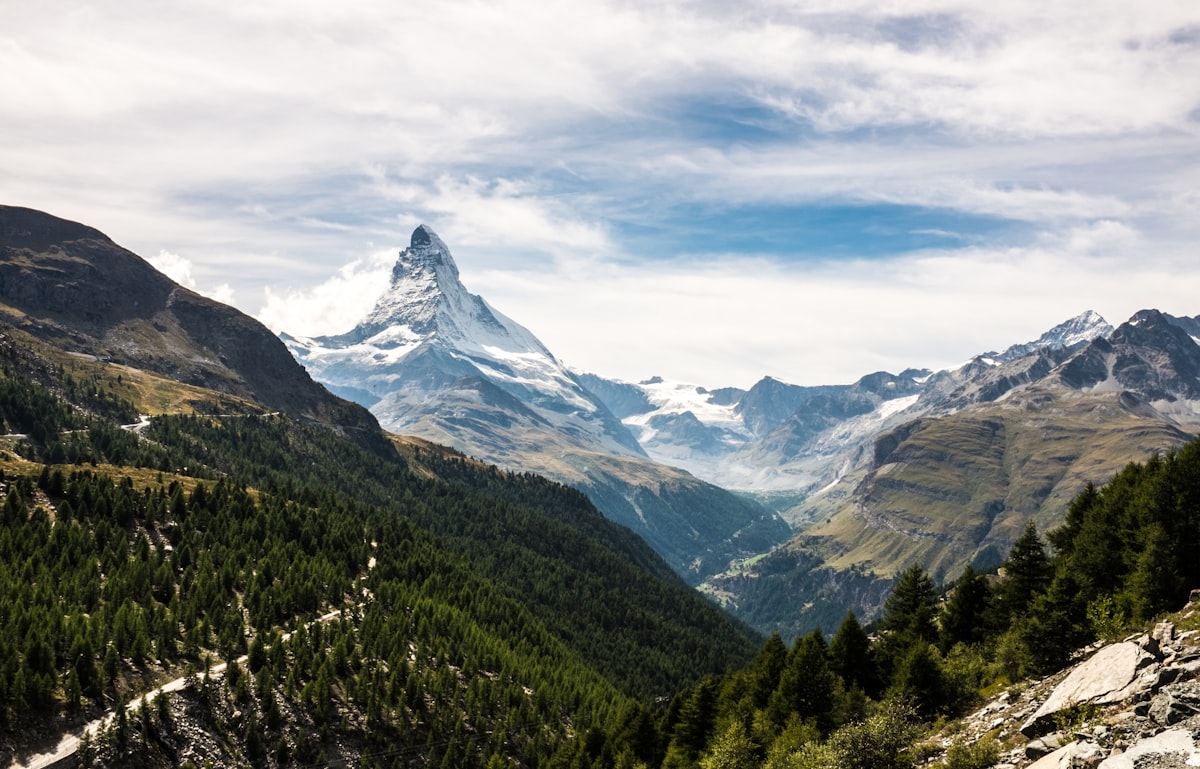
Switzerland divides into three broad geographic zones. The Alps cover roughly 60% of the country across the south and centre — the Bernese Oberland, Valais, the Graubünden ranges, and the iconic peaks of the Matterhorn (4,478 m) and Eiger. The Swiss Plateau (Mittelland), a band of rolling hills, lakes, and farmland between Lake Geneva and Lake Constance, holds most of the population and major cities (Zürich, Bern, Geneva, Lausanne). The Jura Mountains form a lower limestone range along the northwest border with France.
Climate is temperate but highly altitude-dependent. The Plateau has warm summers (June–August averaging 18–25°C) and cold, often grey winters. Mountain regions are far colder, with heavy snow from roughly November to April — the basis of the ski economy. South of the Alps, Ticino enjoys a near-Mediterranean climate, with palm-lined lakes and the country's warmest, sunniest weather.
There is no monsoon. Rainfall is spread year-round, with summer thunderstorms common in the mountains. The föhn, a warm dry downslope wind, can bring sudden mild spells and sometimes triggers headaches and unsettled mountain weather. High passes (Furka, Susten, Grimsel) close under snow in winter.
Tell us your dates and we'll tailor your Switzerland trip around them.
WhatsAppWhen to Visit
Summer (June–September) is peak season for hiking, lakes, and city sightseeing; July and August are busiest and warmest, with trails and cable cars fully open. Winter (mid-December–March) is peak ski season in resorts like Zermatt, St. Moritz, and Verbier — December holidays and February (European school breaks) command the highest prices.
Shoulder seasons offer the best value and fewer crowds: late April–May brings alpine wildflowers and green valleys (though some high lifts remain closed for maintenance), and late September–October delivers crisp air, golden larches, and the wine harvest. November and the post-Easter to early-May windows are the genuine off-season, when many mountain resorts partly shut down between ski and hiking seasons.
Festivals worth planning around: Fasnacht (Carnival) in Basel and Lucerne (February/March), Montreux Jazz Festival (early July, Lake Geneva), Sechseläuten spring festival in Zürich (April), Locarno Film Festival (August), and Christmas markets in Basel, Zürich, and Montreux (Advent).
Visa & Entry
Switzerland is part of the Schengen Area (though not the EU). Citizens of the EU/EEA, the UK, US, Canada, Australia, New Zealand, Japan, and many other countries may enter visa-free for up to 90 days within any 180-day period for tourism. Many other nationalities require a Schengen visa obtained in advance from a Swiss embassy or visa centre.
From late 2026, the EU's ETIAS travel authorisation is expected to apply to currently visa-exempt visitors — a quick online pre-registration, not a visa. The EES biometric entry/exit system is also being rolled out at Schengen borders. There is no visa-on-arrival or general e-visa scheme for tourism.
This is general guidance only. Always verify entry requirements, passport validity (typically 3+ months beyond departure), and any transit rules with the Swiss embassy or consulate for your nationality before booking.
Want us to time your trip around a festival? We'll handle it.
WhatsAppMoney & Costs
The currency is the Swiss Franc (CHF), not the euro — though many tourist businesses accept euros, change is usually given in francs at poor rates. At time of writing roughly CHF 1 ≈ USD 1.10 (the franc and dollar trade close to parity).
Typical daily budgets per person:
- Budget: CHF 100–150 (~USD 110–165) — hostel dorm or camping, supermarket meals (Coop, Migros), regional transport with passes.
- Mid-range: CHF 250–400 (~USD 275–440) — 3-star hotel, a restaurant meal or two, paid cable cars and excursions.
- Luxury: CHF 600+ (~USD 660+) — 4/5-star hotels, fine dining, private guides, premium ski passes.
For reference: a basic restaurant main runs CHF 22–35, a coffee CHF 4–5, a beer CHF 6–8, and a single inner-city transit ticket around CHF 3–4.
Cards (Visa/Mastercard) and contactless/mobile payments are accepted almost everywhere, including small shops and mountain huts; ATMs are ubiquitous. Tipping is modest — service is included by law, so locals simply round up or add ~5–10% for good restaurant service. Taxi fares are usually rounded up.
Getting In
Switzerland's main international airports are Zürich (ZRH) — the largest hub, served by Swiss International Air Lines — Geneva (GVA) in the southwest, and Basel–Mulhouse–Freiburg (BSL/EuroAirport), shared with France. Smaller airports include Bern (BRN) and Lugano (LUG). Many travellers also fly into nearby Milan, Munich, or Lyon and arrive by train.
As a landlocked country, entry is otherwise by road or rail. Switzerland has excellent direct rail links: high-speed TGV Lyria from Paris, ICE from Germany (Frankfurt, Munich), EuroCity from Milan, and connections from Austria. Trains arrive at central stations in Zürich, Geneva, Basel, and Bern.
Land borders with France, Germany, Italy, Austria, and Liechtenstein are open Schengen crossings, though spot ID/customs checks occur. Drivers using the motorway network must buy an annual vignette (CHF 40) — there are no per-trip tolls. There are no sea ports, but scenic lake ferries connect to Germany (Lake Constance) and Italy (Lake Maggiore, Lake Lugano).
We handle the bookings and budgeting — you just travel.
WhatsAppGetting Around
The Swiss Travel System is the country's crown jewel. A dense, punctual network of SBB/CFF/FFS trains, PostBuses (yellow buses reaching remote valleys), trams, boats, and many cable cars is fully integrated and timed to connect. Domestic flights are essentially unnecessary given the distances.
For visitors, the Swiss Travel Pass (from ~CHF 244 for 3 days) gives unlimited travel on trains, buses, and boats, free entry to 500+ museums, and discounts on mountain railways — excellent value if moving around. The Half Fare Card (CHF 120, one month) halves all fares and suits slower itineraries. Scenic routes worth the journey include the Glacier Express (Zermatt–St. Moritz), Bernina Express, and GoldenPass Line.
Taxis are reliable but expensive; Uber operates in Zürich, Geneva, Basel, and Lausanne. Roads are superb but mountain driving requires care, and winter tyres/chains may be needed on passes. Switzerland is notably low on scams — the main thing to watch is accidentally boarding without a valid ticket, as fines for fare-dodging are steep and strictly enforced.
Culture & Etiquette
Switzerland is multilingual and regionally proud: German (Swiss German dialects) dominates the centre and east, French the west (Geneva, Lausanne, Neuchâtel), Italian the south (Ticino), and Romansh survives in parts of Graubünden. A greeting in the local language — Grüezi, Bonjour, or Buongiorno — is appreciated. Handshakes are standard; among friends, three cheek-kisses (alternating sides) are common in French-speaking areas.
The Swiss value punctuality, privacy, discretion, and order. Arrive on time, keep your voice down on public transport, and avoid loud or overly familiar behaviour with strangers. Quiet hours (typically 10 pm–6 am, and often Sundays) are respected — noise, laundry, and recycling can be restricted on Sundays in residential buildings.
Dress is generally smart-casual; there are few major religious-site dress codes, though modest attire (covered shoulders/knees) is courteous in churches and cathedrals. Tipping is light (round up). Photography is fine in public, but ask permission before photographing people, and note that some viewpoints and museums restrict tripods or flash. A key don't: never assume a French- or Italian-speaking Swiss person wants to speak German — language sensitivity matters.
Prefer to talk it through? We're a WhatsApp message away.
WhatsAppSafety
Switzerland is one of the safest countries in the world, with very low violent crime. The main urban risk is petty theft and pickpocketing in crowded stations, trams, and tourist hotspots (Zürich, Geneva, Lucerne) — keep an eye on bags. Roads are well-maintained and policing is professional and approachable.
The principal hazards are natural and alpine: sudden mountain weather changes, avalanches in winter (heed local warnings and avoid closed off-piste areas), rockfall, and fast-rising rivers from snowmelt. Hikers should carry proper gear, check forecasts, respect trail markings (white-red-white for mountain paths, white-blue-white for demanding alpine routes), and not overestimate their fitness at altitude. Glacier travel requires a guide. The emergency number is 112; alpine rescue (often via REGA helicopter) is 1414.
No special vaccinations are required beyond routine immunisations; tick-borne encephalitis (TBE) is a consideration for those hiking in forested areas in spring/summer, so a vaccine may be advised. Tap water is excellent and safe everywhere, including the many public fountains in cities. Healthcare is world-class but expensive — comprehensive travel insurance covering mountain rescue and medical evacuation is strongly recommended.
Top Regions
- Bernese Oberland — The classic Swiss Alps: Interlaken, the Jungfrau, Eiger, and Lauterbrunnen's waterfall-lined valley.
- Valais — Home of the Matterhorn, Zermatt, Verbier, sunny vineyards, and the country's highest peaks.
- Graubünden (Grisons) — The largest, easternmost canton, with St. Moritz, the Swiss National Park, and the Bernina/Glacier Express routes.
- Lake Geneva Region (Vaud/Geneva) — French-speaking shores with Geneva, Lausanne, Montreux, and the Lavaux terraced vineyards.
- Central Switzerland — Lucerne, Lake Lucerne, and the founding cantons around Mounts Pilatus, Rigi, and Titlis.
- Ticino — The Italian-speaking south, with palm-fringed Lake Lugano and Lake Maggiore (Locarno, Ascona).
- Zürich Region & Northeast — The financial and cultural hub plus Lake Constance, Appenzell's rolling hills, and the Rhine Falls.
- Jura & Three-Lakes — Quiet limestone hills, watchmaking towns, and the lakes of Neuchâtel, Biel, and Murten.
Tell us your dates and we'll tailor your Switzerland trip around them.
WhatsAppTop Destinations
- Zürich — The largest city: a stylish finance and cultural hub on a lake, with a charming Old Town, top museums, and lively nightlife.
- Geneva — French-speaking lakeside city of diplomacy (UN, Red Cross), the Jet d'Eau fountain, and luxury watch boutiques.
- Lucerne — Postcard-perfect lakeside town with the covered Chapel Bridge, framed by Mounts Pilatus and Rigi.
- Bern — The medieval, UNESCO-listed capital, with arcaded streets, the Zytglogge clock tower, and the Aare river loop.
- Zermatt — Car-free alpine resort beneath the Matterhorn, a magnet for skiers, climbers, and hikers.
- Interlaken — Adventure-sports gateway between two lakes and the springboard to Jungfraujoch, the "Top of Europe."
- Lausanne — Hilly lakeside university city, home of the International Olympic Committee and a striking Gothic cathedral.
- St. Moritz — Glamorous Engadine resort, a winter-sports pioneer and luxury playground in Graubünden.
- Lugano — Italianate lakeside city in Ticino, with Mediterranean flair, piazzas, and mountain-ringed waters.
- Basel — Cultural capital on the Rhine, packed with world-class art museums (Fondation Beyeler, Kunstmuseum) and a famous carnival.
- Montreux — Riviera-like Lake Geneva town known for its jazz festival and the lakeside Chillon Castle.
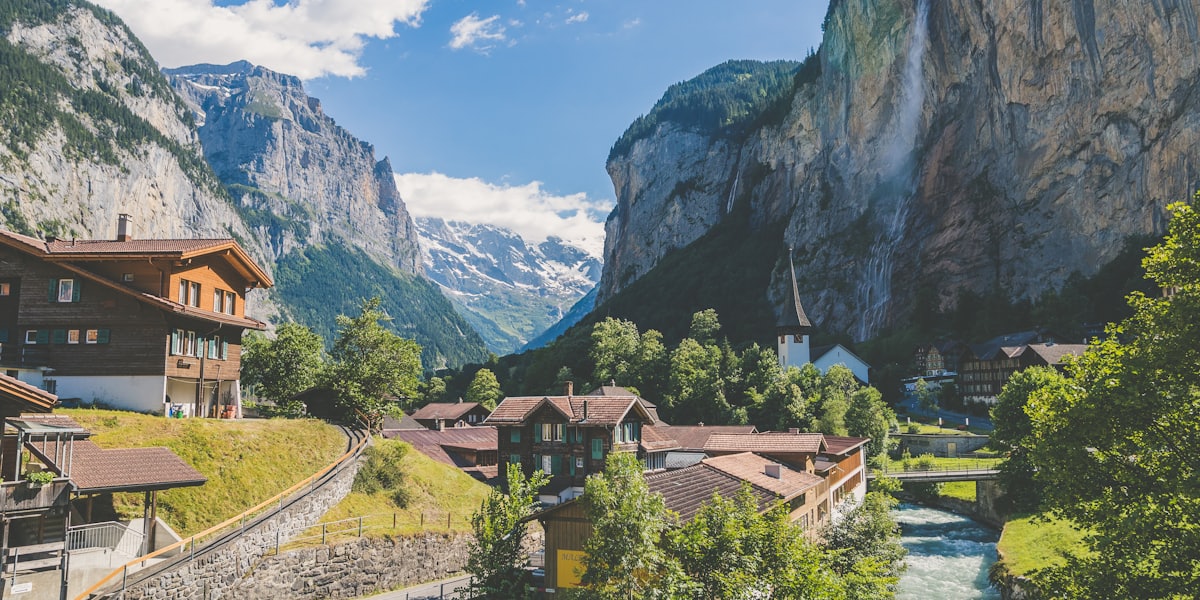
- Lauterbrunnen — A dramatic glacial valley of 72 waterfalls and sheer cliffs, gateway to Mürren and Wengen.
Regions & States
Switzerland has 26 regions with guides — pick one to drill into its destinations.
Aargau
21 destinations
Appenzell Ausserrhoden
12 destinations
Appenzell Innerrhoden
6 destinations
Basel-Landschaft
13 destinations
Basel-Stadt
3 destinations
Berne
20 destinations
Fribourg
11 destinations
Genève
12 destinations
Glarus
9 destinations
Graubünden
15 destinations
Jura
10 destinations
Luzern
13 destinations
Neuchâtel
10 destinations
Nidwalden
11 destinations
Obwalden
7 destinations
Sankt Gallen
12 destinations
Schaffhausen
10 destinations
Schwyz
10 destinations
Solothurn
10 destinations
Thurgau
10 destinations
Ticino
15 destinations
Uri
11 destinations
Valais
29 destinations
Vaud
19 destinations
Zug
11 destinations
Zürich
13 destinations
Not sure where to start in Switzerland? Tell us how you like to travel and we'll shape the route.
WhatsAppTop Destinations
The places first-time and returning travellers ask for most.
Aadorf
Aadorf is a town in Thurgau, Switzerland.
Aarau
Aarau is the German-speaking capital city of the northern Swiss canto…
Aarburg
Aarburg is a small historic town in the canton of Aargau, Switzerland…
Adelboden
Adelboden is a town in Berne, Switzerland.
Aesch
Aesch is a town in Basel-Landschaft, Switzerland.
Aigle
Aigle is a town in Vaud, Switzerland.
Airolo
Airolo is a town in Ticino, Switzerland.
Allschwil
Allschwil is a town in Basel-Landschaft, Switzerland.
Alpnach
Alpnach is a town in Obwalden, Switzerland.
Altdorf
Altdorf is a town in Uri, Switzerland.
Altst??tten
Altst??tten is a town in Sankt Gallen, Switzerland.
Amriswil
Amriswil is a town in Thurgau, Switzerland.
Contact Us
Get in touch with us.
Get in touch
Contact Us
Tell us where you'd like to go and how you like to travel. A real Tripcuro planner — not a bot — will craft an itinerary around you.
- Personalised, hassle-free planning end-to-end
- Transparent pricing, no hidden costs
- 24/7 support for complete peace of mind