
Songgyungwan
Kaeseong, North Korea
Why visit Songgyungwan?
Songgyungwan (Koryo Songgyungwan) was the supreme state academy during the Koryo Dynasty (918–1392), founded in 992 CE during the reign of King Seongjong. Located in Kaesong, North Korea, the institution educated the civil service elite, administering national state examinations and instructing scholars in Confucian classics, history, and administration. Reconstructed in 1602 following its destruction during the Imjin War, the compound stands as Korea's oldest surviving educational complex.
In 1987, the academy buildings were converted into the Koryo Museum (Kaesong Koryo Museum). In 2013, the property was inscribed as a UNESCO World Heritage Site under the listing "Historic Monuments and Sites in Kaesong." The grounds span approximately 10,000 square meters and preserve 18 traditional timber structures, stone stelae, and more than 1,000 artifacts ranging from Goryeo celadon pottery to metal movable type and Buddhist art.
Kaesong has a temperate continental climate marked by cold, dry winters and warm, humid summers. Winter temperatures from December through February regularly fall to −10 °C (14 °F), while summer highs in July and August reach 28 °C to 31 °C (82 °F to 88 °F) alongside heavy monsoon rainfall.
Planning Songgyungwan? Tell us your dates and we’ll tailor the trip.
Ask on WhatsAppHow do you get there?
Independent travel to North Korea is not permitted. All foreign nationals must travel on an organized itinerary booked through an authorized agency (such as the state-run Korea International Travel Company / KITC, Koryo Tours, or Young Pioneer Tours). All transit to and within Kaesong is arranged by the tour provider.
By Air
No airport exists in Kaesong. The nearest international gateway is Pyongyang Sunan International Airport (FNJ), located 160 km (99 miles) north. Air Koryo and Air China operate scheduled flights connecting Pyongyang with Beijing Capital (PEK, 2 hours) and Shenyang (SHE, 1 hour). Tour operators meet arriving travelers at the airport and transfer groups south to Kaesong by road.
By Bus
No public bus service operates between Pyongyang and Kaesong for foreign tourists. Visitors travel on private chartered tour buses and minibuses arranged by state tour operators. The 140 km (87-mile) route south from Pyongyang along the Pyongyang–Kaesong Motorway takes 2 to 2.5 hours. Transit costs are included in the overall guided tour package (€800–€2,200 / $870–$2,400 USD depending on total itinerary length).
By Train
The Korean State Railway operates the Pyongbu Line linking Pyongyang Station with Kaesong Station. However, regular passenger train services on this line are restricted to domestic citizens, and tourist itineraries do not use this rail route. Cross-border train service from Dorasan Station in South Korea is suspended.
By Car
Independent car rentals and self-driving are prohibited in North Korea. All road travel is conducted in government-licensed vehicles operated by state-assigned drivers. Travel from Pyongyang proceeds along the six-lane Pyongyang–Kaesong Motorway (Reunification Highway / AH1), covering 140 km (87 miles) in approximately 2 to 2.5 hours. Road conditions vary, with uneven concrete surface seams. Crossing the Military Demarcation Line from Seoul (70 km south) is closed to civilian traffic.
Visitors tour the Songgyungwan complex on foot as part of a guided group. Independent walking outside designated tour zones is prohibited. All transit between Songgyungwan and other destinations in Kaesong is provided by the group's assigned tour vehicle. No public taxis or ride-hailing applications operate for foreign tourists.
What are the things to do?
Myongryun Hall (Myongryundang) — The central lecture hall reconstructed in 1602. Scholars attended lectures and studied Confucian texts within this single-story timber structure with wide wooden verandas. Admission is included in standard Kaesong tour packages.
Taesong Hall (Taesongjon) — The shrine hall located behind the main courtyard. Historically dedicated to Confucius and prominent Korean scholars, it now houses exhibits displaying ancient weaponry, stone tools, and royal court documents.
Millennium Ginkgo and Zelkova Trees — Two massive, protected trees in the central academy courtyard, planted during the Goryeo dynasty in the 10th and 11th centuries.
Koryo Museum Celadon Gallery — Exhibition halls displaying authentic Goryeo jade-green celadon wares, inlaid incense burners, pottery, and bronze mirrors dating from the 10th to 14th centuries.
Hyonhwasa Pagoda and Stone Lantern — A 1020 CE seven-story stone pagoda and carved stone lantern relocated to the museum courtyard from the ruins of Hyonhwasa Temple.
Kaesong Stamp and Souvenir Shop — Located in the outer courtyard near the entrance gate. It sells DPRK postage stamps, postcards, hand-painted posters, and local ginseng products.
Explore Goryeo Dynasty Artifacts: Walk through the four main exhibition galleries with your state guide to examine metal moveable type, Buddhist scriptures, and historical relics from the 10th through 14th centuries.
Photograph Traditional Architecture: Capture images of classical Korean wooden architecture, curved eaves, decorative dancheong paintwork, and stone pathways.
Send Postcards Abroad: Purchase DPRK commemorative stamp sets and mail stamped postcards to international addresses directly from the on-site postal counter.
Tour Kaesong Monuments: Combine your Songgyungwan visit with nearby Goryeo landmarks, including the Sonjuk Bridge and the South Gate.
Planning Songgyungwan? Want these on a customised itinerary?
Ask on WhatsAppWhere to eat?
Meals in Kaesong are arranged as part of pre-booked tour programs.
- Tongil Restaurant (Reunification Restaurant) — Known for serving pansanggi, a traditional Kaesong meal presented in 11 to 13 covered bronze bowls containing rice, soup, kimchi, seasoned bean curd, and fish. Diners can order Kaesong ginseng chicken soup (samgyetang) for an additional fee of approximately $30 USD / €28. Price tier: Mid-range ($15–$35 USD).
- Kaesong Folk Hotel Restaurant — Located within the traditional courtyard complex, serving kaeseong mandu (boiled pork dumplings), seasoned mountain greens, and naengmyeon (cold noodles). Price tier: Mid-range ($15–$25 USD).
- Janamsan Hotel Dining Room — Serves traditional multi-course banquets including braised pork, fried fish, seasonal vegetable dishes, and rice. Price tier: Mid-range ($12–$22 USD).
- Thongil Street Teahouse — A designated stop offering hot ginseng tea, regional sweet rice snacks (yakgwa), and bottled drinks. Price tier: Budget ($3–$8 USD).
Where to drink?
Bottled spring water and carbonated drinks are provided with tour meals. Kaesong is famous for Kaesong Koryo Insam Liquor, a traditional spirit (30–40% ABV) distilled with whole ginseng roots. Taedonggang Beer (DPRK state-brewed lager) is widely served with lunch and dinner for $2–$3 USD per bottle. Tap water is untreated and unsafe for drinking; drink only sealed bottled water.
Planning Songgyungwan? We’ll book the stays and dining for you.
Ask on WhatsAppWhere to stay?
Independent hotel bookings are not available; accommodations are arranged through your tour operator.
- Budget: No independent budget hotels or hostels exist. All visitors stay in state-approved accommodations included in group packages.
- Mid-range: Kaesong Folk Hotel (Minsok Hotel) — A traditional courtyard guesthouse consisting of restored tiled-roof houses along the stream in the old town. Rooms feature traditional ondol floor heating and floor sleeping mats. Nightly rates run $70–$110 USD per room (typically included in tour packages).
- Mid-range: Janamsan Hotel — A state hotel located near Mount Janam. Rooms have twin beds and private bathrooms, with hot water provided during scheduled morning and evening hours. Nightly rates: $50–$80 USD.
- Upscale: For modern international standards, tours base guests in Pyongyang (140 km north) at the Yanggakdo International Hotel or the Koryo Hotel ($120–$180 USD per night), which offer 24-hour hot water, revolving restaurants, and recreation facilities.
What should you buy?
The on-site stamp shop at the Songgyungwan entrance sells North Korean philatelic items, including collector stamp sheets, first-day covers, and commemorative envelopes. The shop also stocks Kaesong Insam (Koryo ginseng roots, tea, and tonics), local embroidery, hand-painted propaganda posters, and books published by the Foreign Languages Publishing House. Purchases are made in foreign currencies, including euros (€), Chinese yuan (RMB / ¥), or US dollars ($); local North Korean won is not accepted.
Where to go next?
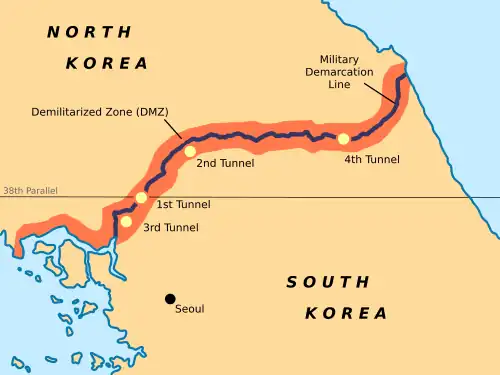
- Panmunjom and the DMZ (10 km south) — The Joint Security Area at the Demilitarized Zone, where the 1953 Korean War Armistice Agreement was signed. Guided tours visit the conference pavilions and the Military Demarcation Line.
- Tomb of King Kongmin (14 km west) — The 14th-century twin-mound royal tomb of the 31st Goryeo monarch and his queen, featuring detailed granite statues and hillside scenery.
- Sonjuk Bridge (2 km east) — A stone bridge dating to 1216, known as the site where loyal Goryeo scholar-official Jeong Mong-ju was assassinated in 1392.
- Pakyon Falls and Taehungsan Fortress (25 km north) — A 37-meter-high waterfall set in the granite mountains north of Kaesong, adjacent to the historic mountain fortress walls.
- Pyongyang (140 km north) — The national capital, featuring the Mansudae Grand Monuments, the Victorious Fatherland Liberation War Museum, and the Pyongyang Metro.
Nearby in Kaeseong
More places to explore around Songgyungwan.
Guide content as of June 2026.

Contact Us
Get in touch with us.
Get in touch
Contact Us
Tell us where you'd like to go and how you like to travel. A real Tripcuro planner — not a bot — will craft an itinerary around you.
- Personalised, hassle-free planning end-to-end
- Transparent pricing, no hidden costs
- 24/7 support for complete peace of mind