
Panmunjom
Kaeseong, North Korea
Why visit Panmunjom?
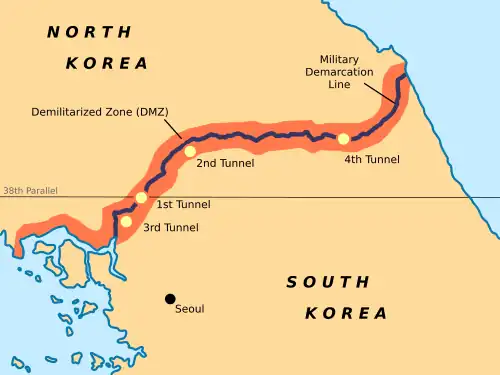
Panmunjom (Korean: 판문점), also romanised as P'anmunjŏm, is a small village straddling the Military Demarcation Line (MDL) between North and South Korea in the Kaesong region. It is one of the last tangible relics of the Cold War and the site where the Korean War armistice was signed on 27 July 1953. Because a formal peace treaty was never concluded, the two Koreas remain technically at war, and the surrounding Demilitarized Zone (DMZ) — a 4-km-wide buffer centred on the MDL — is among the most heavily fortified borders on earth. Visiting Panmunjom is a profoundly unusual travel experience: access is only possible on tightly controlled, military-escorted tours arranged in advance through approved operators.
The Joint Security Area (JSA), roughly 1 km east of the original village, is the centrepiece for visitors. This 800-metre-diameter patch of land is jointly policed by both sides and contains the iconic blue conference rooms that straddle the border. On 30 June 2019, US President Donald Trump met North Korean leader Kim Jong-un here and briefly stepped across the MDL — the first sitting US president to set foot on North Korean soil.
The climate mirrors the Korean peninsula's broader pattern: hot, humid summers (June–August, 25–33 °C) and cold, dry winters (December–February, down to −15 °C). Spring (April–May) and autumn (September–October) offer the most pleasant conditions for a visit.
Planning Panmunjom? Tell us your dates and we’ll tailor the trip.
Ask on WhatsAppHow do you get there?
By Plane
The nearest major airport on the South Korean side is Incheon International Airport (ICN), approximately 70 km southwest of the DMZ, or Gimpo International Airport (GMP), about 50 km away. From the North Korean side, Pyongyang Sunan International Airport (FNJ) serves as the gateway, roughly 215 km north via the Reunification Highway.
By Train
There is no direct rail service to Panmunjom. On the South Korean side, a regional train runs between Seoul Station and Imjingak (approximately ₩1,300 one way, twice daily), with additional services terminating at Paju, 7 km short of the DMZ. From Pyongyang, tours typically depart by road rather than rail.
By Car / Road
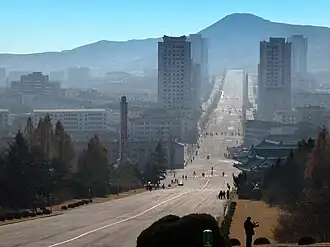
From Seoul, the JSA is roughly 62 km north — about one hour's drive along the Freedom Road (Intervincial Highway 1), a 12-lane motorway that grows eerily quiet as you approach the border. The road is flanked by barbed wire, observation posts, and tank traps. From Pyongyang, the six-lane Reunification Highway runs 215 km south to the JSA; it is wide but poorly maintained. Both routes are accessible only as part of an organised military-escorted tour.
Independent exploration is not possible. Whether you arrive from the North or the South, your movement is entirely controlled by military escort. You will be bussed into the JSA compound and guided between sites on foot. Inside the blue conference rooms you may move freely and even cross the MDL through the building, but you may not exit through the door on the opposite side. Photography is permitted at designated points but restrictions change without notice — follow your guide's instructions precisely.
What are the things to do?
Blue Conference Rooms (T1–T3) — The three blue huts straddling the MDL are the most iconic sight. Inside, a neat line of microphones on the table marks the exact border. South Korean soldiers stand in a modified Tae Kwon Do stance facing North; North Korean soldiers glare back. You can walk around the room and step into the "other Korea" while inside.
Bridge of No Return — After the Korean War, prisoners of war were offered the choice to cross this bridge or remain with their captors. The bridge was the site of the 1976 "Axe Murder Incident" in which North Korean soldiers killed two US officers with axes during a tree-trimming operation. The bridge is now closed; a newer structure to the north is used instead.
Freedom House (자유의 집) — South Korea's large administrative building facing the MDL on the southern side. Visitors are usually taken to the adjacent Peace Pagoda for panoramic views of the JSA and surrounding countryside. Accessible from the South only.
Panmun-guk — North Korea's counterpart administrative building on the northern side of the JSA. Accessible from the North only.
North Korea Peace Museum — Located 500 m north of the JSA, this is the building where the 1953 armistice was actually signed. Original copies of the agreement are displayed, along with the axe from the Axe Murder Incident. Guarded by a tattered UN flag and a well-preserved DPRK flag. Accessible from the North only.
Camp Bonifas — The combined US/South Korean military base 2,400 m south of the JSA. All visitors from the South change buses here and receive a security briefing before entering the DMZ.
Taesong-dong ("Freedom Village") — A South Korean settlement inside the DMZ with around 200 residents farming under 24-hour military guard. Entry is forbidden; you will pass by en route to the JSA from Seoul.
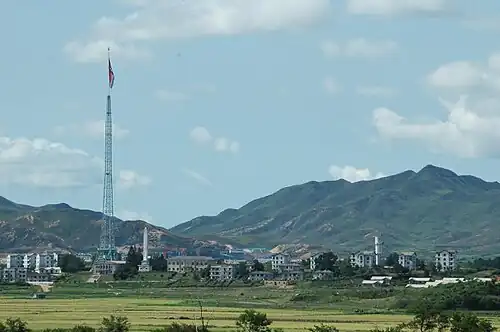
Kijong-dong ("Propaganda Village") — A North Korean village on the northern side of the DMZ featuring apartment blocks and a 160-metre flagpole (once the world's tallest). South Korea claims no one lives there. Visible from the JSA; binoculars help.
Imjingak (Paju) — A four-storey museum and observatory 7 km south of the DMZ, the closest civilians can get without security clearance. Views across the Imjin River toward North Korea. Open daily 09:00–18:00.
Guided DMZ and JSA Tour — The primary activity. Full-day tours from Seoul typically include the JSA conference rooms, the Bridge of No Return, Camp Bonifas briefing, and often the Third Tunnel of Aggression. Book well in advance; availability is limited and tours can be cancelled without notice due to security conditions.
Third Tunnel Visit — One of several tunnels dug by North Korea under the DMZ, discovered in 1978. Visitors descend by foot or tram into the tunnel. Combined JSA + Third Tunnel tours are the most popular option from the South.
Dora Observatory — On the South Korean side, visitors can peer through telescopes into North Korea, including the half-finished Ryugyong Hotel in Pyongyang on clear days.
From the North — If visiting via a North Korean tour, you will see the original Panmunjom village site, the Peace Museum, and the JSA from the northern perspective. This is a markedly different experience, with different propaganda framing.
Planning Panmunjom? Want these on a customised itinerary?
Ask on WhatsAppWhere to eat?
Food options are minimal and entirely determined by your tour package. Most South Korean–side tours include a meal, typically Korean military-style rations or a boxed lunch. The Koridoor tour explicitly excludes lunch (US$160 per person). Some operators include a stop at a local restaurant near Imjingak. From the North, meals are usually provided as part of the broader Pyongyang or Kaesong tour itinerary, often featuring traditional Korean dishes such as naengmyeon (cold buckwheat noodles) for which Kaesong is famous.
Where to drink?
There are no bars, cafés, or independent drinking establishments accessible at Panmunjom or the JSA. Water is provided on tour buses. From the North Korean side, your tour may include North Korean beer or soju as part of a group meal. Stay hydrated in summer — the DMZ area can be extremely hot and humid with little shade.
Planning Panmunjom? We’ll book the stays and dining for you.
Ask on WhatsAppWhere to stay?
There is no accommodation at Panmunjom itself. All visitors stay elsewhere and travel in for a day trip.
- Budget: Guesthouses and hostels in Paju or northern Seoul (Hongdae, Sinchon) from roughly ₩30,000–50,000 per night.
- Mid-range: Business hotels in Seoul (Myeongdong, Jongno) typically ₩80,000–150,000 per night. The LOTTE Hotel Seoul (near Eulgiro 1-ga Station) is a common tour departure point.
- Upscale / heritage: In Pyongyang (if visiting from the North), the Yanggakdo International Hotel or the Koryo Hotel are standard for foreign visitors, typically included in tour packages at US$150–250 per night.
What should you buy?
Shopping opportunities are extremely limited. At Imjingak (South Korean side) there are souvenir stalls selling DMZ-themed memorabilia, miniature flags, and propaganda posters. On the North Korean side, a small gift shop at the Peace Museum sells DPRK postcards, stamps, and books. There are no commercial facilities at the JSA itself.
Where to go next?
- Kaesong (30 km north) — The historic capital of the Goryeo dynasty, home to the Royal Tombs and the Kaesong Namdaegun gate. Easily combined with a DMZ visit from the North.
- Seoul (62 km south) — South Korea's vibrant capital, a one-hour drive from the JSA. Essential for any visitor to the peninsula.
- Imjingak Peace Park (7 km south) — The closest accessible point to the DMZ without security clearance; museum, observatory, and the old Gyeongui Line railway platform.
- Third Tunnel of Aggression (approximately 50 km north of Seoul) — Often included in DMZ tours; a 1.6-km tunnel dug by North Korea under the border.
- Dorasan Station (65 km north of Seoul) — The northernmost train station in South Korea, built in anticipation of reunification. A poignant symbol; trains once ran to Pyongyang from here.
Nearby in Kaeseong
More places to explore around Panmunjom.
Guide content as of June 2026. Portions adapted from Wikivoyage, CC BY-SA 4.0.

Contact Us
Get in touch with us.
Get in touch
Contact Us
Tell us where you'd like to go and how you like to travel. A real Tripcuro planner — not a bot — will craft an itinerary around you.
- Personalised, hassle-free planning end-to-end
- Transparent pricing, no hidden costs
- 24/7 support for complete peace of mind