

Laiwu
Shandong Sheng, China
Why visit Laiwu?
Laiwu (莱芜 Láiwú) is a district of Jinan in central Shandong Province, set in the upper valley of the Wen River (汶河) on the northern foothills of the Mount Tai range. Once a prefecture-level city in its own right, it was absorbed into Jinan in 2019, with its former territory now split between Laiwu District and Gangcheng District. Its roots run deep: this was the heart of the ancient Mou State (牟国) during the Spring and Autumn Period (771–403 BCE), which earned the area the literary name "Yingmou" (赢牟) and the romantic nickname "Phoenix City" (凤城). Modern Laiwu, however, is best known as one of China's historic steel towns — the Laiwu Iron and Steel Group has dominated the local economy since the 1960s — and yet the surrounding mountains, parks and lake country mean it is often cited by Chinese travellers as one of the most liveable industrial cities in the country.
For visitors, Laiwu makes most sense as a quieter, greener stop on a Shandong itinerary built around Jinan, Tai'an (Mount Tai) and Qufu. The downtown core, on the north bank of the Wen, is compact and easy to navigate, threaded by Wenhua Road and Hongshi Park; Gangcheng District lies to the east and is more industrial in feel, but holds Qishan and several food streets. The real draw is what surrounds the city: Lianhua Mountain to the south (the highest peak in greater Jinan at 999 m), the Xueye Lake tourist area to the north, and the Xiangshan and Huashan forest parks in the western hills.
Climate is warm-temperate semi-humid monsoon, with four sharply defined seasons. Summers (Jun–Aug) are hot, humid and very wet — July and August alone account for roughly 380 mm of the year's rainfall and are best avoided unless you specifically want green hills and waterfalls in flood. Spring (Apr–May) and autumn (Sep–Oct) are the prime windows: 15–27 °C, low humidity, clear mountain views. Winters are cold and dry, with January lows around −5 °C; there is modest snow and a small local ski operation.
Planning Laiwu? Tell us your dates and we’ll tailor the trip.
Ask on WhatsAppHow do you get there?
By Plane
The nearest airport is Jinan Yaoqiang International Airport (TNA), roughly 90 km northwest of Laiwu in Licheng District. A direct airport coach connects TNA with Laiwu in about 2 hours for ¥60; taxis or pre-booked cars run ¥300–400 and take 75–90 minutes via the Jinghu Expressway. From Xueye Lake on Laiwu's northern fringe, the airport is only about a 30-minute drive — useful to know if you are basing yourself out there.
By Train
Laiwudong Railway Station (莱芜东站), on Daqiao North Road in Laiwu District, is the only passenger station serving the city. It is a small stop on a conventional (non–high-speed) line, with sparse service:
- Tai'an — Train 7053, ~1.5 hours, hard seat ¥3.
- Zibo — Train 7054, ~4 hours, hard seat ¥8.5.
There is no high-speed rail in Laiwu itself. Travellers from further afield (Beijing, Shanghai, Qingdao) should take a high-speed train to Jinan West or Tai'an and continue by bus or car — that is almost always faster than the slow trains into Laiwudong. Buy tickets through the official 12306 app, Trip.com, or at any station window with your passport.
By Car / Road
Laiwu sits at the intersection of four expressways, making road approach genuinely easy:
- G2 Jinghu Expressway (Beijing–Shanghai)
- G22 Qinglan Expressway (Qingdao–Lanzhou)
- S26 Laitai Expressway (Laiwu–Tai'an)
- S29 Bintai Expressway (Binzhou–Taierzhuang)
Typical drives: central Jinan ~75 km (1 hr), Tai'an ~60 km (50 min), Qufu ~130 km (1.5 hr), Qingdao ~370 km (4 hr), Rizhao ~230 km (2.5 hr). Road quality on the expressway network is excellent; tolls are modest and accepted via ETC or cash.
Long-distance buses are the most practical option for those without a car. The Laiwu Bus Terminal on Wenhe Street (the largest in the city) runs frequent daily departures to central Jinan, Tai'an, Qufu, Qingdao and Rizhao. Tickets are sold on the day; bring your passport.
Downtown Laiwu is walkable, and most sights in the urban area are clustered within a 3–4 km radius of Hongshi Park.
- City buses are the workhorse. Standard fare is ¥1; air-conditioned routes (numbers prefixed K) are ¥2; long-distance suburban K20-series buses are ¥3. Stop announcements are usually Chinese-only, so screenshot your destination's Chinese name (ç«™å??) or follow the route on Amap (高德地图) / Baidu Maps.
- Taxis start at ¥7. Drivers rarely speak English and seldom read Latin script — write your destination in Chinese characters or use DiDi (滴滴出行) to hail and pay in-app. Cabs thin out after 21:00 and are scarce in outlying districts; the local taxi dispatch line is +86 0531 6677 8888 (Mandarin only).
- Public bicycles: a city scheme of around 70 stations and ~2,100 bikes. The first hour is free with a local IC card, and you can swap bikes at any station to reset the clock. Cards from other Shandong cities are honoured. Useful for the parks-along-the-Wen circuit.
- Ride-hailing: DiDi works as it does elsewhere in China. Foreign credit cards are increasingly accepted via Alipay or WeChat Pay TourPass; set this up before you arrive.
- Scams: low risk. The main annoyance is meterless "black cabs" (黑车) outside the bus station — decline and use DiDi.
What are the things to do?
Parks
- Redstone Park (红石公园 Hóngshí GÅ?ngyuán), Gongyuan Road, Laiwu District. The city's signature green space, 54 ha around Yuebo Lake, Hongshi ("Red Rock") Valley and a small waterfall — the red sandstone is genuinely 100+ million years old, dating to the Jurassic. Open 24 hr, free. Buses K8, K16, K17 to Hongshi Park stop.
- West Sea Park (西海公园 XÄ«hÇŽi GÅ?ngyuán), 25 Shunhe West Street. A 9.4-hectare riverside park along the Wen, popular for evening strolls and tai chi. Open 24 hr, free. Buses 7, K9 to Xihai Park stop.
- Lianhe Park (莲河公园 Liánhé GÅ?ngyuán), 69 Wenhua North Road. A long, linear park built along the Lian River in the north of the urban area — quieter than Redstone, good for joggers. Open 24 hr, free. Buses 7, 101, K19, K26 to Jianshe Mansion.
Mountains and forest parks
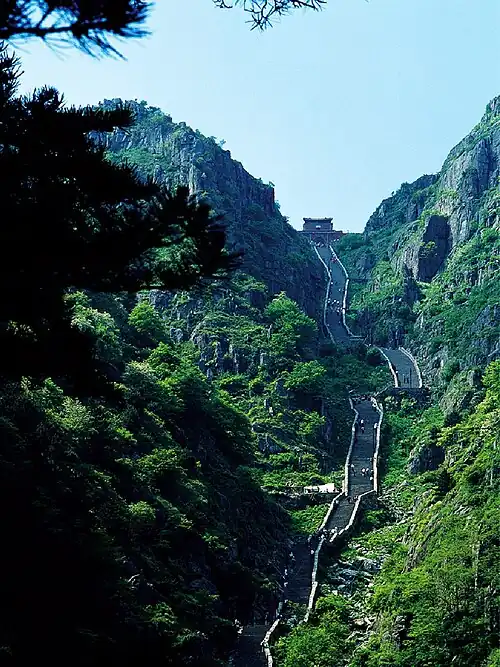
- Lianhua Mountain Scenic Area (莲花山风景区), Liujialin Village, Gaozhuang Town, ~15 km south of the city. The main peak, Lihuajian, is 999 m — the highest in all of Jinan. Han Emperor Wu reputedly sought immortals here, and the summit "Palace of Encountering Immortals" still draws Buddhist pilgrims. Hours 08:30–17:00, ¥50. Take bus 60 from the south gate of Hongshi Park (¥2).
- Xiangshan International Tourist Resort (山东香山国际旅游度å?‡åŒº), Dawangzhuang, ~30 km northwest. AAAA-rated forest mountain with the well-known "Buddha-gazing-at-the-sky" rock silhouette and a heady summer scent of wild herbs and flowers. 08:00–18:00, ¥80. Bus K206 from Laiwu Bus Terminal, then Longwei minibus. ☎ +86 0531 7658 7199.
- Huashan National Forest Park (å?Žå±±å›½å®¶æ£®æž—公园), northwestern Laiwu District, ~30 km from downtown. An offshoot of the Mount Tai range with three scenic clusters — Bailongtan, Dazhouyuan and Yongninggu — and Xiangshan Peak at 918.7 m, the highest point in the city. 87% forest cover, excellent for spring and autumn hiking. ¥20.
- Qishan National Forest Park (棋山国家森林公园), eastern Lixin Street, Gangcheng District. A 596 m peak wrapped in folklore ("one day in the mountains, a hundred years in the world") and known for its local food scene at the trailhead. Free entry; ~¥60 by taxi from downtown Laiwu.
Lakes and eco-tourism
- Xueye Tourist Area (雪野湖旅游区), northern Laiwu District. A large artificial lake ringed by fresh-fish restaurants, water-sports operators and an aviation sports centre that hosts the well-known Xueye air show. 30 min from Yaoqiang Airport, ~45 min from downtown Laiwu. Bus K204 from Laiwu Bus Terminal, ¥3.
- Fanggan Eco Tourism Area (房干生æ€?旅游区), inside the Xueye area. Four sub-sites — Jiulong Canyon and Jintai Mountain (¥52), Fantasy Lovers Valley and Shiyun Mountain (¥52), or all four (¥82). 07:00–17:00. ☎ +86 0531 7638 6366. Three express buses daily from Laiwu Bus Terminal; otherwise K204 to Shangyou (上游) and taxi the last 13 km.
Museums
Laiwu Campaign Memorial Museum (莱芜战役纪念馆), 43 Wenyang Street. The 1947 Laiwu Campaign was a pivotal Chinese Civil War battle in which the PLA encircled and destroyed several Nationalist divisions; the museum tells that story with dioramas, weapons and archival film. May–Sep 08:30–12:00 / 13:30–17:30; Oct–Apr 08:30–12:00 / 13:00–17:00, closed Mondays. Free. Buses 21, K8, K10. ☎ +86 0531 7880 5690.
Iron and Steel Museum of China (中国莱芜钢é“?å?šç‰©é¦†), 150 m south of Longtan East Street × Fenghuang Road. A genuinely unusual museum dedicated to the history of Chinese iron and steel smelting — useful context for why Laiwu exists in its modern form. Hours 09:00–11:30, 14:30–17:00. Bus 101 from Laiwu Bus Terminal to Qiansong, ¥1.
Hike Lianhua Mountain. The full circuit from base to the 999 m Lihuajian summit and back is a half-day workout; signposted stone stairs make it accessible without a guide. Best in late April for wildflowers and mid-October for foliage.
Water sports at Xueye Lake. In summer the lake operates jet-skis, banana-boats, kayaks and stand-up paddleboards from the central pier. Multiple lakeside restaurants will cook the fish you point at.
Watch the Xueye Air Show. Laiwu's aviation sports centre on the lake hosts paragliding, ultralight and hot-air balloon events through the warmer months — schedules vary year to year, but autumn is the headline season.
Ski in winter. A small ski resort operates in the hills north of the city from roughly mid-December through February, with beginner and intermediate runs and equipment rental.
Day-trip to Mount Tai. With Tai'an only 60 km away, many travellers base in Laiwu's quieter hotels and tackle Tai Shan as a single long day — 04:00 start, summit for sunrise, back for dinner.
Cycle the Wen River parks. Pick up a public bike, link Redstone → West Sea → Lianhe parks along the river, and stop for street food in between. About 12 km round trip.
Planning Laiwu? Want these on a customised itinerary?
Ask on WhatsAppWhere to eat?
Laiwu cooking is firmly in the Lu (Shandong) tradition — wheat-based staples, generous use of vinegar and scallions, plenty of pork and freshwater fish, and an unapologetic love of garlic and ginger. The city's signature dish is Laiwu sweet-sour spare ribs (莱芜糖醋里脊), but the local talking point is Laiwu black pork (莱芜黑猪), a heritage breed raised on the surrounding hills and treated with the same reverence as Iberico in Spain. Other things to seek out:
- Chopped pancake (莱芜烧饼 shÄ?obÇ?ng) — sesame-crusted, baked in a barrel oven, eaten with stewed donkey or beef.
- Wenyang fish hotpot (汶阳鱼锅) — whole carp or catfish from the Wen River, slow-stewed with tofu and vinegar.
- Xueye Lake whole fish — usually crucian carp or bighead carp, steamed or braised, served lakeside.
- Laiwu mutton soup (莱芜羊汤) — a milky bone broth eaten for breakfast with flatbread.
Recommendations across price tiers:
- Budget — Laiwu Mutton Soup stalls along Wenyang Street. Look for the queues of locals at 07:00. A bowl with flatbread runs ¥15–25. Order yáng tÄ?ng (羊汤) and huÇ’shÄ?o (ç?«çƒ§) and you cannot go wrong.
- Budget — Qishan Foothill Food Street (Gangcheng District). A cluster of family-run grill houses at the base of Qishan, famous for chicken stewed with mountain herbs. Dishes ¥30–60.
- Mid-range — Xueye Lake fish restaurants. A whole-fish dinner for two with sides and a beer typically lands at ¥150–250. Most cluster along the south shore near the K204 bus stop.
- Mid-range — Phoenix City Restaurant (凤城大酒店 dining hall), Wenhua Road area. Classic Lu-cuisine banquet hall, reliable for sweet-sour ribs and Laiwu black-pork dishes. ¥80–150 per person.
Dietary notes: Vegetarian-only restaurants are rare; ordering vegetable dishes (ç´ è?œ sùcài) à la carte at any Lu-cuisine restaurant is the standard workaround, though watch for hidden pork stock. Halal options exist around the mutton-soup stalls (look for the green crescent or 清真 signage). Gluten-free is genuinely difficult given the wheat-heavy cuisine — bring your own snacks for emergencies.
Where to drink?
Shandong is one of China's great beer provinces — Tsingtao is brewed in Qingdao a few hours east, and you will find it on every menu in Laiwu, often draught and very cheap (¥5–10 a glass). Local Laiwu Beer (莱芜啤酒) also turns up in smaller restaurants. For something stronger, the regional baijiu of choice is Trick Soju / Jingzhi and other Shandong sorghum spirits, served neat in small cups during banquets — pace yourself.
Tea culture is alive but understated: green tea predominates, and you will be poured a small cup of jasmine or chrysanthemum tea on sitting down at most restaurants. Look out for Laiwu ginger tea (莱芜姜茶), a warming infusion of the local ginger sold in sachets at markets — a useful winter purchase.
For cafés, the area around Wenhua Road and Phoenix Square has the densest cluster of chain coffee shops (Luckin, Manner) and small independents catering to a young crowd; expect ¥20–35 for a latte. Bars are scarcer than in Jinan — most nightlife happens in KTV (karaoke) parlours and hotel lounges.
Water safety: do not drink tap water. Bottled water is ¥2–4 a bottle everywhere; hotels provide kettles and free bottled water in rooms. Restaurants serve hot tea or boiled water (开水 kÄ?ishuÇ?) by default, which is safe.
Planning Laiwu? We’ll book the stays and dining for you.
Ask on WhatsAppWhere to stay?
- Budget — Hanting Hotel Laiwu Wenhua Road (汉庭酒店莱芜文化路店). Reliable national chain on the main commercial strip; clean, predictable, English-light. Doubles ¥180–250.
- Budget — 7 Days Inn Laiwu Bus Terminal (7天连é”?酒店莱芜汽车站店). Practical pick if you are arriving late by bus. Doubles ¥150–220.
- Mid-range — Vienna Hotel Laiwu (维也纳酒店莱芜店), Hongshi Road area. Comfortable mid-tier business hotel near Redstone Park, decent breakfast, good for families. Doubles ¥280–400.
- Mid-range — Jinyu Holiday Hotel (金宇å?‡æ—¥é…’店), central Laiwu District. Long-running locally owned property; large rooms, friendlier reception than the chains. Doubles ¥320–450.
- Upscale — Phoenix City Hotel (凤城国际大酒店). The headline business hotel of the city, used for government events and weddings — banquet halls, sizeable rooms, on-site Lu-cuisine restaurant. Doubles ¥450–650.
- Upscale / resort — Xueye Lake resort hotels. Several lakeside hotels in the Xueye Tourist Area target weekend travellers from Jinan, with rooms ¥500–900 and packages including boating and meals. Best in late spring and early autumn.
What should you buy?
Laiwu is not a designer-shopping destination — locals head to Jinan for that. What you can usefully pick up is food and farm produce. The "Three Treasures of Laiwu" (莱芜三辣) are the local trinity: Laiwu ginger (莱芜生姜), pungent and fibrous, prized across Shandong; Jiqi garlic (鸡腿大蒜), with its drumstick-shaped cloves; and Laiwu chilli (鸡心椒). All three are sold dried, pickled or in gift boxes at the Laiwu Vegetable Market on Wenhua Road and in supermarkets along Hongshi Road.
For sit-down shopping, the Wenhua Road and Changshao North Road commercial belt covers the standard Chinese mid-tier brands plus Laiwu's main department stores. Phoenix Square (凤城广场) is the central shopping plaza. Bargaining is normal in markets and small stalls (expect to settle around 20–30% below the asking price) but fixed-price in malls and supermarkets. Cash is widely accepted, but WeChat Pay and Alipay are dominant; set up a tourist wallet before you arrive.
Where to go next?
- Jinan (济å?—) — ~75 km / 1 hr by expressway. The provincial capital, famous for its 72 artesian springs and Daming Lake. The obvious next stop.
- Tai'an & Mount Tai (泰安 / æ³°å±±) — ~60 km / 50 min. China's most sacred Taoist mountain and a UNESCO World Heritage site; do the dawn-summit pilgrimage.
- Qufu (曲阜) — ~130 km / 1.5 hr. Hometown of Confucius, with the Kong Family Mansion, Confucius Temple and Cemetery — together a World Heritage site.
- Zibo (æ·„å?š) — ~130 km / 2 hr (or the slow 7054 train, ~4 hr). Recently famous nationwide for its barbecue (æ·„å?šçƒ§çƒ¤) street-food scene.
- Qingdao (é?’å²›) — ~370 km / 4 hr by expressway. Coastal city, German colonial architecture, the original Tsingtao brewery and Shandong's best beaches.
- Linyi (临沂) — ~180 km / 2.5 hr south. Less touristed prefecture city, gateway to the Yimeng Mountains and a major Chinese Civil War history circuit that pairs naturally with Laiwu's Campaign Memorial.
Nearby in Shandong Sheng
More places to explore around Laiwu.

Guide content as of May 2026. Portions adapted from Wikivoyage, CC BY-SA 4.0.

Contact Us
Get in touch with us.
Get in touch
Contact Us
Tell us where you'd like to go and how you like to travel. A real Tripcuro planner — not a bot — will craft an itinerary around you.
- Personalised, hassle-free planning end-to-end
- Transparent pricing, no hidden costs
- 24/7 support for complete peace of mind