
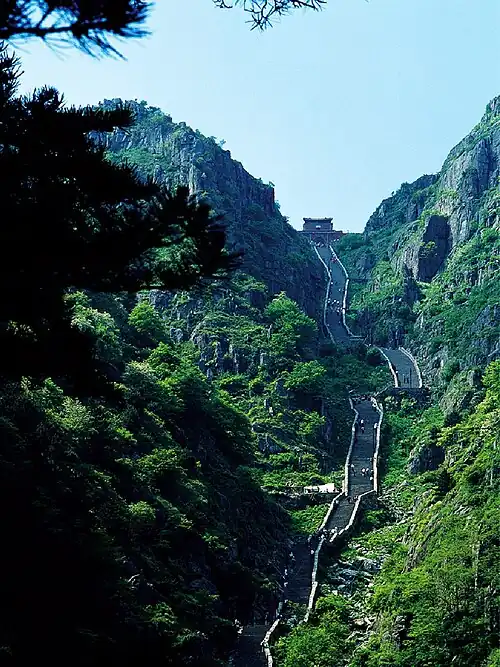
Mount Tai
Shandong Sheng, China
Why visit Mount Tai?
Mount Tai (Tài Shān), rising over 1,500 m above the plains of central Shandong just north of Tai'an city, is the foremost of China's Five Great Mountains and arguably the most culturally significant peak in the country. For more than three millennia, Chinese emperors made the pilgrimage here to perform the feng and shan sacrifices, ritual acts believed to confirm their Mandate of Heaven. Confucius is said to have climbed it, and Du Fu wrote one of Chinese poetry's most famous verses about it. UNESCO inscribed Mount Tai as a Mixed Cultural and Natural World Heritage Site in 1987 — one of a very small number of sites worldwide to satisfy the majority of the possible listing criteria. It remains the most-climbed mountain in China, threaded with stone staircases, carved inscriptions, Taoist and Buddhist temples, and small shrines worn smooth by centuries of footfall.
The classic experience is the night ascent: hikers start late and time the climb to reach the summit before dawn, joining a crowd huddled in rented coats to watch the sun lift over the sea of cloud. The traditional "four wonders" of Tai Shan — sunrise from the peak, the golden glow of sunset, the distant Yellow River shining in the morning light, and a sea of clouds below the ridges — are all best caught in clear, dry weather. Climate is continental: cold and often snowy on top from December through February (the summit runs noticeably colder than Tai'an below), pleasantly cool and green from late April to June, hot and crowded with domestic tourists in July–August, and at its most beautiful in September–October when skies clear and foliage turns. Avoid the Chinese national holidays in early May and early October, when the staircases become very crowded and summit accommodation rates rise sharply.
The mountain itself splits roughly into three zones for visitors: the base around Dai Temple in northern Tai'an, the Midway Gate to Heaven where the road, bus and lower cable car meet, and the summit village clustered around the South Gate to Heaven, where the hotels, restaurants and viewing platforms are.
Planning Mount Tai? Tell us your dates and we’ll tailor the trip.
Ask on WhatsAppHow do you get there?
By Plane
The nearest major airport is Jinan Yaoqiang International Airport (TNA), roughly 80 km north of Tai'an. From the airport, shuttle buses run to Tai'an several times daily; taxis are also available. Qingdao Liuting (TAO) further east is an alternative if combining the trip with the coast, though the onward journey to Tai'an takes several hours.
By Train
Tai'an has two stations and you should know which one your ticket is for:
- Tai'an Railway Station (old station) in the city centre, served by conventional trains. A local bus runs from here toward the Red Gate trailhead area.
- Tai'an West / Taishan Station on the Beijing–Shanghai high-speed line, several kilometres west of the city — take a taxi or city bus into town.
High-speed trains from Beijing South reach Tai'an in around two hours; from Shanghai it's around four hours; from Jinan just twenty minutes; from Qingdao around three and a half hours. Older overnight trains from Beijing still run for budget travellers, but high-speed services are now overwhelmingly the better option. Book through 12306 or a travel platform a few days ahead during weekends and holidays.
By Car / Road
Tai'an sits on two major national expressways. Drive times: Jinan around an hour, Qufu around 45 minutes, Qingdao around four hours, Beijing five to six hours. Roads are modern and well-signed; tolls apply. Long-distance coaches from Beijing, Jinan, Qingdao and Qufu use Tai'an's long-distance bus station, but with high-speed rail so fast, coaches are now mostly a fallback.
In Tai'an city, local buses run at flat, low fares. The route most travellers need links the railway station with the main trailhead area near the Red Gate. Taxis are metered and inexpensive for a cross-town ride. Didi (滴滴出行) works in Tai'an for ride-hailing — you'll need a Chinese mobile number or a payment-enabled WeChat/Alipay account.
On the mountain, your options are:
- Hike — stone-paved staircases the entire way. The classic east route from the Red Gate to the South Gate to Heaven runs several kilometres and thousands of steps; allow four to six hours up at a moderate pace, longer if you stop for tea and inscriptions.
- Scenic-area buses run from the base up to Midway Gate to Heaven (Zhongtianmen).
- A cable car runs from Zhongtianmen to near the South Gate to Heaven. It shuts during thunder or strong wind, so always check the forecast before counting on it for the descent.
Watch out for: vendors near the trailheads, "guides" offering to carry you up in sedan chairs at a quoted (and negotiable) price, animals used as photo props, and accommodation touts who meet you at the top and quote inflated rates. Negotiating is normal everywhere on the mountain.
What are the things to do?
- Dai Temple — the grand Taoist temple complex at the base of the mountain in Tai'an, where emperors traditionally prepared for their ascent. Vast courtyards, centuries-old cypresses, and a Song-dynasty hall with murals depicting the god of Mount Tai.
- Red Gate — the classical starting point of the pilgrim's route, with an archway and early temple buildings clustered at the foot of the stairs.
- Early waypoints on the ascent are rich in Taoist statuary, including a tower and a palace dedicated to a stellar deity.
- A short detour off the main path leads to a sloping rock face where a Buddhist sutra is carved in massive characters.
- Midway Gate to Heaven (Zhongtianmen) — roughly halfway up, where buses arrive and the lower cable car station sits. Tea shops, snack stalls and the start of the steepest section.
- Path of Eighteen Bends — the brutal final ascent, with well over a thousand near-vertical steps climbing to the South Gate to Heaven. Don't be embarrassed to take it slow.
- South Gate to Heaven — the dramatic stone arch marking arrival on the summit ridge.
- Heaven Street — the summit "village," a stone-paved lane of shops, guesthouses and shrines.
- Bixia Temple — the summit Taoist temple to the Princess of the Azure Clouds, daughter of the god of Tai Shan, much visited by Chinese pilgrims praying for family and children.
- Jade Emperor Peak — the actual summit, marked by a stele proclaiming it the highest peak among the Five Great Mountains.
- Sun-Viewing Peak — the traditional sunrise platform, a short walk east of the summit hotels.
- Stone inscriptions — Tai Shan is essentially an open-air epigraphic museum; well over a thousand carved inscriptions line the route, including imperial proclamations, poems and dedications spanning two millennia.
Entry: a combined scenic-area ticket covers most of the route, with a separate cable-car fare; prices vary by season and a student rate is often available.
- Make the night climb to catch sunrise. Start from the Red Gate late in the evening, climb steadily with a head torch, reach the summit a couple of hours before dawn, and find a spot on Sun-Viewing Peak to wait, renting a thick coat if you need one. This is the iconic Tai Shan experience.
- Climb by day, sleep on top, descend at dawn. A gentler version: hike up across the afternoon, eat dinner at Heaven Street, sleep in a summit guesthouse, watch the sunrise, then descend.
- Take the lazy ascent. Bus to Zhongtianmen, cable car to the summit, do a loop of the major shrines, then reverse the trip. Good for travellers with limited time or mobility issues.
- Descend by an alternative route. A quieter trail down the back, west side of the mountain passes waterfalls and pine forest and ends at a different scenic-area gate.
- Pay your respects with a red ribbon or padlock. Pilgrims buy red headbands or inscribe wishes onto small padlocks fixed to chains along the summit railings.
- Visit the springs and stone forest on the western route.
Planning Mount Tai? Want these on a customised itinerary?
Ask on WhatsAppWhere to eat?
Shandong (Lu) cuisine is one of the four great regional schools of Chinese cooking, leaning toward braising, wheat-based staples, vinegar, garlic and seafood from the nearby coast. On the mountain itself the food is utilitarian — instant noodles, steamed buns, hard-boiled eggs and snacks — and prices climb with the altitude. For a proper meal, plan around Tai'an city.
Signature dishes to look for: a local version of the Shandong wheat-crepe, brushed with sweet bean paste and wrapped around raw spring onion and a fried egg, sold from carts on the mountain; a Tai'an layered hotpot casserole of pork, tofu, mushroom and vegetables; and a delicate stew of white cabbage, tofu and Tai Shan spring water known locally as "the three beauties." Vegetarians do well in Tai'an thanks to the strong Buddhist-Taoist tradition; halal noodle and lamb shops cluster near the train station.
- Mountain trail carts sell the crepe snack described above along all routes — cheap, hot, salty, oniony fuel for the climb.
- Restaurants around the old town near Dai Temple serve mid-range Lu cuisine, good places to try the local hotpot and tofu stew.
- Food alleys east of Dai Temple offer sit-down skewer joints, lamb noodle soup and dumpling houses.
- Heaven Street summit canteens sell set menus and rice plates at a tourist mark-up; a hot meal after a night climb is worth the cost regardless.
Where to drink?
Tai'an isn't a nightlife city — pilgrims and hikers turn in early. A local lager brewed in Tai'an is the obvious thing to order with dinner, served everywhere from street stalls to hotels. Stronger drinking means baijiu — Shandong's regional brands are rough sorghum spirits drunk in shot-glass toasts.
On the mountain itself, drink is mostly about staying watered: vendors line the trail selling bottled water, sports drinks, Tai Shan green tea and instant coffee. A teahouse roughly halfway up is a traditional rest stop.
In Tai'an proper, a cluster of cafés and bars has grown up around the old town and Dai Temple's north square — your best bet for a sit-down drink. Tap water is not safe to drink anywhere in China — stick to bottled or boiled water, which all hotels provide in flasks in your room.
Planning Mount Tai? We’ll book the stays and dining for you.
Ask on WhatsAppWhere to stay?
Budget
- Hostels near the trailhead offer dorm beds and simple private rooms; an easy taxi ride from the railway stations.
- Summit guesthouses on Heaven Street offer bare-bones rooms, often at higher rates than you'd expect given the quality — you're paying for proximity to Sun-Viewing Peak at dawn. Hot water is typically only available for a short evening window; confirm before paying.
Mid-range
International-standard and modern Chinese mid-scale chain hotels are found in central Tai'an within walking distance of Dai Temple.
Upscale / heritage
- A long-established three-star hotel just above the Confucius Temple area on the summit is the most established option on top of the mountain, with hot water around the clock, an on-site restaurant and the only buffet breakfast on the summit. Expect rates to rise sharply during national holidays.
- International hotel brands in Tai'an city offer full-service luxury for travellers who want civilization waiting for them after they descend.
What should you buy?
The base of the mountain and Heaven Street on top are lined with the standard Chinese tourist-mountain inventory: jade pendants of dubious provenance, dried mountain herbs, Taoist talismans, walking sticks and Tai Shan souvenirs. A few things are worth buying:
- Red blessing headbands and ribbons, commonly worn or tied to the summit chains for long life and prosperity.
- Stone rubbings of mountain inscriptions and calligraphy, sold in shops near Dai Temple.
- Carved Tai Shan stone, small pieces engraved with a traditional house-protection charm ("Tai Shan stone steadies all").
- Local dried produce — wild jujubes, walnuts and chestnuts from the surrounding hills.
Bargaining is expected at all stalls and many shops on the mountain; opening prices are routinely well above what locals pay. Fixed-price shops in Dai Temple and the better hotel arcades are an exception.
Where to go next?
- Qufu — Confucius's birthplace, with the Confucius Temple, Cemetery and Mansion, all UNESCO-listed. A short train ride away, and the natural pairing with Tai Shan.
- Jinan — Shandong's provincial capital, famed for its springs and Daming Lake, a short high-speed train ride away.
- Qingdao — coastal city with German colonial architecture, beaches and the original Tsingtao Brewery.
- Mount Lao — a coastal Taoist mountain east of Qingdao, a quieter complement to Tai Shan.
- Linyi and the Yimeng Mountains — less-visited rural Shandong, with revolutionary-history sites and dramatic karst landscapes.
- Beijing — Tai Shan's classic gateway; pair Tai Shan with the Temple of Heaven for a complete arc of imperial ritual.
Nearby in Shandong Sheng
More places to explore around Mount Tai.

Guide content as of July 2026. Portions adapted from Wikivoyage, CC BY-SA 4.0.

Contact Us
Get in touch with us.
Get in touch
Contact Us
Tell us where you'd like to go and how you like to travel. A real Tripcuro planner — not a bot — will craft an itinerary around you.
- Personalised, hassle-free planning end-to-end
- Transparent pricing, no hidden costs
- 24/7 support for complete peace of mind