
Laiyang
Shandong Sheng, China
About Laiyang
Laiyang (莱阳) is a county-level city of roughly 795,000 people sitting in the middle of the Shandong Peninsula, administered under Yantai prefecture. Its history runs deep: this was the land of Laiyi under the Xia, Laiguo under the Shang, and was absorbed into Qi in 567 BC after Duke Xiang of Lu's sixth year. The city's modern reputation, however, rests on two very different pillars — the orchards that earned it the nickname "City of Pears," and the chalky Cretaceous badlands south of town where China's first complete dinosaur skeleton, Tsintaosaurus spinorhinus, was excavated in 1951. For a small inland city, Laiyang punches well above its weight in fossil heritage, fruit culture, and the gentle hill-and-gully scenery that defines the peninsula's interior.
The climate is a continental monsoon variant of the northern temperate zone — four sharp seasons. Winters are cold, dry, and slightly humid (January averages -7 °C to 3 °C); summers are warm, wet, and rainy, with July and August together delivering over 330 mm of precipitation. Spring (April–May) is the headline season: pear blossom in the Zhaowangzhuang orchards turns the western townships white, and the Pear Blossom Festival anchors the local tourism calendar. Autumn (September–October) is the other prime window — clear skies, mild days, and the apple and pear harvest in full swing. Avoid late June through August if you dislike humidity and downpours.
Laiyang Subdistrict is the administrative and commercial core — most hotels, restaurants, and the long-distance bus station sit here. The interesting countryside fans out from it: Lügezhuang Town to the south for the Cretaceous Geopark, Zhaowangzhuang Town to the west for the pear orchards and Li Xiang travel zone, and a ring of agricultural townships (Zhuwu, Fenggezhuang, Yangjiabu, Shaojia) where orchard picking and folk-craft visits are the draw. You will not exhaust the city in a day; two nights is the realistic minimum to combine the geopark with the orchards.
Planning Laiyang? Tell us your dates and we’ll tailor the trip.
Ask on WhatsAppHow to reach
By Plane
The nearest airport is Yantai Penglai International Airport (YNT), about 90 km northeast of Laiyang. From the airport, the most reliable onward route is to take an airport shuttle or taxi into Yantai city, then continue by high-speed train (about 30 minutes to Laiyangbei) or by intercity bus from Yantai's long-distance bus station (around 2 hours).
By Train
Laiyang has two stations and you should pick carefully — they are not close to each other.
- Laiyang Station (莱阳站), No. 1 Jingshan Road, ☎ +86 0535 7316534, open 06:00–22:00. The older station, an intermediate stop on the Lanyan and Qingrong intercity lines. Best for conventional services and convenient to the city centre.
- Laiyangnan Station (莱阳�站), northeast of Hucheng Village, Gaogezhuang Town, ☎ +86 0535 6258998, open 06:00–22:00. An intermediate station on the Laiyang–Rongcheng high-speed line. Faster long-distance services land here, but it's well outside town — budget for a taxi.
High-speed trains from Yantai take about 30 minutes; services from Qingdao and Weihai are also routine. Book via the 12306 app or a Chinese travel agent; foreign passports are accepted at station ticket windows with the original document.
By Car / Road
From Qingdao, the standard self-drive route follows the Qingyin Expressway (G18 Rongwu) roughly 120 km — about 2 hours 5 minutes in normal traffic. From Yantai, expressway and surface combinations bring you in under 2 hours.
The S16 Rongwei Expressway between Laiyang and Weifang is undergoing a renovation and expansion project at the time of writing — expect partial closures, single-lane stretches, and slower transit on that corridor; allow extra time.
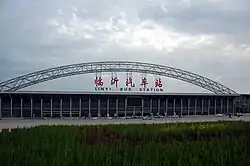
Long-distance buses converge on Laiyang Central Bus Station in town, with frequent services to Yantai (around 2 hours) and onward into the peninsula. The Central Bus Station is also the jumping-off point for local buses bound for Lügezhuang (for the Geopark) and the outlying townships.
Laiyang is compact by Chinese standards and the city centre is broadly walkable along Wenhua Road and the Xian River park strip. For anything beyond the core:
- Taxis are the path of least resistance. The flagfall is low and crossing the urban area rarely tops a modest fare; drivers expect cash, though many will accept WeChat Pay or Alipay.
- City buses run from the Central Bus Station and along the main arteries; routes and timings are posted at stops and on local tourism apps, but signage is almost entirely in Chinese. Useful for the Geopark run if you don't mind the time.
- Didi (滴滴出行) works in Laiyang and is the easiest option if you have a Chinese phone number and a working payment method linked.
- Self-drive is realistic if you already have a Chinese licence — Wenhua Road and the expressway approaches are in good shape. Parking is plentiful outside the immediate downtown.
Watch for the usual small-city issue of taxis "not running the meter" for out-of-town tourists; insist on the meter (打表 dǎ biǎo) or agree the fare before getting in.
Things to do
Laiyang Cretaceous National Geopark (莱阳白垩纪国家地质公å›) — Jingangkou Village, Lügezhuang Town; ☎ +86 535 7986789 / +86 535 7551001; [email protected]. The headline sight: a fossil-rich Cretaceous landscape where the complete skeleton of Tsintaosaurus spinorhinus — the duck-billed dinosaur named for nearby Qingdao — was excavated in 1951. The park includes a large fossil museum, a petrified-wood garden assembled from specimens worldwide, and the original excavation pit. Normal hours 08:30–17:00; general entry is free, the museum is Â¥40, the petrified-wood garden Â¥30, combo ticket Â¥50. From the Central Bus Station take a bus bound for Lügezhuang (å?•æ ¼åº„) or Xuanfang (ç©´å?Š) and alight at Jingangkou. Note: as of March 2022 the park was reported temporarily closed — call ahead before making the trip.
Li Xiang Style Travel Zone (梨乡风情旅游区) — Zhaowangzhuang Town; ☎ +86 535 7619638. Open 24 hours, free admission. The cradle of the Laiyang pear and the main venue of the annual Pear Blossom Festival and Laiyang Pear Cultural Festival. The orchards cover more than 10,000 mu, with the venerable "Pear Tree King" and "Gong Pear Tree" reckoned at over 400 years old. The zone bundles more than ten sub-attractions — Shuanghe Pond, Lilac Courtyard, the Cultural Monument Corridor, Wedding Square, the Folk Museum, Four Seasons Garden, Guanyun Bridge — alongside seasonal activities including the Pear Champion Selection and orchard self-picking. Best visited in April for blossom or September–October for harvest.
Xianhe Park (蚬河公å›) — Jingqi Road, Chengxiang Street. Open 05:00–17:00, free. A long, comprehensive park hugging the Xian River, designed around spring blossom with pear flowers as the centrepiece. More than 100 species of garden plants, 54 landscape installations, walking trails, lakes, and broad green space. Best at dawn for the local tai chi and morning-exercise scene.
Laiyang Pear Orchards (general) — Throughout the western and southern townships of Zhuwu, Fenggezhuang, Zhaowangzhuang, and Xiaojiazhuang. The defining Laiyang experience: the city is so heavily planted that "City of Pears" is no exaggeration. Self-picking is welcomed at most orchards in season.
Pear Blossom Festival (梨花节) — usually April, centred on Li Xiang Travel Zone in Zhaowangzhuang. Open-air performances, food stalls, and orchard walks under the white canopy. This is the single best week to be in Laiyang.
Laiyang Pear Cultural Festival — September/October at the same venue, timed to the harvest. Fruit-judging, the Pear Champion selection, farmhouse meals, and orchard self-picking.
Orchard self-picking (采摘) — apples in particular, alongside pears and grapes, are the harvest mainstays in Zhuwu, Xiaojiazhuang, and Beigou townships from late August through October. Pay by the jin (500 g) at the orchard gate.
Fossil-hunting and palaeontology day at Lügezhuang — combine the Geopark museum with a walk through the excavation pit and the petrified-wood garden; a half-day, easily.
Yangjiabu folk-craft visit — Yangjiabu Town is the local centre for traditional handicrafts and folk art, worth a stop for woodblock-style prints and paper-cuts when workshops are open.
Hiking the low hills — Laiyang's terrain is gentle hill country with crisscrossing gullies rather than dramatic peaks; pleasant cool-weather walking territory in spring and autumn.
Planning Laiyang? Want these on a customised itinerary?
Ask on WhatsAppFood & Dining
Laiyang's food scene tracks Shandong cuisine (��) broadly: wheat-based staples (mantou, jiaozi, hand-pulled noodles), seafood arriving in volume from the Yantai coast, generous use of scallion and garlic, and braised pork and lamb dishes. The local twist is pear — incorporated into desserts, sauces for duck and pork, and the famous pear paste.
Signature things to seek out:
- Laiyang pear in every form — fresh, candied, in sweet soups, paired with pork ribs.
- Shandong-style jiaozi — particularly seafood-and-pork or fennel-and-pork varieties.
- Coastal seafood — though inland, Laiyang is close enough to Yantai's docks that prawns, clams, and small fish are routine on menus.
- Stewed pork with pear (梨炖肉) — a regional home-style dish worth asking for.
For practical purposes, the densest concentration of restaurants is along Wenhua Road and the streets immediately around Laiyang Central Bus Station; orchard farmhouse meals (nongjiale, 农家�) in Zhaowangzhuang and the surrounding townships are the more memorable experience and run around ¥40–80 per person for a multi-dish spread. Vegetarian options exist but are not a Shandong strength — expect to order around meat dishes rather than from a dedicated veg menu. Halal (qingzhen, 清真) restaurants are present but sparse; look for the green crescent signage.
Cafes & Nightlife
Laiyang's drinks culture leans local and unfussy. The northern Chinese staples apply: green tea through the day, baijiu at the dinner table, and Tsingtao (�岛啤酒) — brewed an hour and a bit down the road in Qingdao — as the default beer. Shandong is a serious baijiu province; local brands sit alongside the national names on most restaurant tables.
The local angle worth knowing:
- Laiyang pear juice and pear paste drinks — sold bottled at supermarkets and orchard shops; the paste, diluted with hot water, is the traditional sore-throat remedy.
- Yantai-region wine — Shandong's Jiaodong Peninsula is China's most established wine region; Yantai bottles (Changyu, Chateau Junding) turn up on better restaurant lists.
Café culture in Laiyang is thin compared with Yantai or Qingdao; you'll find a handful of chain coffee shops along Wenhua Road and inside the larger hotels.
Tap water is not drinkable. Stick to bottled water (¥2–3 for 500 ml at any convenience store) or boiled water — every hotel room provides a kettle.
Planning Laiyang? We’ll book the stays and dining for you.
Ask on WhatsAppPlaces to Stay
- Budget: Small guesthouses (kuaijiedian, å¿«æ?·åº—) and chain budget hotels — 7 Days Inn (7天连é”?酒店) and Hanting (汉åº) both operate properties in the Laiyang Subdistrict core. Rates typically Â¥120–200 per room per night. Foreign-passport registration can be patchy at the cheapest tier; ask before booking.
- Mid-range: Chain mid-tier brands such as Jinjiang Inn Select (锦江之星) and similar business hotels cluster near Laiyang Station and along Wenhua Road; rates roughly ¥250–450 per night, with breakfast usually included.
- Upscale: Laiyang does not have international-brand five-stars. The top tier is local four-star business hotels in the urban core, typically ¥500–800 per night. For genuine luxury, base in Yantai or Qingdao and day-trip in.
What to buy
The local specialty is, unsurprisingly, the Laiyang Chi Pear (莱阳茌梨) — also written Laiyang pear — one of Shandong's traditional rare cultivars, prized for its crisp flesh, thin skin, and high juice content. Boxed gift packs are sold at orchard gates and along the highways into town during harvest; the boxed grade for gifting is significantly better than what shows up in supermarkets elsewhere in China.
Beyond fresh fruit, look for:
- Dried Laiyang pear and pear paste (梨�) — a traditional preparation marketed for sore throats; widely sold at orchard shops and pharmacies.
- Yangjiabu folk crafts — woodblock prints, paper-cuts, and other handmade work from Yangjiabu Town's traditional workshops.
- Apples, grapes, and apple-derived products — the agricultural townships produce these in volume; roadside stalls during harvest sell at well below city-market prices.
Bargaining at orchards and roadside stalls is light — knock 10–20% off the asking price and expect a friendly back-and-forth. In supermarkets and modern shops, prices are fixed. WeChat Pay and Alipay are accepted almost everywhere; foreign cards are not.
Go next
- Yantai (烟�) — about 30 minutes by high-speed train or 2 hours by bus. Coastal city, the prefectural capital, Penglai Pavilion and the historic Zhifu Island.
- Qingdao (�岛) — about 120 km / 2 hours by expressway, faster by HSR. Tsingtao Brewery, the German colonial old town, and the best urban beach scene in Shandong.
- Weihai (�海) — eastern tip of the peninsula, reachable on the Laiyang–Rongcheng HSR line. Clean coastline and the Liugong Island naval-history site.
- Penglai (蓬莱) — north of Yantai, about 2.5 hours total. The legendary "Eight Immortals" coastline and Penglai Pavilion, one of China's four great towers.
- Weifang (��) — west along the S16 corridor (allow extra time for the expressway works). The kite capital of China and host of the International Kite Festival each April.
- Rongcheng (��) — terminus of the HSR line through Laiyangnan. Swan Lake at Yandunjiao in winter draws photographers from across the country.
Nearby in Shandong Sheng
More places to explore around Laiyang.
Portions adapted from Wikivoyage, CC BY-SA 4.0.

Contact Us
Get in touch with us.
Get in touch
Contact Us
Tell us where you'd like to go and how you like to travel. A real Tripcuro planner — not a bot — will craft an itinerary around you.
- Personalised, hassle-free planning end-to-end
- Transparent pricing, no hidden costs
- 24/7 support for complete peace of mind