
Huangmei
Hubei Sheng, China
Why visit Huangmei?
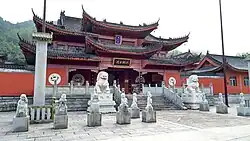
Huangmei (黄梅) is a county-level town in the far eastern corner of Hubei Province, wedged against the Yangtze River where Hubei meets Anhui and Jiangxi. For a place barely on the foreign-tourist radar, Huangmei punches well above its weight in Chinese cultural memory: it is the cradle of Huangmei opera (黄梅æˆ?), the lyrical "tea-picking song" form that grew out of local folk tunes and went on to become one of China's five great operatic traditions. It is also one of the holiest landscapes in Chan (Zen) Buddhism — the Fourth and Fifth Patriarchs of the Chan school both taught in the green hills just north of town, and Huineng, the Sixth Patriarch whose teachings shape Zen across East Asia today, received transmission here at Wuzu Temple.
The county seat itself is a workaday Chinese small city — broad avenues, tile-fronted shophouses, motor-pedicabs weaving through traffic — and most visitors use it as a base for the temple mountains rather than a destination in its own right. The real draw is what surrounds it: terraced tea fields, the wooded ridges of Dongshan (East Mountain) and Shuangfengshan (Double Peak Mountain), and a string of working monasteries that still keep the old rhythms of bell, incense and chant.
Huangmei has a humid subtropical climate. Spring (April–May) is the sweet spot: tea harvest is on, temple azaleas are out, and the haze lifts off the mountains. Autumn (October–early November) is similarly pleasant and drier. Summers are hot, sticky and prone to heavy Yangtze-basin rain through June and July; winters are cold, damp and grey, though rarely snowy.
Planning Huangmei? Tell us your dates and we’ll tailor the trip.
Ask on WhatsAppHow do you get there?
By Plane
The nearest airport is Jiujiang Lushan Airport (JIU) (ä¹?江åº?山机场), about 40 km south across the Yangtze in Jiangxi Province. It handles domestic-only flights to hubs including Beijing, Shanghai, Guangzhou, Shenzhen and Kunming. Operating hours are roughly 06:00–19:30. A taxi or pre-booked car from the airport to central Huangmei takes about an hour and costs in the region of ¥150–200; there is no direct airport bus, so most arrivals taxi to Jiujiang Railway Station and continue from there.
For more frequent connections, Wuhan Tianhe International Airport (WUH), about 220 km west, is the more practical option — pair it with the high-speed train into Huangmei East.
By Train
Huangmei has two stations:
- Huangmei East Railway Station (黄梅东站) — the high-speed rail station, on the Hefei–Anqing–Jiujiang HSR corridor. This is what you want. Frequent G- and D-trains link Wuhan (about 1h 40m), Nanchang (about 1h), Hefei (about 2h) and Jiujiang (about 20 minutes). Onward connections to Shanghai Hongqiao run via Hefei or Nanjing in roughly 4–5 hours.
- Huangmei Station (黄梅站) — the older conventional-rail station at the junction of the Beijing–Jiujiang and He'an–Jiujiang lines. Hours roughly 06:00–22:30. Slower but cheaper, useful for sleeper services to more distant cities.
Book through the 12306 app (the only official seller; foreign passports are accepted with a verification step) or via Trip.com for an English interface. Bring your passport — it doubles as your ticket at the gates.
By Car / Road
Huangmei sits on the G50 Shanghai–Chongqing Expressway and the G70 Fuyin Expressway, making it an easy road trip from much of the central Yangtze region. Approximate drive times in good conditions: Wuhan ~3h 30m (220 km), Hefei ~3h (240 km), Jiujiang ~45m (50 km, crossing the Yangtze on the Jiujiang Bridge), Huanggang ~1h 30m (120 km).
The main long-distance bus terminal is Huangmei Passenger Terminal (黄梅客è¿?ç«™) at No. 88 Huangmei Avenue, open 06:00–19:30, with frequent departures to Wuhan, Jiujiang and Huanggang. Long-distance buses are the cheapest way in — a Wuhan–Huangmei seat is typically under ¥100 — but slower and less comfortable than the high-speed train.
Huangmei town is small and largely walkable across its main commercial strip along Huangmei Avenue and Wuzu Avenue. Motor-pedicabs (三轮车) are the local default: flag one down and negotiate before getting in — short hops within town are usually ¥5–10. Metered taxis exist but are thin on the ground; expect a ¥6–8 flagfall.
DiDi (滴滴出行) ride-hailing works in Huangmei and is the easiest option for non-Chinese speakers since the destination goes in by map pin. You will need a Chinese phone number or a linked international payment method (Alipay's "DiDi" mini-program accepts foreign cards).
For the temples in the hills north of town, you'll need a car. Day-hire taxis from the town centre to do a Wuzu/Sizu loop run roughly ¥300–400 — agree the route, waiting time and price up front. There is no public transport directly to the temple gates, though a shuttle bus from the Wuzu Tourist Center to Wuzu Temple runs every half hour (¥15, about 15 minutes) since vehicle access to the temple road was closed in 2019.
Watch for the usual small-city scams: unmetered taxis quoting tourist prices, and pedicab drivers "forgetting" the agreed fare on arrival. Settle the number, in writing on a phone screen if needed, before you set off.
What are the things to do?
Chan Buddhist temples (the headline attraction — all in the mountains north of town):
- Wuzu Temple / Gozo-ji (五祖寺), 100m west of 059 Township Road, Wuzu Town. The monastery of Hongren, the Fifth Patriarch of Chan, on East Mountain (Dongshan/Tungshan). This is where Huineng, the future Sixth Patriarch, received Hongren's robe and bowl in the 7th century — a foundational moment for Zen across China, Korea and Japan. Hours 08:00–16:30. Entry ¥15. Cars stop at the new tourist center in Wuzuzhen Village; take the half-hourly shuttle (15 minutes) up to the temple gate.
- Sizu Temple / Fourth Patriarch Temple (四祖寺), Sizu Temple Road, on Shuangfengshan (Double Peak Mountain). The seat of Daoxin, the Fourth Patriarch, founded in the early Tang. The setting — mist, old cedars, a working monastic community — is arguably more atmospheric than Wuzu. Hours 08:00–17:00. Entry ¥10.
- Laozu Temple (è€?祖寺), set among hill tea gardens beside a small lake further into the same range. Quieter and less visited; ask your driver to add it to a Sizu day-trip.
In town:
Guta (å?¤å¡”) — a historic Buddhist pagoda in the centre of Huangmei, a quick stop on a walk through the old town.
Huangmei Opera Museum (黄梅æˆ?å?šç‰©é¦†), No. 123 Huangmei Avenue. The official memory-keeper of the local opera tradition: costumes, instruments, video archives, and panels tracing Huangmei opera's spread from these tea hills to the national stage. Hours 09:00–17:00. Free.
See Huangmei opera performed. The form is famous across China for its lilting, conversational melodies — closer to folk song than the percussive grandeur of Beijing opera. Performances are seasonal and often tied to local festivals; ask at the Opera Museum or your hotel about scheduled shows at municipal cultural venues.
Walk the temple mountains. Both Sizu and Wuzu sit in proper hill country with stone-paved pilgrim paths leading higher up the ridges past pavilions, springs and rock inscriptions. A half-day at each is reasonable; pack water and decent shoes.
Tea-garden visits. The hills around Laozu Temple and Wuzu are working green-tea country. In April and early May you'll see hand-picking under way; some farms welcome casual drop-ins for a tasting.
Day-trip across the Yangtze to Jiujiang and Lushan. Jiujiang's old riverfront and Lushan National Park, a UNESCO-listed mountain resort, are within easy reach (see Go Next).
Vegetarian retreat day at Wuzu or Sizu. Both monasteries offer simple temple lunches and, by arrangement, short stays for those interested in Chan practice.
Planning Huangmei? Want these on a customised itinerary?
Ask on WhatsAppWhere to eat?
Huangmei eats like the rest of eastern Hubei: rice rather than noodles as the staple, freshwater fish from the Yangtze and its lakes, a love of pickles and chillies, and a strong vegetarian tradition borrowed from the temples. Most action clusters along Huangmei Food Street and around the night-market end of Huangmei Avenue.
- Yuanfu Daotian Train Restaurant (è¢?夫稻田), Yong'an Dahe (☎ +86 173 9821 2903). The town's quirky favourite — a converted, permanently parked train set among rice paddies and a duck pond, with a small youth hostel in one of the sleeper cars and rooms for rent nearby. Mains and shared dishes ¥300–800 for a small group.
- Huangmei Tofu Skin (黄梅豆皮), stalls along Huangmei Food Street, 07:00–21:00. The signature street snack: a thin rice-batter pancake, crisp outside, soft inside, eaten with chilli or garlic sauce. ¥10–20.
- Buddhist Vegetarian Meals (佛教素斋), Suzhai Hall at Wuzu Temple, 09:00–18:00. Light, herb-forward temple cooking — fresh vegetables, bean curd, mountain mushrooms — served in calm courtyard settings. ¥30–50. Naturally vegetarian; vegan-friendly if you skip the egg dishes.
- Huangmei Crisp Pastry (黄梅酥饼), bakeries around the town centre, 08:00–20:00. Golden, flaky shortcakes with red-bean or sesame fillings — the local afternoon-tea staple, ¥10–15.
Halal and gluten-free options are limited; vegetarians, by contrast, are well served thanks to the temple food culture.
Where to drink?
Tea is the everyday drink and Huangmei takes it seriously.
- Huangmei Green Tea (黄梅绿茶) — the classic local cup, fresh and slightly sweet. Tea houses and specialty shops, ¥5–20 a serving, hours roughly 09:00–19:00.
- Huangmei Black Tea (黄梅红茶) — fuller-bodied, pairs well with the local pastries. ¥10–30.
- Huangmei Flower Tea (黄梅花茶) — made from locally grown flowers; floral, light, popular as a daytime drink. ¥15–40.
For something stronger:
- Huangmei rice wine (米酒) — sweet, low-alcohol, traditionally served warm with food. Try it at Huangmei Country Restaurant (黄梅乡æ?‘饭馆), hours 10:00–21:00. ¥10–30.
- Yellow plum wine (黄梅梅å?é…’) — a fruit wine made from local plums, sweet with a clean tartness, low-alcohol and easy drinking. ¥20–50.
Water: as elsewhere in mainland China, do not drink the tap water. Bottled water is universally available and cheap (¥2–3 a bottle); restaurants and hotels supply boiled water freely.
Planning Huangmei? We’ll book the stays and dining for you.
Ask on WhatsAppWhere to stay?
Mid-range
- Royal Hotel (皇家大酒店), No. 500 Huangmei Avenue (☎ +86 713 335 2888). A four-star property on the main avenue with comfortable rooms, an in-house restaurant and a quiet feel — the most reliable mid-range pick in town. Roughly ¥300–500/night.
Upscale
- Huangmei Liwen Hotel (黄梅丽文大酒店), No. 352 Wuzu Avenue (☎ +86 713 351 8777). Modern design, larger rooms, near the Huangshang Shopping Center; the better-equipped option for business travellers. Roughly ¥500–800/night.
What should you buy?
Huangmei has three local specialties worth carrying home:
- Huangmei silk (黄梅ä¸?绸) — a centuries-old handicraft producing soft, durable silk used for clothing, scarves and bedding. Prices range from about ¥200 for a scarf to ¥1,000+ for finer pieces. Look in the handicraft market in the town centre; hours typically 10:00–18:00.
- Huangmei green tea (黄梅茶å?¶) — hand-picked from the surrounding mountains, fragrant and lightly sweet. Specialty stores along Huangmei Avenue sell tins from around ¥50 up to ¥300 for premium grades. Hours roughly 08:00–17:00.
- Buddhist souvenirs (佛教纪念å“?) — prayer beads, incense, amulets and printed scriptures from the gift shops at Wuzu and Sizu temples. ¥50–200 for most pieces. Quality is genuinely better than the generic temple souvenirs you find in larger cities.
Bargaining is expected in the handicraft market and with street vendors — start at around 60–70% of the asking price and meet in the middle. In branded specialty stores and museum shops, prices are fixed.
Where to go next?
- Jiujiang (ä¹?江) — about 50 km south, a 20-minute high-speed train or 45-minute drive across the Yangtze. Riverfront old town and gateway to Lushan.
- Lushan National Park (åº?å±±) — UNESCO World Heritage mountain resort, about 2 hours from Huangmei via Jiujiang. Cool-air villas, waterfalls and the cloud-shrouded peaks immortalised in classical poetry.
- Huanggang (黄冈) — about 120 km west, 1h on the high-speed train. Birthplace of the Ming-era pharmacologist Li Shizhen, with associated museum and gardens.
- Wuhan (武汉) — about 220 km west, 1h 40m by HSR. Yellow Crane Tower, East Lake, hot-dry noodles and the cultural capital of central China.
- Anqing (安庆) — about 130 km east in Anhui, around 1h by train. The other historic heartland of Huangmei opera, with a handsome Yangtze waterfront of its own.
- Nanchang (å?—昌) — about 200 km south, 1h by HSR. Provincial capital of Jiangxi and a useful jumping-off point for Jingdezhen porcelain country.
Nearby in Hubei Sheng
More places to explore around Huangmei.
Guide content as of May 2026. Portions adapted from Wikivoyage, CC BY-SA 4.0.

Contact Us
Get in touch with us.
Get in touch
Contact Us
Tell us where you'd like to go and how you like to travel. A real Tripcuro planner — not a bot — will craft an itinerary around you.
- Personalised, hassle-free planning end-to-end
- Transparent pricing, no hidden costs
- 24/7 support for complete peace of mind