
Wudalianchi
Heilongjiang Sheng, China
Why visit Wudalianchi?
Wudalianchi (五大连池), meaning "Five Connected Ponds," is a county-level city in northern Heilongjiang Province, named for the chain of five volcanic barrier lakes that formed after a series of eruptions in 1719–1721. Wudalianchi is the site of China's most complete and accessible volcanic landscape, recognised as a UNESCO Global Geopark and a national forest park. The area features 14 volcanic cones, lava flows, mineral springs, and the five connected lakes that stretch across a valley between two volcanic ranges.
The region has a subarctic climate with extremely cold winters (average January −24°C) and mild summers (July 21°C). The best time to visit is June to September when the landscape is green and all attractions are accessible. The mineral springs are a major draw year-round and are believed to have therapeutic properties. Wudalianchi is one of Heilongjiang's premier natural attractions.
Planning Wudalianchi? Tell us your dates and we’ll tailor the trip.
Ask on WhatsAppHow do you get there?
By Plane
The nearest major airports are Heihe Aihui Airport (HEK, IATA), about 220 km northwest (3 hours by car), and Harbin Taiping International Airport (HRB, IATA), about 380 km south (5 hours by car).
By Train
Wudalianchi Railway Station (五大连池站) is about 20 km south of the scenic area, on the Bei'an–Heihe railway. Trains from Harbin take about 5 hours (¥80–120). Direct trains also run from Heihe (2 hours). From the station, take a bus or taxi to the scenic area (¥30–50).
By Car / Road
Wudalianchi is accessible via the G1211 Jiayin–Heihe Expressway. Driving from Harbin takes about 4 hours, from Heihe about 2.5 hours. Direct long-distance buses run from Harbin (5 hours, ¥120) and Bei'an (1 hour, ¥30).
The scenic area is spread out — a car or taxi is essential for visiting the different volcanoes and lakes. A tourist shuttle bus operates during peak season connecting the main sites (¥50 for a day pass). The town of Wudalianchi at the entrance to the park has taxis and Didi.
What are the things to do?
Old Black Mountain (老黑山): The most accessible volcanic cone, with a well-maintained boardwalk to the crater rim and panoramic views of the lava fields and five lakes. Entry included in the loop ticket (¥80).
South Medicine Spring (南药泉): One of several mineral spring sites where visitors come to drink the carbonated, iron-rich spring water reputed to have healing properties. Free entry.
Five Connected Lakes (五大连池): The five lakes — Lianhuan, Yanlian, Fuli, Yaolian, and Tailian — connected by channels. Boat tours available (¥50).
Lava Field (石海): An otherworldly expanse of black basalt lava — the "Stone Sea" — from the 1720 eruption.
Glacial Cave (冰洞): A lava tube cave that maintains year-round ice formations, even in summer. Entry ¥30.
Water Lake (水湖) — The largest of the five lakes, ideal for boating and photography.
Volcano Museum (火山博物馆): Educational exhibits on volcanic geology and the history of the Wudalianchi eruptions.
Climb Old Black Mountain: A 40-minute hike to the summit crater — the highlight of any visit.
Mineral spring bathing: Some facilities offer baths in the mineral-rich spring water (¥80–150).
Boat tour of the five lakes: A 1-hour cruise connecting the lakes with views of the volcanoes.
Photography: The contrast between black lava fields, blue lakes, and green forest creates dramatic compositions, especially at sunrise and sunset.
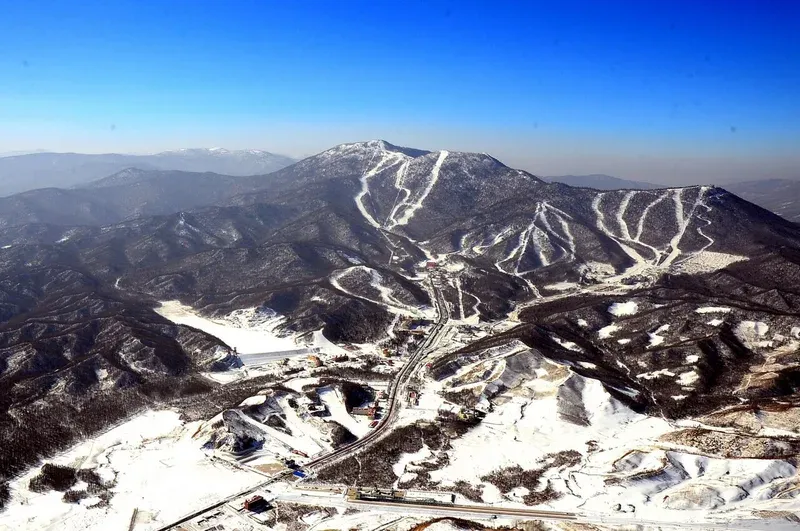
Winter activities: Cross-country skiing and snow hiking in the geopark in winter (entry is cheaper December–March).
Planning Wudalianchi? Want these on a customised itinerary?
Ask on WhatsAppWhere to eat?
- Volcanic hot pot (火山火锅): A local take on hot pot using mineral spring water as the broth.
- Wudalianchi fish (五大连池鱼): Freshwater fish from the lakes — typically steamed or braised.
- Dongbei dumplings (东北水饺): Hearty pork and cabbage dumplings.
- Wild mushroom dishes (野生蘑菇): Mushrooms foraged from the surrounding forests.
- Grilled corn (烤玉米): Sweet local corn, a popular snack at the scenic area.
Where to drink?
Wudalianchi mineral water is the local speciality — it is naturally carbonated with a distinctive iron-rich taste. The South and North Medicine Springs are the primary sources. Several mineral water brands are produced locally.
Planning Wudalianchi? We’ll book the stays and dining for you.
Ask on WhatsAppWhere to stay?
- Budget: Wudalianchi Youth Hostel (五大连池青年旅舍) — basic dorm beds from ¥50/night.
- Mid-range: Wudalianchi Scenic Area Hotel (五大连池景区宾馆) — standard hotel near the park entrance, from ¥200/night.
- Upscale: Wudalianchi Hot Spring Resort (五大连池温泉度假村) — full-service resort with spring baths, from ¥400/night.
What should you buy?
Wudalianchi is famous for its mineral water, sold in bottles throughout China. You can also buy volcanic rock souvenirs, local honey, and medicinal spring water products. The town at the park entrance has many souvenir shops.
Where to go next?
- Heihe (220 km northwest, 2.5 hours by car) — border city on the Amur River with a vibrant cross-border trade scene and access to Blagoveshchensk, Russia.
- Yichun (180 km southeast, 3 hours by car) — known for the Wuying National Forest Park and dinosaur fossil sites.
- Harbin (380 km south, 5 hours by car) — Heilongjiang's capital with its famous Ice and Snow Festival.
- Mohe (500 km north, overnight train) — China's northernmost city, known for winter solstice festivals and aurora viewing.
Nearby in Heilongjiang Sheng
More places to explore around Wudalianchi.
Guide content as of July 2026.

Contact Us
Get in touch with us.
Get in touch
Contact Us
Tell us where you'd like to go and how you like to travel. A real Tripcuro planner — not a bot — will craft an itinerary around you.
- Personalised, hassle-free planning end-to-end
- Transparent pricing, no hidden costs
- 24/7 support for complete peace of mind