
Zhalong National Nature Reserve
Heilongjiang Sheng, China
Why visit Zhalong National Nature Reserve?
Zhalong National Nature Reserve (扎龙自然ä¿?护区) is one of China's most important wetland ecosystems, sprawling across roughly 2,100 square kilometres of reed marsh, shallow lakes, and grassland on the Songnen Plain about 26 km southeast of Qiqihar in western Heilongjiang province. Established in 1979 and designated a Ramsar wetland of international importance in 1992, Zhalong is celebrated above all as the "Land of the Cranes" — it hosts six of the world's fifteen crane species, most famously the red-crowned crane (Grus japonensis), of which roughly 400 of the world's ~2,000 wild birds pass through or breed here. In total the reserve records around 269 bird species, including storks, swans, geese, ducks, herons, grebes, and egrets.
The reserve is a working conservation site rather than a polished tourist resort, and that is part of its appeal: boardwalks lead out over genuine reed marsh, and outside the captive crane enclosures near the visitor area you are walking through real habitat. Climate-wise, the timing of your visit matters more than at almost any other destination in northeast China. Late April through May (spring migration) and September through early October (autumn migration, with golden reeds) are the prime windows. Summer (June–August) is hot, humid, and infamously mosquito-ridden, but the cranes are present and active. Winters are brutally cold — temperatures routinely drop below −20 °C — and the marsh freezes over; most wild cranes have migrated south by then, though the captive birds remain on display.
Practically, "Zhalong" for the visitor means the small core area around the main gate: an entrance plaza, a captive-breeding enclosure, an observation tower, and a network of boardwalks out into the marsh. The town of Zhalong itself is tiny; almost all travellers base themselves in Qiqihar and visit as a day trip.
Planning Zhalong National Nature Reserve? Tell us your dates and we’ll tailor the trip.
Ask on WhatsAppHow do you get there?
By Plane
The nearest airport is Qiqihar Sanjiazi Airport (IATA: NDG), about 13 km northeast of central Qiqihar and roughly 40–45 km from the reserve. It has domestic connections to Beijing, Shanghai, Guangzhou, Harbin, and several other Chinese cities. From the airport, a taxi into central Qiqihar costs around ¥40–60 and takes 25–30 minutes; an airport shuttle bus runs to the city centre for around ¥15. For the reserve itself, you will need to transfer in Qiqihar — there is no direct airport service to Zhalong.
For more frequent international and domestic options, Harbin Taiping International Airport (HRB) is the regional hub, about 290 km east of Qiqihar.
By Train
Qiqihar Railway Station is the gateway. It is well connected on the Harbin–Manzhouli line, with frequent services to Harbin (1.5–2 hours by high-speed G/D train, 3–4 hours by conventional train), as well as direct trains to Beijing, Shenyang, Changchun, and Hailar. High-speed trains can be booked through 12306.cn or via apps like Trip.com and Ctrip; book a few days in advance during peak travel periods (Golden Week, Spring Festival).
From the station, buses to Zhalong leave from the corner of Longsha Lu and Zhanqian Dajie, about one block north of the station — look for "扎龙" on the destination boards.
By Car / Road
By road, Zhalong is roughly 30 km southeast of central Qiqihar via the S301 / Zhalong road, a 40–50 minute drive on good asphalt. From Harbin it is around 320 km (4–4.5 hours) via the G10 Suiman Expressway. A return taxi or chauffeured car from Qiqihar to the reserve, with several hours of waiting time, typically costs around ¥200–300 — agree the price before setting off.
The local bus to Zhalong (route 306 as of recent reporting; numbers do occasionally change) leaves from the Longsha Lu / Zhanqian Dajie corner near Qiqihar station. If no bus is waiting, take a tuk-tuk or short taxi (5–10 minutes) to Dagangzi (大岗å?) and pick up the Zhalong bus from the parking lot on the right side of the road near the gas station. The ride takes about 40 minutes, and a round-trip ticket runs around ¥20.
Inside the reserve, walking is the main way to get around the visitor zone — the entrance, captive crane enclosure, observation tower, and main boardwalks are all within a short, flat stroll of each other. Electric golf carts shuttle visitors between the gate and the more distant viewing platforms for a small fee (typically ¥20–40 per person, payable at the entrance). In summer, boat rides through the reed channels are offered from the small dock near the main viewing area; prices vary by boat size and route but expect ¥30–80 per person.
There is no public transport circulating inside the reserve. Outside the gate, you are reliant on the Qiqihar–Zhalong bus, tuk-tuks, or a pre-arranged taxi back to the city. Didi (滴滴出行) works in Qiqihar itself but coverage out at the reserve is patchy — if you are taking a taxi or Didi out, have the driver wait, or arrange a return pickup time in advance. Standard taxi flagfall in Qiqihar is around ¥8.
Scams are rare here compared with major tourist cities, but at the bus stop be wary of touts quoting inflated "private car" prices to Zhalong — the public bus is cheap and reliable.
What are the things to do?
The reserve is a single integrated experience rather than a list of separate sights, but within it the key viewpoints are:
- Red-Crowned Crane Enclosure & Release Area — the headline attraction. Captive cranes are housed in spacious pens a short walk from the entrance, and are released to fly free over the marsh four times daily for feeding. Historic release times have been 10:10, 11:10, 14:30, and 15:30; check the current schedule at the gate on arrival, as times shift seasonally. Seeing several dozen red-crowned cranes lift off in formation overhead is the reason most visitors come. Included in the entrance ticket.
- Main Observation Tower — a multi-storey wooden tower a few minutes' walk along the boardwalk from the enclosure, giving a panoramic view over the reed beds. Best at sunrise and sunset.
- Boardwalk Wetland Trails — raised walkways extending out into the marsh from the visitor area. En route you can spot ducks, terns, herons, geese, grebes, and many other waterbirds in genuine wild habitat. Bring binoculars.
- Zhalong Wetland Museum / Visitor Centre — near the main gate, with exhibits on the reserve's ecology, crane biology, and conservation history. Signage is primarily in Chinese with limited English. Included in the entrance ticket.
Fees and hours: Entrance is ¥50 per adult. The reserve is generally open daily from around 08:00 to 16:30 (shorter hours in winter); the crane releases are the practical anchor for any day-trip plan — aim to arrive by 09:30 to catch the morning flights.
- Bird-watching, properly. Beyond the crane release spectacle, the boardwalks are a serious birding destination in spring and autumn migration. Bring binoculars, a long lens, and a Chinese field guide if you can. Dawn is best.
- Reed-channel boat trip. In summer, take one of the small boats through the reed channels — it is the closest you will get to the marsh as the cranes themselves experience it.
- Photography. The combination of golden reeds (best in late September/October), open sky, and large flocks of cranes makes Zhalong one of the iconic wildlife photography sites in China. Tripods are fine on the boardwalks; drones generally are not — check at the gate before flying anything.
- Visit Qiqihar. Pair the reserve with the city itself: Longsha Park (a large 19th-century landscape garden in central Qiqihar), the Ming Yue Island wetland park, and the Qiqihar Museum are all worth half a day.
- Crane-banding and conservation talks. Occasional ranger-led activities run during peak season — ask at the visitor centre. Mandarin only in most cases.
Planning Zhalong National Nature Reserve? Want these on a customised itinerary?
Ask on WhatsAppWhere to eat?
There are only a handful of simple eateries clustered outside the reserve gate — mostly family-run Northeast Chinese spots serving fish from the wetland, stewed pork, dumplings, and stir-fries. They are cheap (¥30–80 per person), cash-friendly, and Mandarin-only; point-and-order works fine. Vegetarians can usually get tofu dishes, stir-fried greens, and egg-and-tomato, but strict vegan or gluten-free diets are difficult — bring back-up snacks.
Most travellers eat their main meal in Qiqihar, which is famous across China for one dish in particular:
- Qiqihar barbecue (é½?é½?哈尔烤肉) — the city's signature. Diners grill marinated beef on a tabletop charcoal grill, paired with garlic, cumin, chilli, sesame, and cold beer. Qiqihar claims to consume more beef per capita than anywhere else in China.
- Budget: street barbecue stalls along Bukui Street — a full grilled meal with beer for ¥40–70 per person.
- Mid-range: established beef-barbecue houses such as those in the Longsha and Tiefeng districts — sit-down restaurants with picture menus, ¥80–150 per person.
- Local specialties to try: guo bao rou (锅包肉, sweet-and-sour crispy pork — a Northeast classic), xiao ji dun mogu (å°?鸡炖蘑è?‡, chicken stewed with wild mushrooms), freshwater fish from the Nenjiang River, and bing gun'r (冰æ£?å„¿, traditional ice lollies) in summer.
Where to drink?
Northeast China is beer country, and Harbin Beer (哈尔滨啤酒) is the default lager on every table — cheap, cold, and excellent with barbecue. Snow (雪花) is the other ubiquitous brand. Locally distilled baijiu (sorghum spirit) appears at any serious meal; sip rather than shoot.
Non-alcoholic options include strong Chinese black tea, soy milk at breakfast, and the very Northeast Chinese habit of drinking hot water with meals year-round. Western-style cafés are scarce at the reserve itself but plentiful in Qiqihar (Luckin, Manner, and local independents along Bukui Street).
Tap water is not potable anywhere in the region — drink bottled or boiled water only. Bottled water is sold at the reserve entrance for ¥3–5; bring more than you think you need in summer.
Planning Zhalong National Nature Reserve? We’ll book the stays and dining for you.
Ask on WhatsAppWhere to stay?
Most visitors stay in Qiqihar and day-trip to the reserve. There is some accommodation immediately outside the Zhalong gate, but options are limited and basic.
- Budget:
- Family-run guesthouses (农家ä¹?) outside the Zhalong gate — simple twin or kang-bed rooms, shared or basic en-suite bathrooms, ¥80–150 per night, often including a home-cooked dinner. Mandarin only; book on Ctrip/Meituan or just walk up.
- In Qiqihar, chain budget hotels such as 7 Days Inn (7天连é”?酒店) and Hanting Hotel (汉庭) near the railway station offer clean en-suite rooms from around ¥150–220.
- Mid-range:
- Jinjiang Inn Select / Atour Hotel branches in central Qiqihar — reliable 3–4 star comfort, ¥280–450 per night.
- Upscale / heritage:
- Qiqihar Hesheng International Hotel (鹤城宾馆 / Hecheng Hotel) and similar full-service hotels in the city centre — ¥500–800 per night for an executive room, with Western breakfast and English-speaking front desk.
Reserve-side accommodation is functional rather than luxurious; if comfort matters to you, sleep in Qiqihar and leave early for the morning crane release.
What should you buy?
Zhalong is a nature reserve, not a shopping destination — souvenir options are limited to a few stalls and a small shop near the entrance selling crane-themed postcards, fridge magnets, embroidered patches, picture books, and bottled water and snacks. Prices are modest and broadly fixed; light bargaining is acceptable but not expected.
For more substantial shopping, head back to Qiqihar. The Bukui Pedestrian Street (�奎大街) in the city centre is the main downtown shopping artery, with department stores, brand outlets, and street food. Local specialties to look out for include Qiqihar barbecue seasonings, Heilongjiang rice and soybean products, and Northeast Chinese pickles (酸�). The region is also known for fur and down products, though ethical considerations apply.
Where to go next?
- Qiqihar (26 km / 40 min) — your base city. Longsha Park, Ming Yue Island wetland, Qiqihar Museum, and the famous barbecue scene easily fill another day.
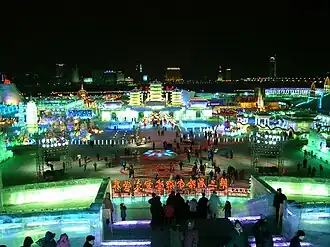
- Harbin (290 km / 1.5–2 hr by high-speed train) — Heilongjiang's capital, with its Russian-influenced architecture along Zhongyang Street, Saint Sophia Cathedral, and the world-famous Harbin Ice and Snow Festival in January–February.
- Daqing (~150 km / 2 hr by road) — China's oil capital, with the Iron Man Memorial Museum and Lianhuan Lake wetlands; a useful stopover en route between Qiqihar and Harbin.
- Wudalianchi (~280 km / 4 hr by road from Qiqihar) — a UNESCO Global Geopark of volcanic craters, lava fields, and mineral springs in northern Heilongjiang.
- Hulunbuir Grasslands & Manzhouli (~600 km / overnight train west to Hailar) — vast Inner Mongolian grasslands and the Sino-Russian border town of Manzhouli; a natural extension if you are heading further into the northeast.
- Jingpo Lake (镜泊湖, ~700 km southeast) — a long but rewarding trip to one of China's largest alpine lakes, with a frozen waterfall in winter and lush forest scenery in summer.
Nearby in Heilongjiang Sheng
More places to explore around Zhalong National Nature Reserve.


Guide content as of May 2026. Portions adapted from Wikivoyage, CC BY-SA 4.0.

Contact Us
Get in touch with us.
Get in touch
Contact Us
Tell us where you'd like to go and how you like to travel. A real Tripcuro planner — not a bot — will craft an itinerary around you.
- Personalised, hassle-free planning end-to-end
- Transparent pricing, no hidden costs
- 24/7 support for complete peace of mind