

Khovd
Hovd, Mongolia
About Khovd
Khovd (also spelled Hovd; Mongolian: Ховд) is the capital of Hovd Province in western Mongolia, a tree-lined town of around 30,000 people on the banks of the Buyant River. Its history reaches back roughly 240 years: at the northern edge of town stand the ruins of a fort where the Manchu (Qing) dynasty's viceroy once lived with his garrison, until Mongolian revolutionaries drove the Manchus out in 1912. The trees the Manchu rulers planted along the main streets still shade the town today. Since independence, Khovd has grown into a regional centre with a large hospital, a university serving the youth of western Mongolia, an airport, a cinema and a theatre.
What makes Khovd genuinely distinctive is its ethnic diversity. The surrounding aimag is divided into 17 sums (counties), home to Kazakhs and seven different Mongolian ethnic groups, many with their own dialects, dress, dances, songs, instruments and ceremonies. The Uriankhai, concentrated in the Altai Mountain sums of Munkhkhairkhan and Duut, are known for a unique form of archery that involves shooting rubber-tipped arrows at leather balls. For travellers, Khovd is both a cultural crossroads and the natural base for exploring western Mongolia's mountains, lakes and ancient rock art.
The climate is harshly continental. Winters are long and very cold — January averages around −16°C by day and −28°C by night — while summers are warm, with July highs near 26°C. Most rain falls in summer, though totals are low. The comfortable travel season is roughly June to early September; visit then for warm days, the rivers, and any chance of catching cultural events. The town is easy to navigate: orientation hangs on four landmarks — the central square, the "big boots" monument (an intersection two blocks east of the square), the market (three blocks south of the big boots), and the airport, 6 km south of town.
Planning Khovd? Tell us your dates and we’ll tailor the trip.
Ask on WhatsAppHow to reach
By Plane
Khovd Airport (IATA: HVD) lies about 6 km south of the city centre, reached by heading straight west from the main square (the road soon curves south). Two carriers serve it. Hunnu Air (office on the 1st floor of the Buyant Hotel building; +976 11 331111 in Ulaanbaatar, +976 7043 8889 in Khovd; [email protected]) flies between Ulaanbaatar and Khovd and is reliable, with good service and prices — round-trip fares for foreigners run around US$280, and flights regularly sell out, so book ahead. AeroMongolia (+976 11 330373 in Ulaanbaatar, +976 99164050 in Khovd; [email protected]; Khovd office in the Zoos Bank building west of the main square) charges foreigners up to about US$324 round-trip. Note that the airlines' published timetables are not always accurate — confirm directly. A taxi into town runs on the standard local rate of about ₮500 per km.
Ulaanbaatar ticket agents who can book domestic flights (and generally speak moderate to good English) include Air Trans ([email protected]), Air Market (+976 70105050; [email protected]), Air Link ([email protected]), Mon Air Tour ([email protected]) and Air Express Travel (+976 77114466; [email protected]).
By Train
By Car / Road
A daily bus runs between Khovd and Ulaanbaatar, taking 24 hours or more and costing around US$30, with one food stop and roadside breaks on request. In Ulaanbaatar the Khovd bus leaves from the Dragon Centre; tickets can be bought up to three days ahead — look for the ticket window marked "Ховд". Shared vehicles also leave from the Naran Tuul (Black Market) when full, at around ₮65,000 one way, but travel times from the Black Market can stretch anywhere from 36 to 58 hours depending on the driver and vehicle. Heading back, vehicles for Ulaanbaatar leave continuously from a small enclosed area across from the southeast corner of Khovd's central market.
Overcrowded vans ply the route to Ölgii, taking about 7 hours including a meal break; the fare is around ₮20,000–30,000. From China, buses run from Urumqi (Xinjiang) toward the border via Qinghe county; after crossing, onward rides toward Bulgan sum are easy to arrange.
A taxi around Khovd costs about ₮500 per km, the standard local rate. The town centre is compact and walkable, anchored by the central square, the "big boots", and the market. To travel within Hovd aimag or to neighbouring aimags, hire a car, jeep or furgon (a 4×4 UAZ van) at the central market — vehicles for the sums leave from along the main road at the north entrance and from the road behind the market. Most vehicles lack signs, so ask around; if a driver isn't going your way, they will usually point you to someone who is. Many vehicles to distant sums come in only at weekends, and the market is closed on Thursdays, so leaving mid-week can be hard. Sample one-way sum fares from Khovd include Buyant ₮1,500, Myangad and Khovd sum ₮2,500, Mankhan and Durgun ₮6,000, Zereg ₮10,000, Must/Tsetseg/Chandmani/Munkhkhairkhan ₮12,000, and Bulgan and Uyench ₮25,000.
Things to do
Historic sites and monuments
- Statues by the government building — Three western-Mongolian heroes are commemorated near the central square: Ard-Ayush (1859–1939), a Khovd commoner turned revolutionary against Manchu rule, at the front of the main square; Galdan Boshogt (1644–1697), the Zungar king who founded Khovd as a fort in 1685, closer to the government building; and Amarsanaa, who led the last battle against the Manchus, in a hidden park behind the government building.
- The ruined Manchu fort — At the north end of town stand the remains of the fort where the Qing viceroy's garrison was based until 1912.
Museums and culture
- Khovd Museum — In a yellow two-storey building across from the police station. Highlights include full traditional costumes of the aimag's ten ethnic groups, archaeological artefacts of nomadic life, Buddhist relics, and old documents in ancient Mongolian script, plus photographs of the Tsenkheriin Agui cave paintings as they appeared before vandalism. Summer hours: daily 09:00–17:00 (may vary). Admission ₮2,000; photo fee ₮6,000; video fee ₮11,000–12,000.
- Theatre — A large bright-red building opposite the square, home of the Altain Tsuurai ensemble, known for traditional Mongolian music. It hosts plays, concerts and performances featuring khöömii (throat singing), long song, morin khuur and dombra. Officially open weekdays but often locked unless an event is on.
Nature and rock art
Baatar Khairkhan Mountain — 6 km south of the city, 1 km south of the airport. A historic site where a Mongolian general gave the order to free Khovd from the Manchus in 1912, with many ancient petroglyphs on its south and southwest slopes.
Cave paintings — The aimag's best-known are at Tsenkheriin Agui in Mankhan sum, just under 100 km southeast; these red-ochre paintings of camels, sheep, ibex and other animals are thought to be around 15,000 years old. If you can't spare two days, the mountain behind the airport has its own fine set of rock pictures.
Mineral springs — A large spring northeast of the city on the Buyant/Myangad road is said to treat poisoning; "Drop Spring", about 5 km behind town, is believed to be good for the heart.
Swim in the Buyant River — The Buyant runs right through town and locals swim in it through summer; many residents move out to gers along its banks in the warm months.
Catch a performance — If you are in town when the theatre has an event, hear throat singing, long song and traditional instruments by the Altain Tsuurai ensemble.
Day trips to rock art and the Altai — Hire a jeep at the market for excursions to Tsenkheriin Agui, Baatar Khairkhan's petroglyphs, or deeper into the mountains.
Experience the cultural mix — Kazakh, Khalkha and other Mongolian ethnic customs are all present; visiting nearby sums or attending a festival is the best way to see them.
Planning Khovd? Want these on a customised itinerary?
Ask on WhatsAppFood & Dining
Khovd's food is typical western-Mongolian fare — meat-heavy, hearty and inexpensive — with a cultural mix that reflects the town's Kazakh and Mongolian communities. Most eateries cluster around the central square and the market.
- Budget — Simple guanz (canteens) around the market serve buuz (steamed dumplings), khuushuur (fried meat pastries), tsuivan (fried noodles) and meat soups for very little.
- Mid-range — Restaurants near the central square offer fuller Mongolian menus, sometimes with Kazakh dishes such as beshbarmak.
- Signature dishes — Look for mutton-based stews, khorkhog (mutton cooked with hot stones), and dairy products such as aaruul (dried curds).
Vegetarians will find options limited — meat is central to the cuisine — so plan ahead. Halal food is more available here than in much of Mongolia given the Kazakh population, but confirm locally.
Cafes & Nightlife
Local drinks are dairy-based and traditional: süütei tsai (salty milk tea) is everyday, and airag (lightly alcoholic fermented mare's milk) is a summer favourite. Cafés and small bars around the central square and market serve coffee, tea, beer and vodka. Tap water should not be drunk untreated — boil, filter or stick to bottled water, and carry treated water for any trip out of town.
Planning Khovd? We’ll book the stays and dining for you.
Ask on WhatsAppPlaces to Stay
- Budget: Simple guesthouses and small hotels around the central market offer basic rooms at modest rates; ask at the market or arrange through a tour operator. Camping along the Buyant River is popular in summer.
- Mid-range: The Buyant Hotel (which also houses Hunnu Air's office) is a central, established option with comfortable rooms; other mid-range hotels operate near the central square.
What to buy
Khovd's central market is the commercial heart of town and the place to pick up everyday goods, food and supplies before heading into the aimag. Look for locally made felt goods, woollens and crafts reflecting the area's many ethnic groups, including Kazakh handicrafts. Note the market is closed on Thursdays. Bargaining is normal in the market but modest — prices are already low. Stock up here on anything you will need for trips to the sums, where shops carry only basics.
Go next
- Khar Us Lake National Park (~40 km east) — A vast shallow lake and reedbed, one of Mongolia's great waterfowl havens.
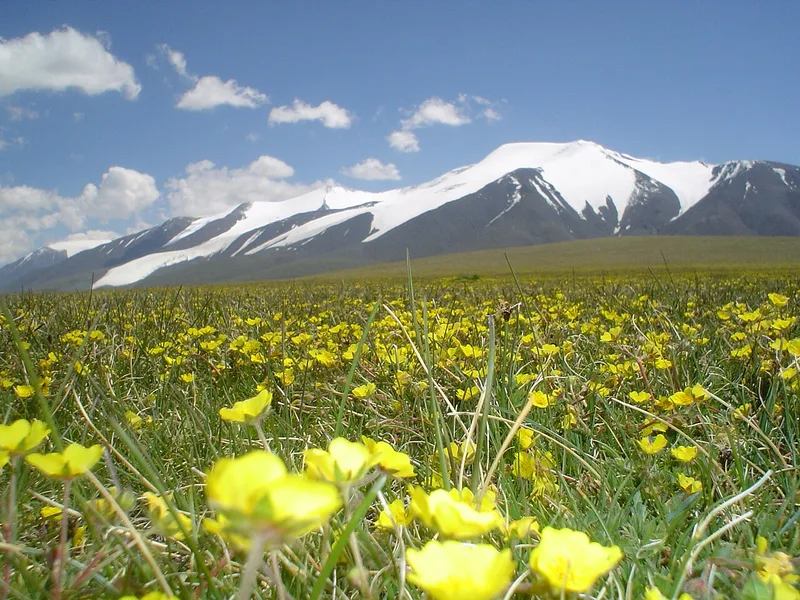
- Tsambagarav Uul National Park (toward the Bayan-Ölgii border) — A glacier-capped Altai massif with snow leopards and Kazakh and Uriankhai herders.
- Ölgii (~210 km, ~7 hr by road) — The Kazakh-majority capital of Bayan-Ölgii and base for eagle hunting and the Altai Tavan Bogd.
- Mankhan sum (~100 km southeast) — Site of the Tsenkheriin Agui cave paintings, around 15,000 years old.
- Mönkhkhairkhan (Altai sum) — A high glaciated peak and Uriankhai herding country.
Nearby in Hovd
More places to explore around Khovd.
Portions adapted from Wikivoyage, CC BY-SA 4.0.

Contact Us
Get in touch with us.
Get in touch
Contact Us
Tell us where you'd like to go and how you like to travel. A real Tripcuro planner — not a bot — will craft an itinerary around you.
- Personalised, hassle-free planning end-to-end
- Transparent pricing, no hidden costs
- 24/7 support for complete peace of mind