
Tabuaeran
Line Islands, Kiribati
Why visit Tabuaeran?
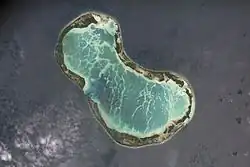
Tabuaeran — known to most outsiders as Fanning Island or Fanning Atoll — is a remote coral atoll in the Northern Line Islands of Kiribati, lying roughly 1,600 km south of Honolulu and a short hop north of Kiritimati (Christmas Island). It is a classic ring-shaped atoll: a thin necklace of palm-covered motu enclosing a turquoise lagoon some 110 km² in area, breached by a couple of narrow passes through which tidal currents rush twice daily. Around 2,000 i-Kiribati live here in a handful of villages strung along the rim, sustained by copra, fishing, seaweed farming, and the occasional cruise ship calling for a "humanitarian" port day. There are no resorts, no banks, no paved roads, and electricity is intermittent — Tabuaeran is as close as the modern Pacific gets to a true outer-island experience.
The atoll's history is short but layered. Discovered by the American sea captain Edmund Fanning in 1798, it later served as a coaling station, a 19th-century coconut plantation under British administration, and a relay point on the trans-Pacific telegraph cable laid in 1902 — the rusted remnants of the cable station are still visible near English Harbour. Kiribati gained independence in 1979 and Tabuaeran has remained one of its quietest corners ever since, briefly enlivened in the 2000s when Norwegian Cruise Line made it a regular stop (the company has long since moved on, though Holland America still calls occasionally en route to French Polynesia).
The climate is equatorial-maritime: warm (26–31°C) and humid year-round, with no real seasons. The driest, calmest months are typically April to October; November to March brings heavier rain squalls and stronger easterly trades. El Niño years can flip this pattern dramatically. There are no "neighbourhoods" in any urban sense — orient yourself instead by the main villages of Paelau (the administrative centre near the main pass), Napia, and Tereitaki, all linked by the single dirt track that loops the lagoon.
Planning Tabuaeran? Tell us your dates and we’ll tailor the trip.
Ask on WhatsAppHow do you get there?
By Plane
The realistic air gateway to the region is Cassidy International Airport (CXI) on Kiritimati, about 230 km south. Fiji Airways runs a weekly service from Nadi (NAN), and Hawaiian Airlines flies from Honolulu (HNL). From Kiritimati, onward travel to Tabuaeran is by sea (see below).
By Boat
The standard route is by inter-island vessel from Kiritimati (Christmas Island). Government and private cargo/passenger boats make the crossing irregularly — anywhere from twice a month to once every couple of months depending on weather, fuel, and demand. The voyage takes roughly 18–30 hours depending on the vessel and sea state, and deck-class fares are typically in the range of A$60–120 one-way (Australian dollars are Kiribati's currency). Schedules are posted, in practice, by word of mouth at the wharf in London (Kiritimati); ask at the Ministry of Communications, Transport and Tourism Development office or at the Captain Cook Hotel.
The other way in is by cruise ship. Holland America Line includes Tabuaeran on selected repositioning itineraries between Hawaii and French Polynesia as a tender call; passengers come ashore for the day at the main dock near Paelau. Independent yachts also clear in here occasionally — the official port of entry for the Northern Line Islands is, however, Kiritimati, so cruisers should clear there first.
A single dirt road circles the lagoon, roughly 60 km in total, passing through every village. Walking is perfectly feasible for short hops between settlements, but the equatorial sun is brutal — carry water and cover up.
Bicycles are the workhorse for visitors. A small fleet is kept near the main dock and can be rented informally for a few Australian dollars a day; ask at the dock or at any of the houses immediately behind it. Bikes are basic single-speeds — fine for the flat track, less fine for the sandier stretches.
The occasional pickup truck doubles as an unofficial taxi/share-ride; flag one down and offer a few dollars for a lift to the next village. There are no metered taxis, no buses, no ride-hailing apps, and no fuel station in any conventional sense (small drums of petrol arrive by ship). For lagoon crossings and reaching the outer motu, locals run outrigger canoes and small skiffs — negotiate directly with the boat owner, typically A$20–50 depending on distance.
When walking the dirt trails that branch off the main road, be mindful that almost all land is privately held under traditional tenure. A friendly Mauri! ("hello") and a request before crossing someone's plot is both polite and expected.
What are the things to do?
There are no museums, no ticketed sights, no opening hours — what you see is the atoll itself.
The Lagoon — a 110 km², impossibly clear turquoise basin that is the whole point of coming. Best viewed from the leeward (western) side near Paelau, where the water shelves gently. Free; always open.
English Harbour — the main pass into the lagoon at the north end, named for 19th-century British cable-station operations. Strong tidal currents make for spectacular drift snorkelling on the incoming tide; dangerous on the outgoing. Free.
Whaler Anchorage / Cable Station ruins — scattered concrete foundations and rusting hardware from the 1902 trans-Pacific telegraph relay station, near English Harbour. Free, unsigned; ask a local to point them out.
The seaweed farms — shallow stretches of lagoon staked out with lines of cultivated Eucheuma seaweed, a key cash crop. Visible all along the lagoon-side road; farmers are usually happy to explain the harvest if approached respectfully.
The basketball court at Paelau — a slab of cracked concrete built by a visiting cruise line years ago, and the social hub of the island's young men. More a cultural sight than a sporting one.
Napia village — the largest settlement, with the island's main church (a simple whitewashed Catholic structure) and a maneaba (traditional meeting house) where community gatherings are held.
Snorkel and dive the lagoon and passes — the reefs are healthy by global standards, with reef sharks, manta rays, eagle rays, and large schools of jack and snapper. Bring all your own gear; there is no dive shop and no rental.
Drift the pass at English Harbour on a slack-to-incoming tide — one of the best wild snorkel experiences in the central Pacific.
Surf — Tabuaeran has uncrowded reef breaks at several points around the atoll's outer edge, working best on south or north swells depending on season. Strictly experts only; no rescue, no doctor, no nearby hospital.
Sportfishing — bonefish on the lagoon flats, GTs and yellowfin offshore. A handful of locals run informal trips in skiffs; arrange at the dock for around A$100–200 for a half day including boat and guide.
Cycle the lagoon loop — a long but rewarding day on the dirt road, with village stops along the way. Start at sunrise.
Join a pick-up basketball game in Paelau in the late afternoon — the men of the village are welcoming to visitors and the games are competitive, played barefoot, and (as Wikivoyage drily notes) often continued mid-cigarette.
Watch a copra harvest or seaweed sorting — both are central to the island economy and visitors are usually welcome to look on.
Stargaze — with no light pollution and clean equatorial skies, the Milky Way overhead is extraordinary on a moonless night.
Planning Tabuaeran? Want these on a customised itinerary?
Ask on WhatsAppWhere to eat?
Food on Tabuaeran is what comes off the reef, out of the lagoon, and down from the coconut palm. There are no restaurants and no cafés; visitors eat with their hosts (homestay or guesthouse) or self-cater from supplies brought in from Kiritimati or Tarawa. If you are arriving on the cargo boat, plan to bring a stash of dry goods.
Signature local dishes worth asking your host to prepare:
- Ika raw — fresh raw reef fish (often skipjack or yellowfin) marinated in lime, coconut cream, and chilli; the i-Kiribati cousin of Tahitian poisson cru.
- Te bua toro ni baukin — fermented coconut sap, an acquired taste.
- Palu sami — taro leaves baked in coconut cream, sometimes with corned beef.
- Grilled reef fish with breadfruit or boiled rice.
- Coconut crab (te ai) — increasingly rare and protected in many parts of Kiribati; eat only if your host confirms it was legally harvested.
- Toddy (sweet, non-fermented coconut sap) drizzled over rice for breakfast.
Vegetarians can subsist on rice, breadfruit, taro, pumpkin, papaya, and coconut, but should set expectations: refrigeration is intermittent and meals revolve around fish. Halal-observant travellers should bring their own provisions; gluten-free is straightforward (rice and root vegetables dominate). Always ask your host before eating reef fish caught on the ocean side of certain motu — ciguatera poisoning is a known risk in parts of the Line Islands.
Where to drink?
The everyday drink is te karewe — sweet coconut toddy tapped from the spathe of the coconut flower and drunk fresh in the morning, or fermented into the mildly alcoholic kaokioki by afternoon. Visitors are sometimes invited to taste both; the fresh version is wonderful, the fermented version is an acquired taste and packs more of a punch than it looks.
There are no bars on the atoll. Beer (typically Australian VB or Fiji Bitter) and small bottles of spirits trickle in by cargo boat and are sold informally from a few houses; prices are high (A$5–8 for a warm beer) and supply is unreliable. Public drunkenness is frowned upon and several villages observe local restrictions on alcohol — ask before drinking openly.
Water safety: do not drink unfiltered rainwater catchment or well water without treatment. Boil, filter, or stick to bottled water (also imported and expensive). Coconut water straight from a freshly hacked nut is the safest, cheapest, and best drink on the island.
Planning Tabuaeran? We’ll book the stays and dining for you.
Ask on WhatsAppWhere to stay?
Formal accommodation is essentially nonexistent. There are no hotels and no resorts on Tabuaeran. Visitors who are not on a cruise ship stay either with a local family in an informal homestay or in one of a couple of very basic guest huts.
- Budget — Village homestays: arranged on arrival via the village elder or, more reliably, by asking ahead at the Ministry of Internal Affairs office on Kiritimati or via a contact on the cargo boat. Expect a sleeping mat in a thatched kiakia (raised hut), shared bucket-bath washing, and meals included. Around A$30–50 per person per night including food. Bring your own mosquito net.
- Budget — Paelau guest huts: a small number of basic huts near the main dock are sometimes available for visitors, with simple beds and rainwater for washing. Around A$40–60 per night. Availability is unpredictable; nothing is bookable online.
Whatever you arrange, bring: mosquito net and repellent, sunscreen, a torch (mains power is limited to a few hours in the evening, and not in every village), basic medical kit, water purification, and modest small-denomination cash to pay your hosts.
What should you buy?
There are no shops in any conventional sense — no supermarket, no souvenir store, no ATM. A handful of small village kiosks stock the basics (rice, sugar, tinned fish, soap, sometimes cold drinks if a generator is running) at prices well above mainland rates because everything has come by ship.
What you can buy, informally and directly from the maker, is handicraft:
- The signature item is the women's "defence knife" — a wooden sword-like club carved from palm wood, edged with rows of shark teeth and decorated with shells and coir. It is the classic Line Islands souvenir; expect to pay around A$30–80 depending on size and workmanship. Note that customs in some countries (Australia, the US, EU) may restrict or prohibit shark-tooth items — check before you buy.
- Pandanus and coconut-fibre weaving: mats, baskets, fans, and hats.
- Shell jewellery and coconut-shell carvings.
Currency is the Australian dollar; small US dollar notes are also widely accepted (a legacy of the cruise-ship years), though you'll get a less favourable informal rate. Bring small denominations — no one can change a$100 note. There are no card terminals and no ATM. Bargaining is not really a thing — prices are modest and quoted directly; haggling hard is considered rude.
Where to go next?
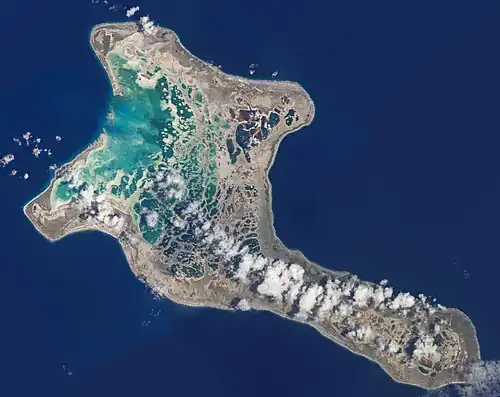
- Kiritimati (Christmas Island) — 230 km south; 18–30 hours by boat or a short charter flight. The administrative hub of the Line Islands, world-class bonefishing, and the only realistic onward connection to Hawaii or Fiji.
- Teraina (Washington Island) — about 160 km northwest; the only freshwater lake in Kiribati and a similarly off-grid atoll experience, accessible by the same inter-island vessels.
- Kiribati's Northern Line Islands marine area — protected reefs and uninhabited motu reachable by chartered local boat from Tabuaeran for divers and naturalists with patience and budget.
- Honolulu, Hawaii (USA) — the primary international gateway, reached via Kiritimati on Hawaiian Airlines; a logical decompression stop after weeks on the atoll.
- Nadi, Fiji — the alternative international hop via Kiritimati on Fiji Airways; opens up onward travel through the South Pacific.
- Tarawa — Kiribati's capital atoll, reached via Kiritimati and Air Kiribati; WWII history (Battle of Tarawa sites), the country's main maneaba culture, and the seat of national government.
Nearby in Line Islands
More places to explore around Tabuaeran.
Guide content as of May 2026. Portions adapted from Wikivoyage, CC BY-SA 4.0.

Contact Us
Get in touch with us.
Get in touch
Contact Us
Tell us where you'd like to go and how you like to travel. A real Tripcuro planner — not a bot — will craft an itinerary around you.
- Personalised, hassle-free planning end-to-end
- Transparent pricing, no hidden costs
- 24/7 support for complete peace of mind