
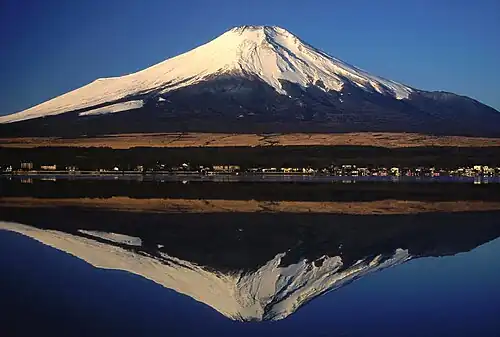
Mount Fuji
Yamanashi, Japan
About Mount Fuji
Mount Fuji (富士山 Fuji-san, 3,776 m) is Japan's highest mountain and the focal point of the sprawling Fuji-Hakone-Izu National Park. Visible from Tokyo on a clear day, it rises to the west of the capital on the main island of Honshu, straddling the border between Shizuoka and Yamanashi prefectures. To prevent either prefecture from "claiming" the mountain, the summit itself is the only place in the country not assigned to any prefecture — its location is, officially, simply "Japan."
A stratovolcano with a nearly perfectly symmetrical cone, Fuji is a near-mythical national symbol, immortalised in countless works of art, most famously Hokusai's Thirty-six Views of Mount Fuji. The Japanese always call it Fuji-san, where -san (山) simply means "mountain"; "Fujiyama" is a Western misreading never used by the Japanese themselves. The mountain was added to the UNESCO World Heritage List in 2013 as a sacred place and source of artistic inspiration.
The official climbing season is short — roughly early July to early September — and exact dates vary by year and trail. Even then, while Tokyo swelters in 30 °C heat, summit temperatures can fall below freezing at night. Around 250,000–300,000 people climb each year, with Saturday nights and the Obon holiday especially crowded. Climbing outside the official season is extremely dangerous without alpine experience and equipment: facilities are closed, winds can be vicious, and submitting a climbing plan to the prefectural police has been mandatory since 2019. For those who only wish to admire Fuji, the Fuji Five Lakes and Hakone offer the classic views.
Planning Mount Fuji? Tell us your dates and we’ll tailor the trip.
Ask on WhatsAppHow to reach
By Plane
Mt. Fuji Shizuoka Airport (FSZ IATA) near Shizuoka opened in 2009, but despite the name it lies over 80 km to the west of the mountain and is not much closer to Fuji than Tokyo's airports. Most visitors arrive via Tokyo's Haneda or Narita airports and continue overland.
By Train
There is no direct rail access to Mount Fuji, but trains get close and connect to buses for the rest of the way. From Tokyo, the two main staging points are Fujiyoshida and Gotemba; visitors from western Japan can use Fujinomiya (Shin-Fuji) instead. Via Fujiyoshida: take the JR Chuo Line to Otsuki and change to the Fujikyu line to Kawaguchiko, from where hourly buses (about 50 minutes, around ¥1,700) shuttle to the Fifth Station. Some Chuo Line and Narita Express trains run directly to Kawaguchiko.
By Car / Road
The easiest way to reach the slopes is the Keio/Fujikyu Express Bus from the Shinjuku Expressway Bus Terminal in Tokyo: buses run several times daily to Lake Kawaguchi (about 1 hour 45 minutes, ¥1,750), with onward buses to the Kawaguchiko Fifth Station (about 55 minutes, ¥1,540 one way). In the warm months, direct buses run from Shinjuku to the Fifth Station (about 2½ hours, ¥2,700). By car from inner Tokyo, take the Chuo Expressway from Shinjuku (tolls around ¥2,500). Note that roads to the Fifth Stations are closed and bus schedules sharply cut outside the climbing season.
Once on the mountain, the only way of getting around is on foot. The sole exception is horseback riding, available on the Yoshida trail between the 5th and 7th stations for a steep ¥14,000. Four main trails climb to the summit — Yoshida (the most popular, from the Kawaguchiko/Subaru Line 5th Station), Subashiri, Gotemba and Fujinomiya — and walkers can ascend by one and descend by another. The Yoshida and Subashiri trails merge higher up; take care to follow the correct colour-coded markers on the descent.
Things to do
The summit crater and Kengamine peak — At the top, a trail circles the crater rim (ohachi-meguri); Kengamine, the true highest point at 3,776 m, is marked by a survey station.
Sunrise from the summit (go-raiko) — The traditional reward of an overnight climb: watching the sun rise over the clouds from the peak.
Mountain huts — The trails are dotted with huts offering shelter, meals and a place to rest before a pre-dawn push to the top.
The mountain itself, from a distance — For simply seeing Fuji, keep some distance: the best-known viewpoints are Hakone to the east and the Fuji Five Lakes just to the north. Fuji is notoriously shy and often wrapped in cloud — visibility is worst in humid summer and best in clear, dry winter.
Climb Mount Fuji — The classic thing to do. Most people take 4 to 8 hours to ascend (depending on pace and starting point) and another 2 to 4 to descend. An overnight climb to reach the top for sunrise is traditional but means shuffling in a slow line near the top; starting in the late morning to reach the summit for sunset is a quieter alternative.
Off-season slope hikes — The gentler trails at the base are suited to afternoon hikes at any time of year, for those not climbing to the summit.
Guided climbing tours — Numerous companies offer Mount Fuji climbing tours, often including round-trip bus fare, a guide, hut stay, meals and a post-climb hot spring; a one-day tour costs around ¥20,000 and a two-day approach over ¥30,000. English-speaking guides can be arranged.
Fuji-Q Highland — In the city of Fujiyoshida at the mountain's foot, a leading amusement park with record-setting roller coasters.
Planning Mount Fuji? Want these on a customised itinerary?
Ask on WhatsAppFood & Dining
Mountain huts along the trails serve simple, warming food to climbers — curry rice, ramen, miso soup and instant noodles — at prices that rise with altitude. At the Fifth Stations, restaurants and shops offer fuller meals before the climb. In the gateway town of Fujiyoshida, the speciality is Yoshida udon, firm chewy wheat noodles in a savoury broth. Carry your own water and snacks, as supplies on the mountain are limited and pricey.
Cafes & Nightlife
Drinks — water, tea, coffee and soft drinks — are sold at the Fifth Stations and mountain huts, again at rising prices with altitude. Carry plenty of water for the climb. Tap water is safe to drink throughout Japan, but treat any natural water on the mountain with caution; bottled water is the norm for climbers.
Planning Mount Fuji? We’ll book the stays and dining for you.
Ask on WhatsAppPlaces to Stay
- Budget: Mountain huts along the trails are the budget option for climbers — basic shared sleeping space with a meal, typically booked in advance for the climbing season. > TODO: Specific named huts and rates could not be confirmed.
- Mid-range: Hotels and guesthouses in the gateway towns of Fujiyoshida and Lake Kawaguchiko serve climbers before and after the ascent. > TODO: Specific named properties and rates could not be confirmed.
- Upscale / heritage: Upscale resort ryokan and hotels with hot springs and Fuji views are concentrated around Lake Kawaguchi and in Hakone. > TODO: Specific named properties and rates could not be confirmed.
What to buy
Mountain huts and Fifth Station shops sell climbing essentials, snacks, oxygen cans and souvenirs, and many climbers buy a wooden walking stick (kongo-zue) to have branded with a stamp at each hut as a record of the ascent. Souvenir shops in the gateway towns sell Fuji-themed goods. Prices on the mountain are higher than in the towns; bargaining is not customary in Japan.
Go next
- Fuji Five Lakes — The lakes just north of the mountain, the classic base for views and climbs.
- Fujiyoshida — The gateway town for the Yoshida trail, home of Fuji-Q Highland.
- Lake Kawaguchiko — The most accessible of the Fuji Five Lakes, with mirror-image Fuji views.
- Hakone — A celebrated hot-spring region with superb Fuji views, to the east.
- Gotemba — A town on Fuji's southeastern side, with an outlet mall and Fuji views.
- Fujinomiya — The southern gateway to the mountain, in Shizuoka Prefecture.
Nearby in Yamanashi
More places to explore around Mount Fuji.

Portions adapted from Wikivoyage, CC BY-SA 4.0.

Contact Us
Get in touch with us.
Get in touch
Contact Us
Tell us where you'd like to go and how you like to travel. A real Tripcuro planner — not a bot — will craft an itinerary around you.
- Personalised, hassle-free planning end-to-end
- Transparent pricing, no hidden costs
- 24/7 support for complete peace of mind