
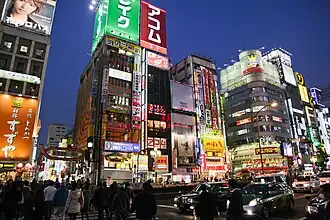
Shinjuku
Tokyo, Japan
Why visit Shinjuku?
Shinjuku (新宿) is a central ward of Tokyo and one of the metropolis's defining districts, officially designated a fukutoshin — a "secondary city centre". The area wrapped around Shinjuku Station forms a vast business, retail and entertainment quarter sitting atop the world's busiest railway station complex. Over 300,000 people live in the ward, including nearly 30,000 foreign residents, and it offers an unusually full spread of things to do for work or play.
Shinjuku splits neatly in two. The west side is Tokyo's skyscraper district, a seismically stable zone of high-rise towers including the colossal twin-towered Tokyo Metropolitan Government Building and the curving, web-faced Mode Gakuen Cocoon Tower. The east side is given over to shopping and nightlife, including Kabukichō — Tokyo's largest red-light district — and Shinjuku Ni-chōme, the heart of the city's gay nightlife. To the north lies student-heavy Takadanobaba near Waseda University; to the east, the quieter residential pockets of Yotsuya and Ichigaya, and Kagurazaka, one of Tokyo's last surviving geisha quarters and home to some of its most authentic French and Italian dining. Nearby Ōkubo and Shin-Ōkubo are packed with Korean, Chinese, Thai and other Asian restaurants and grocers.
Shinjuku has a humid subtropical climate with four distinct seasons. Winters are mild, with January ranging from about 1°C to 10°C; summers are hot and humid, with August often hitting 31°C. The rainy season falls from June into early July, and September can bring typhoons and heavy rain. Spring and autumn are the most comfortable times to visit.
Planning Shinjuku? Tell us your dates and we’ll tailor the trip.
Ask on WhatsAppHow do you get there?
By Plane
From Narita Airport (NRT), the fastest route is the Keisei Skyliner with a change at Nippori to the JR Yamanote Line — about 65–80 minutes including the transfer, ¥2,780, though the Yamanote can be very crowded with luggage at peak hours. JR's Narita Express runs directly to Shinjuku (about 95 minutes, ¥3,250); foreign visitors can buy an N'EX Tokyo Round-Trip Ticket to bring the cost down to ¥2,500 each way. Budget travellers can use the Keisei Narita Sky Access via Higashi-Nihombashi and Bakuroyokoyama stations (around 105 minutes, ¥1,470 total). Limousine buses run frequently from Narita to Shinjuku Station's west exit and area hotels (about 2 hours, ¥3,600). From Haneda Airport (HND), take Keikyu and Yamanote line trains changing at Shinagawa (45 minutes, ¥590), or a limousine bus (50 minutes, ¥1,230).
By Train
Train is the obvious way in. Shinjuku Station is on the JR Yamanote, Chuo, Sobu, Saikyo and Shonan-Shinjuku lines, with subway service on the Tokyo Metro Marunouchi and Fukutoshin lines and the Toei Shinjuku and Ōedo lines, plus terminals for the private Keio, Odakyu and Seibu Shinjuku railways. Guinness World Records recognises it as the busiest railway station in the world, with more than 3.8 million passengers a day. The station is effectively a multi-level warren of department stores, malls and passageways radiating for kilometres underground — getting lost is normal, so allow extra time.
By Car / Road
Most highway and long-distance buses now use the Shinjuku Expressway Bus Terminal (Busta Shinjuku), opened in 2016 above the JR tracks at Shinjuku Station. Airport limousine buses from Narita (¥3,100, roughly 100 minutes) and Haneda (¥1,200, 50 minutes) stop at the station and major hotels, though they are prone to traffic delays. Driving into central Shinjuku is not recommended given congestion and parking costs.
Shinjuku is best covered on foot once you are clear of the station, supplemented by the dense subway and JR network for longer hops; typical Tokyo Metro fares run from about ¥180. IC cards (Suica, PASMO) make travel seamless. Taxis are plentiful but expensive. There are no tuk-tuks; ride-hailing exists but taxis and trains are usually simpler. Kabukichō is safe to walk but be wary of touts outside bars and clubs offering "free" drinks or escort services — ignore them and avoid any venue without clearly posted prices.
What are the things to do?
Tokyo Metropolitan Government Building (都庁) — 2-8-1 Nishi-Shinjuku (Metro Tochōmae). Twin towers by architect Kenzo Tange, with free observatories at 202 m on the 45th floor offering some of the best views in Tokyo. North Observatory daily 09:30–23:00 (closed 2nd and 4th Mondays); South Observatory daily 09:30–17:30 (until 23:00 when the North is closed; closed 1st and 3rd Tuesdays). Free.
Shinjuku Gyoen National Garden (新宿御苑) — A ten-minute walk east of JR Shinjuku Station. A large garden with Japanese, English and French sections, a Taiwanese teahouse and a greenhouse — one of Tokyo's best cherry-blossom spots, and peaceful thanks to the entrance fee. Open 09:00–16:30 (later in spring and summer); closed most Mondays and over New Year. ¥500, seniors/students ¥250, under-15s free.
Hanazono Shrine (花園神社) — Near the Meiji-dōri/Yasukuni-dōri intersection. A pleasant breather amid the bustle, with a weekend flea market in the surrounding park.
Suga Shrine (須賀神社) — 5-6 Sugachō. A small shrine whose front staircase featured in the animated film Your Name. Free, open roughly 10:00–17:00.
Fire Museum (消防博物館) — Yotsuya 4-10, by Yotsuya-sanchōme station. Fire helicopters, trucks and three floors of exhibits; very popular with children. Open 09:30–17:00, closed Mondays. Free.
Tokyo Toy Museum (東京おもちゃ美術館) — Yotsuya 4-20. An old school filled with toys; ¥700 per adult, ¥500 per child. Open 10:00–16:00, closed Thursdays.
Sing karaoke — Chains such as Karaokekan run multiple branches near the station, with rooms for one person up to large groups and all-you-can-drink options.
Catch a film — Shinjuku Piccadilly (Shinjuku 3-15-5) and Wald 9 are modern multiplexes with stadium and premium seating, around ¥1,800 standard.
Watch baseball — Meiji Jingu Stadium (Jingū Stadium) near Sendagaya hosts university and professional games; the Japan National Stadium, built for the 2020 Games, is nearby.
Explore Kabukichō and Ni-chōme at night — Tokyo's wildest nightlife quarters, best experienced with eyes open and wits about you.
Relax at a spa — Hotel spas such as the Park Hyatt's wellness facilities offer upscale pampering.
Planning Shinjuku? Want these on a customised itinerary?
Ask on WhatsAppWhere to eat?
Shinjuku offers everything from one-coin (under ¥500) noodle stands to top-tier gourmet dining. The narrow lanes of Omoide Yokochō ("Memory Lane", also nicknamed "Piss Alley") near the west exit are crammed with tiny grilled-skewer (yakitori) stalls. Kabukichō and the east side hold countless ramen shops, izakaya and international restaurants, while Kagurazaka is known for refined French and Italian cooking. Ōkubo and Shin-Ōkubo are the place for Korean barbecue and other Asian cuisines, including good options for vegetarians and those seeking halal food.
Where to drink?
Shinjuku's drinking scene is legendary. Golden Gai, a warren of six tiny alleys near Kabukichō, packs in around 200 minuscule bars, each with its own character (some welcome tourists more than others — check for cover charges). Kabukichō and Ni-chōme add hundreds more bars and clubs, the latter the centre of LGBTQ+ nightlife. Stylish cafés and cocktail bars cluster in the skyscrapers and around the Southern Terrace. Tap water across Tokyo is safe to drink.
Planning Shinjuku? We’ll book the stays and dining for you.
Ask on WhatsAppWhere to stay?
- Budget — Capsule hotels and hostels around Shinjuku and Ōkubo offer beds from roughly ¥3,000–5,000.
- Mid-range — Numerous business hotels near the station typically run ¥12,000–25,000 per night.
- Upscale — The Park Hyatt Tokyo in Nishi-Shinjuku (of Lost in Translation fame) and the Keio Plaza Hotel are landmark high-end choices, generally from ¥40,000 upward.
What should you buy?
Shinjuku is one of Tokyo's great shopping grounds. Isetan (Shinjuku 3-14-1) is the most prestigious department store in the area, famous for its lavish depachika food hall. Keio and Odakyu department stores sit above the station's west side, and Lumine and NEWoMan target younger fashion shoppers. Electronics giants such as Yodobashi Camera and Bic Camera have huge multi-floor outlets here, often with tax-free counters. Prices are fixed; bargaining is not the norm, though electronics stores may offer point-card credit.
Where to go next?
- Shibuya — One stop south on the Yamanote Line, the youthful shopping and crossing district.
- Harajuku — Between Shinjuku and Shibuya, with Takeshita-dōri and Meiji Shrine.
- Ikebukuro — A few stops north, another major retail and entertainment hub.
- Nakano — Just west on the Chuo Line, home to the Nakano Broadway anime complex.
- Mount Takao — About an hour west on the Keio Line, an easy mountain day trip.
- Kichijoji — West on the Chuo Line, a relaxed neighbourhood beside Inokashira Park.
Nearby in Tokyo
More places to explore around Shinjuku.

Guide content as of May 2026. Portions adapted from Wikivoyage, CC BY-SA 4.0.

Contact Us
Get in touch with us.
Get in touch
Contact Us
Tell us where you'd like to go and how you like to travel. A real Tripcuro planner — not a bot — will craft an itinerary around you.
- Personalised, hassle-free planning end-to-end
- Transparent pricing, no hidden costs
- 24/7 support for complete peace of mind