
Miho Museum
Shiga, Japan
About Miho Museum
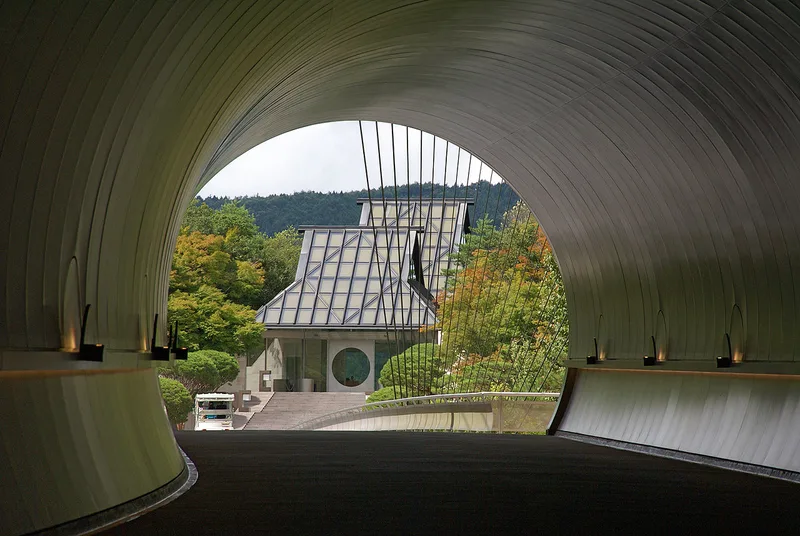
The Miho Museum (ミホミュージアム) is a private art museum set deep in the forested hills of southern Shiga prefecture, near Shigaraki in the city of Koka. It opened in 1997 and was designed by the renowned architect I.M. Pei, who also designed the glass pyramid of the Louvre. The building is the principal reason many travellers make the journey: roughly 80 percent of its structure is concealed underground to protect the surrounding nature reserve, and visitors reach it by walking through a long, gently curving tunnel and across a suspension bridge before the museum reveals itself. Pei is said to have drawn on the classical Chinese tale of the Peach Blossom Spring — the story of a hidden, idyllic valley — as the inspiration for this dramatic approach.
The collection itself was assembled by Mihoko Koyama, founder of the religious organisation that established the museum, and her family, and it ranges across both Asian and Western antiquities. Highlights include ancient Egyptian, West Asian, Greek, Roman, South Asian and East Asian art, displayed in calm, beautifully lit galleries that make the most of natural light. The setting, architecture and art are designed to be experienced as a single unhurried whole.
Crucially, the museum is not open year-round: it operates in seasonal sessions, typically opening for periods in spring, summer and autumn and closing in winter and between sessions. Spring brings cherry and weeping-cherry blossom along the approach path, and autumn brings vivid foliage; both are spectacular and popular. Always check the official seasonal calendar and opening dates before planning a visit, as travelling out to this remote spot only to find the gates closed is a real risk.
Planning Miho Museum? Tell us your dates and we’ll tailor the trip.
Ask on WhatsAppHow to reach
By Plane
By Train
There is no station at the museum. The usual rail-and-bus route is to take the JR Tokaido Main Line (Biwako Line) to Ishiyama Station near Otsu, then ride the connecting bus operated for the museum up into the hills to the Miho Museum stop. The bus journey takes roughly 50 minutes.
By Car / Road
The museum lies in the hills of southern Shiga and is reached by road from Kyoto, Otsu and the expressway network; driving from Kyoto takes roughly an hour. There is a car park, from which visitors walk through the tunnel and over the bridge to the entrance — private cars are not allowed to drive all the way to the building.
The Miho Museum is a single, self-contained destination. From the reception building, an electric shuttle cart is available for those who need it, but most visitors choose to walk the celebrated approach: through the long tunnel, across the suspension bridge and up to the museum entrance, a stroll of several hundred metres that is an essential part of the experience. The galleries themselves are spread between a north wing and a south wing, all easily covered on foot. There is no public transport on site beyond the shuttle cart and the museum's own connecting bus.
Things to do
- The approach tunnel and suspension bridge — I.M. Pei's curved tunnel and the cable-stayed bridge that follows it are an architectural set-piece and the signature image of the museum, framing a long, theatrical reveal of the building.
- The museum building — Pei's largely subterranean structure, with its glass-and-steel roof, geometric skylights and limestone interiors, is itself a major work of architecture worth experiencing slowly.
- The South Wing galleries — Devoted largely to ancient Western and West Asian art, including Egyptian, Mesopotamian, Greek and Roman pieces.
- The North Wing galleries — Focused on East Asian art, including Chinese, Japanese and other Asian works, sometimes shown in rotating special exhibitions.
The thing to do at the Miho Museum is simply to give the visit time. Allow at least half a day: walk the tunnel-and-bridge approach unhurried, explore both wings of the collection, and pause for the views out over the wooded valley, which change beautifully with the seasons. Visiting during cherry-blossom season in spring or the autumn foliage period transforms the approach path, though these are also the busiest times. The museum pairs naturally with the pottery town of Shigaraki, which is close by, making a satisfying full day combining art, architecture and ceramics.
Planning Miho Museum? Want these on a customised itinerary?
Ask on WhatsAppFood & Dining
The museum has its own restaurant and cafe, known for using organic and natural ingredients in keeping with the philosophy of the institution, including dishes suitable for those seeking lighter or vegetable-forward meals. Given the remote setting, these are the most convenient places to eat during a visit. Outside the museum, dining options nearby are limited and rural, so eating on site or back in Kyoto or Otsu is usually easiest.
Cafes & Nightlife
The museum cafe serves coffee, tea and seasonal soft drinks, with the same emphasis on natural ingredients found in its food. Tap water throughout the area is safe to drink, and carrying water is sensible given the walk from the car park.
Planning Miho Museum? We’ll book the stays and dining for you.
Ask on WhatsAppPlaces to Stay
The Miho Museum has no accommodation of its own and is best visited as a day trip. Most visitors stay in Kyoto or Otsu, where hotels and ryokan are plentiful across all price ranges.
What to buy
The museum shop sells art books, exhibition catalogues, postcards, prints and design objects related to the collection and to I.M. Pei's architecture, along with quality souvenirs. The nearby town of Shigaraki is the place for traditional Shigaraki pottery. Prices in Japanese shops are fixed and bargaining is not practised.
Go next
- Shigaraki — Close by in the same hills; a historic pottery town famous for Shigaraki ware and tanuki figures.
- Koka (Kōka) — The wider city the museum sits within; known for its ninja heritage.
- Otsu — On Lake Biwa, the prefectural capital of Shiga, with lakeside temples and cruises.
- Kyoto — Roughly an hour away; Japan's cultural capital, with countless temples and gardens.
- Uji — Southeast of Kyoto; a historic tea town with World Heritage temples.
- Kusatsu — On Lake Biwa; a historic post town on the old Tokaido road.
Nearby in Shiga
More places to explore around Miho Museum.
Portions adapted from Wikivoyage, CC BY-SA 4.0.

Contact Us
Get in touch with us.
Get in touch
Contact Us
Tell us where you'd like to go and how you like to travel. A real Tripcuro planner — not a bot — will craft an itinerary around you.
- Personalised, hassle-free planning end-to-end
- Transparent pricing, no hidden costs
- 24/7 support for complete peace of mind