
Shiogama
Miyagi, Japan
Why visit Shiogama?
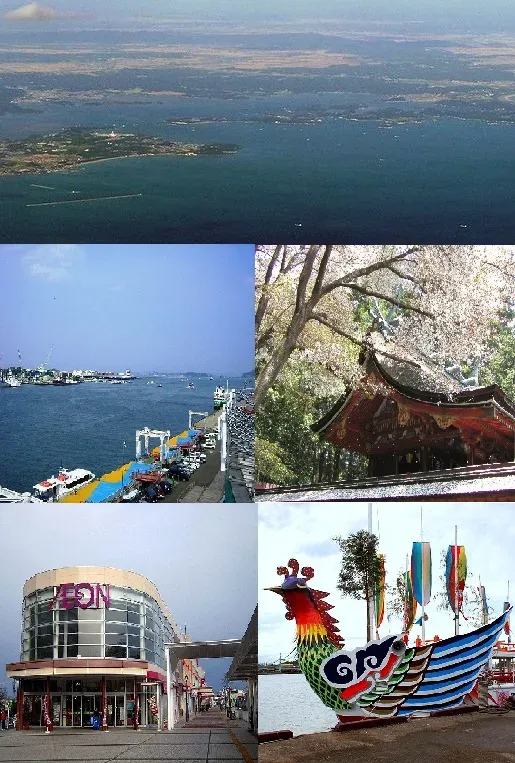
Shiogama (塩竈市, also written 塩釜) is a compact port city on Matsushima Bay in Miyagi Prefecture, wedged between the prefectural capital Sendai and the famous scenic town of Matsushima. The name means "salt cauldron," and the city's identity is bound up with salt and the sea: legend holds that the deity enshrined here taught the people of the region how to make salt from seawater. Today Shiogama is a busy fishing port — one of Japan's leading landing points for fresh tuna — and a working town with a long maritime heritage rather than a polished tourist resort.
For travellers, Shiogama has two main draws. The first is Shiwahiko Shrine (Shiogama Jinja), an ancient and important Shinto shrine set on a wooded hilltop, reached by a steep stone stairway and famous for its early-blooming cherry trees. The second is the seafood: Shiogama's fish market and sushi restaurants are renowned, and the city claims one of the highest concentrations of sushi shops per capita in Japan. It is also the gateway port for sightseeing ferries to Matsushima, making it an easy and rewarding stop on a Sendai–Matsushima itinerary.
The climate is mild coastal Miyagi: cold but lightly snowy winters, a cool rainy season around June, warm humid summers and a clear, pleasant autumn. Spring is a fine time to visit for the shrine's celebrated blossom; any season suits a seafood-and-shrine day trip.
Planning Shiogama? Tell us your dates and we’ll tailor the trip.
Ask on WhatsAppHow do you get there?
By Plane
The nearest airport is Sendai Airport (SDJ), the largest in Tōhoku. From the airport, take the Sendai Airport Access line to Sendai Station and continue to Shiogama by local train (see below).
By Train
Shiogama is well served by two JR lines. Hon-Shiogama Station on the JR Senseki Line is the most convenient, close to the fish market, sushi area and ferry pier, and about 25–30 minutes from Sendai. Shiogama Station on the JR Tōhoku Main Line is a separate station on a different line; do not confuse the two. From Tokyo, take the Shinkansen to Sendai and transfer to the Senseki Line.
By Car / Road
Shiogama lies just off the Sanriku Expressway and Sendai-area road network, around 20–30 minutes by car from central Sendai and a short drive from Matsushima. Local buses connect Shiogama with Sendai and neighbouring towns, though the train is generally the most convenient option.
Central Shiogama around Hon-Shiogama Station is walkable — the shrine, fish market and sushi restaurants are all reachable on foot, though the climb up to Shiwahiko Shrine involves a long flight of stone steps. From Hon-Shiogama Station to the ferry wharf is about a 500 m walk, with signs to guide you. Local buses cover wider areas, and there are taxis at the stations. There is no metro and no ride-hailing; Japan is very safe, with no scams of concern.
What are the things to do?
Shiwahiko Shrine / Shiogama Jinja (鹽竈神社) — Shiogama's foremost sight: an ancient, important Shinto shrine on a wooded hilltop, reached by a steep stone stairway, with handsome vermilion buildings and views over the bay. It is especially famous for its early-blooming "Shiogama-zakura" cherry trees. The adjacent Shiwahiko Shrine (志波彦神社) shares the precinct.
Shiogama Fish Market (塩釜水産物仲卸市場) — a large wholesale market open to the public, where visitors can buy fresh seafood and assemble their own "my-don" seafood rice bowl.
Marine Gate Shiogama — the modern ferry terminal building, departure point for Matsushima Bay cruises, with shops and bay views.
Take a bay cruise to Matsushima — sightseeing ferries depart from Marine Gate Shiogama and weave among the pine-clad islands of Matsushima Bay; a scenic way to combine the two towns.
Build your own seafood bowl at the fish market — buy slices of fresh fish from different stalls and pile them onto a bowl of rice, a popular market experience.
Climb to Shiogama Jinja — the long stone stairway and hilltop shrine reward visitors with bay views, particularly during the spring blossom.
Tour a sake brewery — Shiogama has historic sake breweries open to visitors.
Planning Shiogama? Want these on a customised itinerary?
Ask on WhatsAppWhere to eat?
Shiogama is, above all, a place to eat seafood. Fresh tuna landed at the port is a particular speciality, and the city is celebrated for its sushi — it has a remarkably high density of sushi restaurants. The fish market lets visitors assemble their own seafood rice bowls.
- Sushi restaurants — Shiogama's sushi shops range from budget to upscale; the freshness of the tuna and local fish is the draw.
- Shiogama Fish Market "my-don" — budget-friendly: buy seafood from market stalls and create a custom rice bowl.
- Harbour-side seafood restaurants — moderate-priced spots serving sashimi, grilled fish and rice bowls.
Vegetarian and halal options are very limited in this fishing town; plain noodle and vegetable dishes are the most reliable meat-free choices.
Where to drink?
Shiogama has a notable sake culture, with historic breweries producing well-regarded brews that pair naturally with the local seafood. Cafés around the station and ferry terminal serve coffee, and vending machines are everywhere. Tap water in Shiogama, as throughout Japan, is safe to drink.
Planning Shiogama? We’ll book the stays and dining for you.
Ask on WhatsAppWhere to stay?
- Budget: Simple business hotels and guesthouses near Hon-Shiogama Station run roughly ¥4,000–6,500 per person; budget options are also plentiful in nearby Sendai.
- Mid-range: Standard business hotels in the city centre and near the ferry terminal run roughly ¥6,000–11,000 per night.
- Upscale / heritage: Upscale accommodation is limited in Shiogama itself; for a more comfortable bay-view stay, the resort hotels and ryokan of neighbouring Matsushima are a short trip away.
What should you buy?
Shiogama's signature buys are seafood — fresh, dried and processed — from the fish market and harbour shops, alongside salt-themed products that nod to the city's name and history. Shrine charms are sold at Shiogama Jinja. For a wider range of shopping, nearby Sendai is the place to go. Prices are fixed; bargaining is not practised in Japan.
Where to go next?
- Matsushima (~15 min by train, or by sightseeing ferry) — one of Japan's "Three Great Views."
- Sendai (~25–30 min) — Tōhoku's largest city, capital of Miyagi.
- Tagajō (~10–15 min) — site of an ancient Nara-period government fort, Tagajō.
- Shichigahama (~15 min) — a small peninsula town with beaches and coastal views.
- Ishinomaki (~45 min) — coastal city with the Ishinomori Manga Museum.
Nearby in Miyagi
More places to explore around Shiogama.

Guide content as of May 2026. Portions adapted from Wikivoyage, CC BY-SA 4.0.

Contact Us
Get in touch with us.
Get in touch
Contact Us
Tell us where you'd like to go and how you like to travel. A real Tripcuro planner — not a bot — will craft an itinerary around you.
- Personalised, hassle-free planning end-to-end
- Transparent pricing, no hidden costs
- 24/7 support for complete peace of mind