
Hiraizumi
Iwate, Japan
About Hiraizumi
Hiraizumi (平泉) is a small town of around 7,400 people in southern Iwate, in the northeastern Tōhoku region. Its modern quiet belies an extraordinary past. During the reign of the Northern Fujiwara clan (1100s), Hiraizumi was said to rival Kyoto itself in grandeur and sophistication — a glittering provincial capital and a centre of Pure Land Buddhism. That golden age ended abruptly with the clan's destruction in 1189, and what remains today are mostly ruins, gardens and temple grounds where great halls once stood.
It was these melancholy traces that moved the haiku poet Matsuo Bashō, who passed through in 1689 and wrote his famous lines: "Summer grass — all that remains of warrior dreams." Bashō is now idolised in Hiraizumi to an almost comic degree; statues, monuments and inscribed haiku are everywhere, and cafés advertise their mention in his travel classic, Narrow Road to the Deep North. In 2011, six of the town's sites — Chūson-ji, Mōtsu-ji, Kanjizaiō-in Ato, Muryōkō-in Ato, Yanaginogosho Iseki and Mount Kinkeisan — were collectively inscribed as a UNESCO World Heritage Site celebrating Pure Land Buddhism.
The climate follows the Tōhoku pattern: cold, snowy winters and warm, humid summers. Spring brings cherry blossom and the fresh green that Bashō wrote about; autumn delivers excellent foliage around the temple grounds. The town is compact and easily covered in a day, making it a rewarding stop between Sendai and Morioka.
Planning Hiraizumi? Tell us your dates and we’ll tailor the trip.
Ask on WhatsAppHow to reach
By Plane
The nearest airport is Iwate Hanamaki Airport (HNA), with domestic flights and limited international service; from there continue by train via Morioka or Kitakami. Most travellers, however, arrive by Shinkansen from Tokyo. See "By Train."
By Train
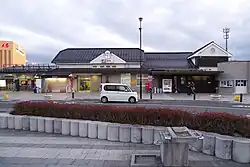
Hiraizumi sits on the JR Tōhoku Main Line, connecting north to Morioka and south to Sendai. The nearest Shinkansen station is Ichinoseki, just 10 minutes away by local train (¥200). Trains from Tokyo reach Ichinoseki in about 2½ hours; the full one-way fare through to Hiraizumi is around ¥12,820, with no charge for Japan Rail Pass holders.
By Car / Road
Hiraizumi lies just off the Tōhoku Expressway near the Hiraizumi-Maesawa interchange, an easy drive of around 10–15 minutes from Ichinoseki and roughly 1.5 hours from Sendai. Local buses connect JR Hiraizumi Station with the main sights, though many visitors walk or cycle instead.
Hiraizumi is small and walkable — the main temples can be reached on foot from the station, though a local "Run Run" loop bus links the principal sights for those who prefer to ride. The most enjoyable option is a bicycle: rental is available just to the right of the station, at about ¥1,000 for a full day (shorter periods also offered). A bike lets you reach the more distant Takkoku no Iwaya temple comfortably and enjoy the countryside along the way. There is no metro and no ride-hailing; the area is very safe.
Things to do
In 2011 six sites were inscribed as the World Heritage Site "Hiraizumi — Temples, Gardens and Archaeological Sites Representing the Buddhist Pure Land."
Temples
- Chūson-ji (中尊寺) — Hiraizumi's largest and most famous temple, renowned for the Golden Hall (Konjikidō), a small shrine sheathed in gold lacquer and mother-of-pearl and protected inside a large glass case. ¥800. About 5 minutes by bus or 20 on foot from the station.
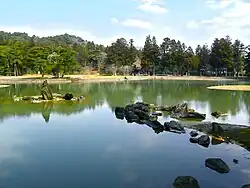
- Mōtsu-ji (毛越寺) — the town's second great temple, celebrated for its Heian-era Pure Land Garden (Jōdo-en) dating to around 800 AD, with wide grassy spaces and small posts marking lost temple buildings. ¥500. About 10 minutes' walk from the station.
- Takkoku no Iwaya Bishamon-dō (達谷窟毘沙門堂) — an atmospheric cave temple dedicated to Bishamon, the god of war; the current structure is the fifth incarnation since 801, and the site also holds the Ganmen Daibutsu, a giant cliff-carved Buddha of which only the head survives. ¥300. About 30 minutes by bike from town. (Not a World Heritage Site, despite being a favourite with visitors.)
Gardens and archaeological sites
Kanjizaiō-in Ato (観自在王院跡) — originally a large garden built by Fujiwara Motohira's wife; now mostly a park with preserved garden elements. Free.
Muryōkō-in Ato (無量光院跡) — the site of a vanished temple, of which only the pond remains.
Yanaginogosho Iseki (柳之御所遺跡) — the site of the former Fujiwara palace; no buildings survive, but the pond and foundations convey its scale, and excavations continue. The nearby Yanaginogosho Museum explains the history when the site itself is closed.
Mount Kinkeisan (金鶏山) — a small sacred hill where Buddhist sutras were once buried.
Cycle the World Heritage circuit — rent a bike at the station and link Chūson-ji, Mōtsu-ji and Takkoku no Iwaya at your own pace.
Follow in Bashō's footsteps — seek out the haiku monuments and the spot that inspired "Summer grass — all that remains of warrior dreams."
Attend a temple event — Mōtsu-ji and Chūson-ji host seasonal ceremonies, including an Heian-style poetry-and-music event at Mōtsu-ji's garden stream.
Enjoy the seasons — come for cherry blossom in spring or foliage in autumn, when the temple grounds are at their most beautiful.
Planning Hiraizumi? Want these on a customised itinerary?
Ask on WhatsAppFood & Dining
Hiraizumi's food culture is modest and temple-oriented — small teahouses and noodle restaurants rather than a dining scene. A local speciality worth seeking out is wanko soba, the playful all-you-can-eat noodle tradition shared with the wider Iwate region.
- Ryoei Sushi (良栄寿司) — a charmingly old-fashioned sushi place run by an elderly owner who makes everything herself, very slowly; sets run from ¥900 to ¥1,700. Worth the wait, but not if you have a train to catch. Moderate. (West from the station to the second set of lights, then right past the bridge.)
- Kanzan-tei (かんざん亭) — a restaurant within the grounds of Chūson-ji serving soba, udon, pizza and desserts. 10:00–16:00.
- Teahouses and souvenir stands within Chūson-ji offer light meals and sweets.
Vegetarian options exist in the form of plain soba and udon; halal facilities are not available.
Cafes & Nightlife
Teahouses around the temple grounds serve green tea and traditional sweets, and cafés in town trade heavily on their Bashō connections. Iwate's sake is worth trying with a meal. Vending machines are plentiful. Tap water in Hiraizumi, as everywhere in Japan, is safe to drink.
Planning Hiraizumi? We’ll book the stays and dining for you.
Ask on WhatsAppPlaces to Stay
- Budget: Minpaku Hiraizumi (民泊 飛来住) — a small family-run inn offering simple, affordable lodging; budget guesthouses in nearby Ichinoseki run roughly ¥4,000–6,000 per person.
- Mid-range: Business hotels in nearby Ichinoseki (10 minutes by train) typically run ¥6,000–10,000 per night and make a convenient base.
- Upscale / heritage: For more comfort, the hot-spring ryokan around Genbikei and Geibikei near Ichinoseki offer Japanese-style stays with onsen; rates roughly ¥12,000–20,000 per person with meals.
What to buy
Hiraizumi's souvenir trade centres on Buddhist-themed crafts, regional confectionery and local pottery and textiles.
- Sekimiya (せき宮) — a shop selling locally made clothing and pottery. 10:00–18:00, closed Wednesdays.
- Souvenir stands within the grounds of Chūson-ji sell sweets, charms and crafts.
Prices are fixed throughout Japan; bargaining is not practised.
Go next
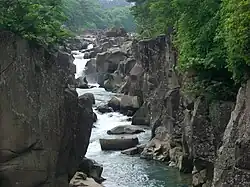
- Ichinoseki (~10 min by train) — the nearest Shinkansen city, gateway to the Genbikei and Geibikei gorges.
- Morioka (~40 min by Shinkansen) — Iwate's capital, with castle park and famous noodles.
- Hanamaki (~20 min by train) — hot springs and the Miyazawa Kenji literary sites.
- Tōno (~1.5 hours) — folklore town of kappa legends and folk villages.
- Sendai (~1.5 hours by Shinkansen) — Tōhoku's largest city.
- Matsushima (~2 hours) — one of Japan's "Three Great Views," a bay of pine-clad islands.
Nearby in Iwate
More places to explore around Hiraizumi.
Portions adapted from Wikivoyage, CC BY-SA 4.0.

Contact Us
Get in touch with us.
Get in touch
Contact Us
Tell us where you'd like to go and how you like to travel. A real Tripcuro planner — not a bot — will craft an itinerary around you.
- Personalised, hassle-free planning end-to-end
- Transparent pricing, no hidden costs
- 24/7 support for complete peace of mind