
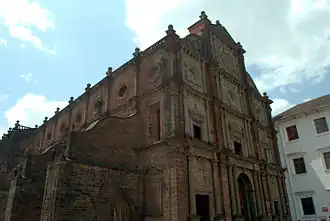
Old Goa
Goa, India
Why visit Old Goa?
Old Goa lies about 9 km east of Panaji, on the south bank of the Mandovi River, and is one of India's most extraordinary historical sites — the former colonial capital of Portuguese India and, at its height, a city said to rival Lisbon in size and splendour. It is a compact cluster of monumental churches and convents, mostly built between the 16th and 17th centuries, set among lawns and trees where a great metropolis once stood. The site is maintained by the Archaeological Survey of India and is inscribed on the UNESCO World Heritage List as the "Churches and Convents of Goa".
The city flourished as the centre of Portuguese power and Catholic missionary activity in Asia — this was the base from which St. Francis Xavier set out, and his tomb in the Basilica of Bom Jesus remains its most venerated draw. Repeated epidemics, particularly malaria and cholera, eventually emptied the city; the administration shifted to Panaji in 1843, and the surrounding metropolis melted back into the landscape, leaving the great religious buildings behind. The result is a place that feels less like a town than an open-air museum of Indo-Portuguese baroque architecture.
Old Goa is small and best understood unhurried — allow at least half a day to take in the churches, museums and the sense of layered history. The main monuments stand close together around a central green. Climate follows the Goan pattern: November to February is dry, warm and ideal; March to May is hot; the June–September monsoon brings heavy rain but turns the grounds lush and green. Mornings are cooler and quieter for visiting.
Planning Old Goa? Tell us your dates and we’ll tailor the trip.
Ask on WhatsAppHow do you get there?
By Plane
The nearest airports are Manohar Parrikar International Airport (GOX IATA, the Mopa airport in North Goa) and the older Dabolim Airport (GOI IATA, about 35–40 km south). Both have prepaid taxi counters; fixing the fare at the counter avoids overcharging. App-based cabs also operate. From either airport, route via or near Panaji, which is just 9 km from Old Goa.
By Train
The nearest railway station is Karmali (station code KRMI) on the Konkan Railway, only a few kilometres away, though many express trains do not halt there. The main railhead for Goa is Madgaon Junction (Margao) to the south, where almost all trains stop; from either station, buses and taxis run to Old Goa via Panaji.
By Car / Road
Panaji is barely 9 km away, an easy drive of around 20–30 minutes along the riverside road through Ribandar. Frequent local buses connect Panaji's Kadamba (KTC) bus stand with Old Goa for a very low fare — the simplest and cheapest way to come. Taxis and app-based cabs are available but tend to overcharge in Goa, so agree the fare in advance or use a prepaid counter. Self-drive scooters are a popular option from Panaji; traffic jams around the monuments are an increasing reality in peak season.
Old Goa is best explored on foot — the monuments stand within easy walking distance of one another around the central green, and walking lets the history sink in. Local guides, some of them approved by the Goa tourism department, are available near the main churches and can add useful context. There is little need for vehicles within the site itself; keep any taxi or scooter for the trip in and out. Parking is available near the Basilica of Bom Jesus but fills up on busy days.
What are the things to do?
Basilica of Bom Jesus — the site's most famous church and a masterpiece of baroque architecture, home to the tomb of St. Francis Xavier, whose relics are displayed to the public during periodic Expositions. Generally open daily; free entry.
Sé Cathedral — one of the largest churches in Asia, dedicated to St. Catherine, with its surviving bell tower housing the celebrated "Golden Bell". Free entry.
Church and Convent of St. Francis of Assisi — a richly decorated church beside the Sé; its convent buildings house the Archaeological Museum.
Archaeological Museum and Portrait Gallery — within the St. Francis of Assisi convent, displaying sculpture, portraits of Portuguese governors and historical artefacts; a modest entry fee applies.
Church of St. Cajetan — modelled on St. Peter's Basilica in Rome, an elegant domed church built by Italian friars.
Chapel of St. Catherine — a small early chapel marking an early Portuguese victory in Goa.
Church of Our Lady of the Rosary — one of the oldest churches on the site, on Holy Hill, in a simpler Manueline style.
Tower of St. Augustine — the dramatic surviving belfry of the ruined Church of St. Augustine, a striking landmark on Holy Hill.
Museum of Christian Art — housed at the annexe of the Santa Monica Convent on Holy Hill, displaying Indo-Portuguese religious art; entry fee applies, and it has a good shop.
Pilar Monastery / Seminary Museum — a short distance away, with a museum collection and hilltop views.
Walk the monuments — the central experience of Old Goa is simply moving slowly between the churches and convents, taking in how this place once sat at a crossroads of global history.
Hire an approved guide — a knowledgeable guide brings the ruined city and its layered Hindu, Portuguese and missionary history to life.
Climb Holy Hill — for the cluster of the Rosary church, St. Augustine tower and the Museum of Christian Art, with views over the surrounds.
Time a visit for a feast — the Feast of St. Francis Xavier in early December draws huge crowds; the rare Exposition of his relics, held only every ten years or so, is a major pilgrimage event.
Cross to the river islands — a ferry crossing behind the church complex links to the quieter islands across the Mandovi, also a calm spot for fishing.
Planning Old Goa? Want these on a customised itinerary?
Ask on WhatsAppWhere to eat?
Dining options inside Old Goa are limited — there are only a few restaurants in the area and a scattering of eateries along the highway that passes through. Expect simple Goan and Indian fare: fish curry rice, thalis, snacks and cold drinks rather than fine dining. For a fuller meal, most visitors return to Panaji, just 9 km away, which has a wide range of Goan restaurants across all price tiers, including vegetarian thali places suited to veg and Jain diets.
Where to drink?
Drink options in Old Goa are as limited as the food — the few local restaurants and highway eateries serve soft drinks, tea, coconut water and the usual cold beer, and feni and Goan port wine may be found at some. For cafes, bars and a proper choice of drinks, head to nearby Panaji. Carry water on a hot day, as the monuments involve a fair amount of walking in the sun; stick to bottled or filtered water and be cautious with ice from informal stalls.
Planning Old Goa? We’ll book the stays and dining for you.
Ask on WhatsAppWhere to stay?
There are few places to stay in Old Goa itself, and most visitors base themselves in Panaji or elsewhere in Goa, since the region is small and easy to get around.
- Budget / mid-range: Old Goa Residency, a Goa Tourism property near the monuments, offers simple, well-located rooms; Shubhankar Heritage Hotel is an economy option located close to the railway station. Expect roughly ₹1,500–3,500 depending on category and season.
- Upscale: The Fern Kadamba, on the Kadamba plateau between Old Goa and Panaji, is the nearest upscale hotel, with full-service rooms and a pool. The DoubleTree by Hilton Goa - Panaji, near the Mandovi River on the bypass, is a five-star option with a spa, fitness centre and multiple restaurants; rates generally start from around ₹8,000 and rise sharply at peak season.
What should you buy?
Shopping is limited in Old Goa — souvenir and trinket stalls cluster near the main churches, but Panaji nearby has a far better selection. The best buying stop on site is the shop at the Museum of Christian Art, in the annexe to the Santa Monica Convent, which sells reproductions, religious art pieces and crafts at reasonable, fixed prices. For cashews, spices, feni and general souvenirs, hold off and shop in Panaji or at the Mapusa market.
Where to go next?
- Panaji (about 9 km west) — the state capital, with the Fontainhas Latin Quarter and the Mandovi riverfront; an easy bus ride.
- Divar Island (a short ferry from Old Goa) — a peaceful island of fields, old churches and villages, almost untouched by tourism.
- Chorao Island and Dr. Salim Ali Bird Sanctuary (a short ferry from Ribandar) — mangrove birdwatching close to the city.
- Ponda (about 20 km southeast) — temple country, with the Mangeshi and Shanta Durga shrines and spice plantations.
- Mapusa (about 20 km north) — North Goa's market town, best on a Friday.
- Calangute and Baga (about 25 km northwest) — Goa's busiest beach belt for shacks, watersports and nightlife.
Nearby in Goa
More places to explore around Old Goa.
Guide content as of May 2026. Portions adapted from Wikivoyage, CC BY-SA 4.0.

Contact Us
Get in touch with us.
Get in touch
Contact Us
Tell us where you'd like to go and how you like to travel. A real Tripcuro planner — not a bot — will craft an itinerary around you.
- Personalised, hassle-free planning end-to-end
- Transparent pricing, no hidden costs
- 24/7 support for complete peace of mind