
Al Jīzah
Egypt · Governorate · 11 destinations with guides
Photography coming soonWhy visit?
Al Jīzah — Giza — is far more than the postcard plateau that made it famous. The governorate sits on the west bank of the Nile directly across from Cairo, its dense riverside districts blending seamlessly into the capital's metropolitan sprawl, then thinning westward into satellite cities and, eventually, hundreds of kilometres of open Western Desert. This elongated shape gives Giza a split personality: a heaving urban core of perhaps several million people on one end, and the palm-fringed quiet of the Bahariya Oasis at the other. Few subdivisions anywhere pack this range — pharaonic wonder, modern megacity, and Saharan emptiness — into a single administrative line on the map.
For travellers, Giza is first and foremost the gateway to ancient Egypt's most concentrated cluster of monuments. The Giza Plateau holds the last surviving wonder of the ancient world, but the governorate also contains the older necropolises of Saqqara, Dahshur, Abusir and the ruined capital of Memphis — together a near-continuous open-air record of more than a thousand years of pyramid-building. The arrival of the Grand Egyptian Museum on the plateau's edge has shifted Giza from a half-day stop into a destination worth several days in its own right.
Beyond the monuments, modern Giza is where Greater Cairo expands and reinvents itself: the planned suburbs of 6th of October City and Sheikh Zayed City, with their universities, malls, studios and gated compounds, draw a younger, car-owning Egypt outward from the old riverbank. The contrast — feluccas drifting past the Corniche, the pyramids glowing at dusk, and glass office towers rising over the desert highway — is the defining texture of the place.
When is the best time to visit?
The comfortable season runs October to April, and it is non-negotiable for anyone planning to spend hours walking exposed plateaus and climbing into airless burial chambers. Daytime temperatures in this window sit pleasantly in the high teens to mid-20s °C, with cool, sometimes genuinely cold evenings (bring a layer for the after-dark sound-and-light show). December and January are the coolest and busiest; March and November offer the best balance of warm light and thinner crowds.
Avoid high summer if you can. From June through August, the plateau bakes at 35–42 °C with little shade, and the desert excursions out toward Bahariya become genuinely punishing in the middle of the day. A regional weather quirk to plan around is the khamsin season (roughly March–May), when hot southerly winds can whip up dust storms that grey out the sky and occasionally close desert roads for a few hours.
Two timing notes specific to the area: visiting during Ramadan (a moving date on the Islamic calendar) means shorter monument hours and many restaurants closed until sunset, but also an atmospheric, lantern-lit city after dark. And the spring festival of Sham El-Nessim (the Monday after Coptic Easter) sees Giza's families pour onto every patch of green and riverbank for picnics — colourful, but expect crowds and traffic.
Tell us your dates and we'll shape a Al Jīzah route around them.
WhatsAppHow do you get around?
Because western Giza is fused with Cairo, the easiest movements are short city hops. The Cairo Metro reaches the governorate on Line 2, with useful stops at Cairo University, Giza and the southern terminus at El Mounib; trains are cheap (a few EGP per ride) and bypass the area's notorious traffic. From a Metro station or anywhere in town, ride-hailing apps (Uber and Careem) are the simplest, fairest-priced way to move — far less haggling than street taxis. White metered taxis exist but agree the fare or insist on the meter first.
Distances are short on the river side and long once you head into the desert. The Giza Plateau is only about 13–18 km from downtown Cairo (20–40 minutes, traffic depending). 6th of October City and Sheikh Zayed City lie roughly 30–35 km west along the Cairo–Alexandria desert road and the 26th of July Corridor; minibuses and app-cars serve them, and a new monorail line linking 6th of October to Greater Cairo is rolling out to ease the commute. The southern pyramid fields — Saqqara and Dahshur — are about 20–30 km south of the plateau, best reached by a hired car or half-day driver since public transport is sparse and the sites are spread out.
For the far west, the Bahariya Oasis is around 360 km from Cairo (a 4–5 hour drive). Upper Egypt Bus Company coaches run from Cairo's main terminals to Bahawiti, the oasis town, but most travellers go with an organised 4x4 trip that bundles transport, a local guide and desert camping — the practical choice given the remoteness.
What should you eat?
Giza eats like Cairo, which is to say generously and cheaply. The unofficial national dish, koshari — a carb-on-carb tumble of rice, lentils, macaroni and chickpeas under fried onions and a tangy tomato-garlic-vinegar sauce — is everywhere and rarely costs more than a few tens of EGP at a busy counter. Breakfast and street staples are ful medames (slow-stewed fava beans) and taameya, Egypt's fava-bean version of falafel, fried green inside and stuffed into baladi bread with salad and tahina.
The governorate has a couple of signature sit-down traditions worth seeking out. The Mariouteya area in Giza is famous for char-grilled chicken and feteer (a flaky, layered Egyptian pastry served savoury or sweet) — the long-running Andrea Mariouteya garden restaurant is the classic address for a leisurely grilled lunch under the trees. For something more old-Cairo, hamam mahshi (pigeon stuffed with seasoned rice or freekeh) is a celebratory dish you'll find on many fuller menus, alongside molokhia (a garlicky jute-leaf stew). Along the Giza Corniche and around the plateau's perimeter, you'll find everything from upscale hotel dining with pyramid views to floating Nile restaurants.
Dietary notes: vegetarians eat extremely well here — koshari, ful, taameya and countless vegetable stews are naturally meat-free — though confirm that ful and rice dishes aren't finished with meat stock. Pork is essentially absent, most meat is halal by default, and alcohol is limited to licensed hotels, tourist restaurants and a few dedicated outlets rather than ordinary cafés.
Want the scenic legs and stays booked for you? Just ask.
WhatsAppWhat is the culture like?
Giza's cultural calendar largely follows Egypt's national rhythm of Islamic and Coptic observances. The two Eids (Eid al-Fitr at the close of Ramadan and Eid al-Adha roughly two months later, both moving dates) empty the offices and fill the parks and riverbanks; Coptic Christmas (7 January) and Easter anchor the Christian calendar, with the pan-Egyptian spring picnic of Sham El-Nessim the following day drawing enormous crowds outdoors. National days such as Revolution Day (23 July) and Armed Forces Day (6 October) — the latter literally the namesake of 6th of October City — bring flags, parades and a festive municipal mood.
The signature cultural fixture tied to the governorate itself is the nightly Pyramids Sound & Light Show at the Giza Plateau, a long-running son-et-lumière narration of pharaonic history projected across the monuments and the Sphinx, with sessions in rotating languages. The western suburbs, meanwhile, host Egypt's screen industry: Media Production City in 6th of October is the country's filmmaking hub, and the area's studios and arenas increasingly stage concerts and large-scale events.
On the crafts and arts side, Giza's strength is its workshops rather than a distinct folk tradition — alabaster carvers, papyrus painters and perfume-essence sellers cluster around the plateau (buy with a sceptical eye and a readiness to bargain), while the oasis communities out west keep their own date-farming and Bedouin desert culture.
What are the standout experiences?
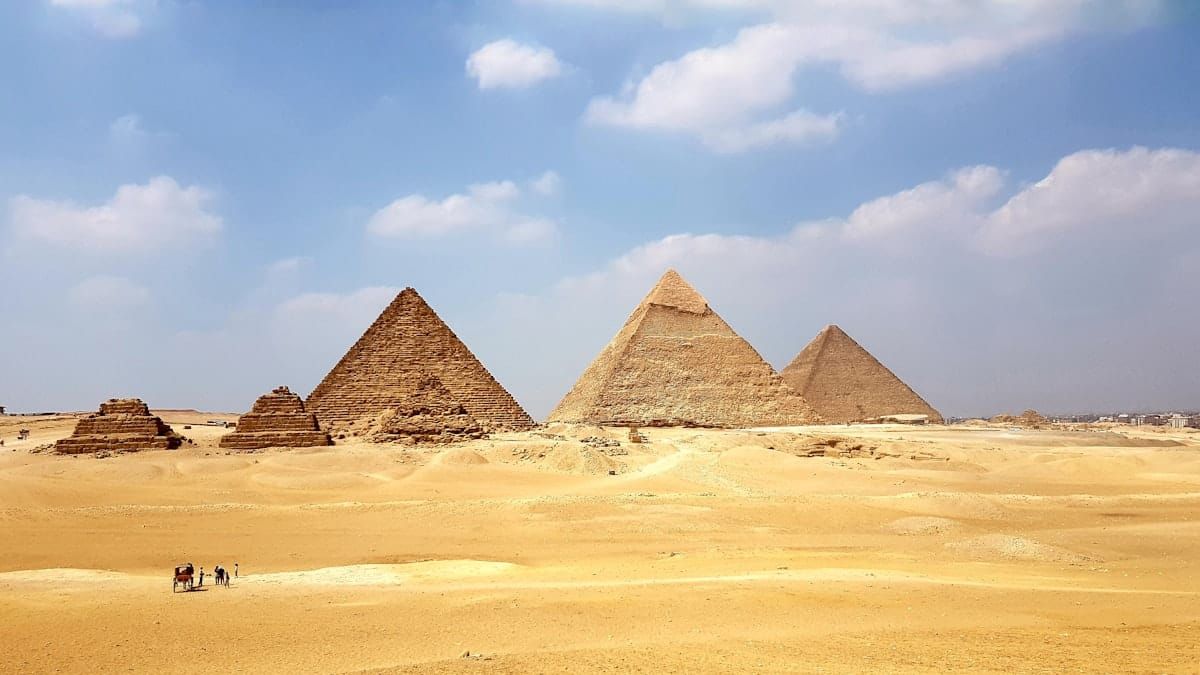
The Giza Plateau at first light. Be at the gates when they open to walk among the Great Pyramid of Khufu, the pyramids of Khafre and Menkaure, and the Great Sphinx before the heat and tour buses arrive. A short camel or horse ride out to the panoramic point gives you the classic three-pyramids-in-a-row view; agree the price and duration in writing before you mount.
The Grand Egyptian Museum (GEM). Opened to the public in 2025 on the plateau's edge, this vast museum is built to display the complete Tutankhamun collection together under one roof for the first time, along with the reconstructed solar boat of Khufu and a monumental statue of Ramesses II in its atrium. Pair it with the plateau in a single, full day.
The southern pyramid circuit: Memphis, Saqqara and Dahshur. A half-day loop south of the plateau traces the evolution of the pyramid itself — from Djoser's stepped Pyramid of Saqqara (Egypt's oldest large stone monument) to the experimental Bent Pyramid and the smooth-sided Red Pyramid at Dahshur, ending among the toppled colossi of ancient Memphis at Mit Rahina.
The evening Sound & Light Show. After dark, the floodlit pyramids and Sphinx become the backdrop for a narrated history-and-light spectacle — a low-effort, atmospheric way to see the monuments a second time without the daytime crowds.
A desert overnight to Bahariya and the Black & White Deserts. From the governorate's far west, 4x4 trips push out to the surreal chalk formations and basalt-strewn plains beyond Bahariya Oasis, with camping under exceptionally dark, star-filled skies — the wild, empty counterpoint to Giza's monumental, crowded east.
Top Destinations
Every destination in Al Jīzah with a guide — tap a place for the full guide.
6th of October City
6th of October City is a city or town in Giza Governorate, part of…
Atfih
Atfih is a small town in Giza Governorate on the east bank of the…
Awsim
Awsim (Ausim) sits on the site of ancient Letopolis, known in…
Badrashin
Badrashin (Al Badrashin) is a town of roughly 90,000 people on the…
Bahariya Oasis
Bahariya Oasis is a depression in Egypt's Western Desert, about 365…
El Ayyat
El Ayyat (formerly Kafr al-Ayyat) is a town of roughly 47,000 people…
El Hawamdeya
El Hawamdeya is a city in southern Giza Governorate overlooking the…
El Saff
El Saff is a city of roughly 59,000 people in southern Giza…
Giza
Giza is Egypt’s third-largest city, part of Greater Cairo.
Kerdasa
Kerdasa is a large town in Giza Governorate on the western edge of…
Sheikh Zayed City
Sheikh Zayed City is a planned satellite city in Giza Governorate…
Sample itinerary
See how a trip to Al Jīzah comes together — a real Tripcuro plan, day by day.
Pair the highlights of Al Jīzah into one easy trip — we'll plan the route.
WhatsApp
Contact Us
Get in touch with us.
Get in touch
Contact Us
Tell us where you'd like to go and how you like to travel. A real Tripcuro planner — not a bot — will craft an itinerary around you.
- Personalised, hassle-free planning end-to-end
- Transparent pricing, no hidden costs
- 24/7 support for complete peace of mind