
Wenshan
Yunnan Sheng, China
Why visit Wenshan?
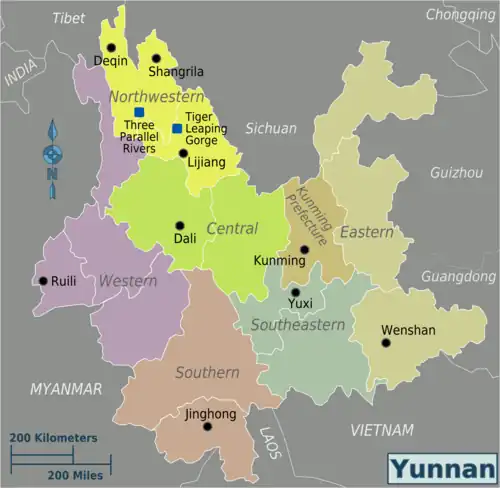
Wenshan (文山) is the seat of Wenshan Zhuang and Miao Autonomous Prefecture, tucked into the karst hills of southeastern Yunnan near the borders with Guangxi and Vietnam. It is far less touristed than the Dali–Lijiang–Shangri-La circuit, and that is precisely its appeal: a working Yunnanese prefecture capital surrounded by Zhuang, Miao, Yi, and Yao villages, with limestone scenery (most famously Puzhehei, an hour northwest in Qiubei County) that rivals Guilin's without the crowds. The city itself is compact, walkable along the Panlong River, and best treated as a base for exploring the prefecture rather than a sight in its own right.
Historically, Wenshan sat on caravan trails moving tin, salt, and tea between the Yunnan plateau and what is now northern Vietnam, and the prefecture is China's heartland for sanqi (三七, Panax notoginseng) — a medicinal root that you will see drying on tarps, stacked in pharmacies, and built into the local economy. The ethnic mix is the other defining feature: Zhuang and Miao together outnumber Han in the prefecture, and market days, weddings, and the lunar Flower-Mountain (花山节) festivals are where this is most visible.
Climate is humid subtropical at a modest elevation (~1,300 m). The dry season from November to April is the best window — cool, mostly clear days and cold nights. May to October is the rainy season; July–August can deliver heavy downpours and occasional landslides on the mountain roads, but it is also when Puzhehei's lotus flowers bloom (June–September), which for many travellers is the whole reason to come.
Planning Wenshan? Tell us your dates and we’ll tailor the trip.
Ask on WhatsAppHow do you get there?
By Plane
Wenshan Puzhehei Airport (IATA: WNH) is the prefecture's gateway, located near Qiubei roughly 90 km northwest of Wenshan city, much closer to Puzhehei itself. It is a small regional airport with daily flights to Kunming Changshui (KMG) and seasonal service to a handful of other Chinese cities.
- From the airport to Wenshan city: shuttle buses and chartered taxis run to Wenshan; allow 1.5–2 hours by road.
- From the airport to Puzhehei: roughly 30–40 minutes by taxi.
By Train
Wenshan is served by Wenshan Railway Station (文山站) on the Yunnan–Guangxi high-speed corridor, with regular high-speed services to Kunming South (around 2.5–3 hours) and eastward to Nanning in Guangxi (around 3–4 hours). This is now by far the easiest way to arrive from Kunming.
Tip: book via the China Railway 12306 app (English interface available); seats on the Kunming–Nanning line sell out on weekends and around national holidays.
By Car / Road
- From Kunming: about 350 km via the expressway, 5–6 hours by car. Road quality is good (modern tolled expressway).
- From Nanning (Guangxi): about 450 km, 6–7 hours.
- From Hekou (Vietnam border): about 240 km via mountainous but paved expressway, 4–5 hours.
Long-distance buses run from Kunming East Bus Station to Wenshan daily, with both day and overnight services. Bus is now slower and less comfortable than the high-speed train and is mainly useful for villages off the rail line.
Wenshan city is small enough that most of the centre is walkable along the riverside promenades. For longer hops:
- City buses: a low flat fare; routes are signed in Chinese only.
- Taxis: cheap flagfall, most cross-town rides inexpensive. Insist on the meter (打表).
- Didi (滴滴): the standard ride-hailing app works in Wenshan and is the easiest option for non-Chinese speakers — pin your destination on the map.
- Long-distance minibuses to Qiubei (for Puzhehei), Maguan, Malipo, and other county seats leave from the prefecture bus station; turn up and buy a ticket on the day.
Scams are rare here compared to bigger tourist cities, but unmetered "black taxis" outside the train station will quote inflated prices — walk to the official rank or call Didi instead.
What are the things to do?
- Panlong Park (盘龙公园) — riverside park in the city centre, with pavilions, a pagoda on the hill, and locals doing tai chi at dawn. Free, open during daylight hours. The best free introduction to the city.
- Wenshan Confucian Temple (文山文庙) — small restored Qing-era temple complex; a quick stop while wandering the old quarter.
- Sanqi (Panax) trade centre — a wholesale market and small display dedicated to sanqi; interesting even if you are not buying, to see the scale of the trade.
Outside the city (best day trips):
Puzhehei Scenic Area (普者黑) — the flagship sight of the prefecture, in Qiubei County roughly 90 km northwest. Karst peaks rising out of a network of lakes, lotus-filled in summer, with boatable caves and Yi villages. Best visited June–September for the lotus bloom, when boat "water battles" are a local tradition.
Bamei Village (坝美) — accessed only by punting through a long limestone tunnel-cave, opening onto a hidden Zhuang valley often compared to Tao Yuanming's Peach Blossom Spring. About 3 hours from Wenshan; doable as a long day trip but better as an overnight.
Laojunshan and other cave systems north of the city.
Lotus season boating at Puzhehei (June–September) — hire a wooden punt and drift through fields of lotus. Bring a change of clothes; getting splashed is part of the experience.
Hike the karst trails around Puzhehei's Qinglong Mountain for the postcard view across the lake basin.
Time your trip to a Flower-Mountain Festival (花山节) — Miao communities across the prefecture celebrate around the lunar new year with antiphonal singing, lusheng pipe dancing, and bullfighting. Maguan and Malipo counties are particularly known for these.
Markets — rotating market days in villages around the prefecture are where Zhuang and Miao women come down in full embroidered dress.
Day trip to the Vietnam border at Tianbao / Malipo for a sense of the frontier; crossing requires a Vietnamese visa arranged in advance and is not always open to foreigners.
Planning Wenshan? Want these on a customised itinerary?
Ask on WhatsAppWhere to eat?
Wenshan eats from the broader Yunnanese playbook — rice noodles, mushrooms, smoky cured meats, generous chilli — with strong Zhuang and Miao influences (sticky rice, sour-and-spicy soups, river fish). Vegetarians can do well by sticking to mushroom dishes, mixed-vegetable hotpots, and rice-noodle stalls (ask for no meat), though pure veg restaurants are rare. Halal options exist around the small Hui (Muslim) quarter near the mosque; look for the green crescent and 清真 signage.
Signature dishes to seek out:
- Crossing-the-Bridge Noodles (过桥米线) — the Yunnanese classic; rice noodles cooked at the table in a bowl of scalding broth.
- Sanqi steamed chicken (三七汽锅鸡) — chicken slow-steamed with sanqi root in a ceramic vessel; medicinal, warming, and a local set-piece.
- Sour-and-spicy fish (酸汤鱼) — Zhuang/Miao staple, usually river fish in a tomato-and-pickled-vegetable broth.
- Five-colour rice (五色饭) — sticky rice naturally dyed in five colours from plants; eaten at Zhuang festivals and increasingly available year-round.
The streets around Kaihua Road and the night-market lanes off the river are the safest bet for a first dinner — point and order at whatever is busiest with locals.
Where to drink?
- Yunnan coffee has surged in the last decade, and Wenshan has a small but growing scene of independent cafés serving beans from Pu'er and Baoshan.
- Pu'er tea is the everyday hot drink; any teahouse will brew it for you gongfu-style.
- Baijiu (白酒) — strong sorghum spirit, drunk in tiny cups at meals. Local rice wines and corn wines turn up at village banquets; accept the first toast politely and pace yourself.
- Sanqi flower tea (三七花茶) — a mild, floral local tisane, said to be cooling.
Water: do not drink tap water. Bottled water is cheap and ubiquitous; hotel rooms typically include a kettle and complimentary bottles. Hot water from the kettle is the standard local drink at any meal.
Planning Wenshan? We’ll book the stays and dining for you.
Ask on WhatsAppWhere to stay?
Wenshan's accommodation is dominated by domestic chain hotels rather than boutique or heritage properties.
Mid-range (the bulk of the market): chain hotels including national budget-to-midscale brands operate properties in Wenshan city and are the most reliable bet — clean rooms, English-capable booking via Trip.com/Ctrip, and central locations.
Upscale: the top of the market in Wenshan is local four-star business hotels rather than international chains.
For Puzhehei trips, consider overnighting in Puzhehei Village or Xianrendong Village in local Yi-run guesthouses rather than commuting from Wenshan city — you get sunrise on the lake without the 90 km drive.
What should you buy?
Wenshan's specialities are agricultural and medicinal more than handicraft:
- Sanqi (三七) — the prefecture is the world centre for Panax notoginseng. You can buy whole dried roots, powder, capsules, and sanqi-based teas. Smaller, traveller-friendly shops cluster along Kaihua Road in the city; bargain on whole roots, not on capsules.
- Bajiao (star anise) and caoguo (black cardamom) — both grown locally and far fresher than what you will find in Kunming supermarkets.
- Miao and Zhuang embroidery and batik — best bought at village markets rather than in the city. Quality varies wildly; look for hand-stitched indigo rather than machine work.
Bargaining is expected at markets and with street vendors; fixed prices apply in supermarkets and chain stores.
Where to go next?
- Puzhehei (普者黑) — 90 km / ~1.5 hours. The prefecture's headline karst-and-lake landscape; stay overnight if you can.
- Bamei Village (坝美) — ~3 hours by road. Hidden Zhuang valley reached by punt through a cave; the closest thing to a real-life Peach Blossom Spring.
- Kunming (昆明) — ~2.5–3 hours by high-speed train. The provincial capital and your most likely connection point onward to Dali, Lijiang, or Xishuangbanna.
- Nanning (南宁, Guangxi) — ~3–4 hours by high-speed train. Gateway to Guangxi's karst country and onward links to Vietnam.
- Hekou (河口) — ~4–5 hours by road. Border town on the Red River, crossing into Lao Cai, Vietnam (for onward travel to Sapa and Hanoi).
- Yuanyang Rice Terraces (元阳梯田) — ~5–6 hours by road via Mengzi. UNESCO-listed Hani rice terraces; spectacular November–April when the paddies are flooded.
Nearby in Yunnan Sheng
More places to explore around Wenshan.

Guide content as of July 2026. Portions adapted from Wikivoyage, CC BY-SA 4.0.

Contact Us
Get in touch with us.
Get in touch
Contact Us
Tell us where you'd like to go and how you like to travel. A real Tripcuro planner — not a bot — will craft an itinerary around you.
- Personalised, hassle-free planning end-to-end
- Transparent pricing, no hidden costs
- 24/7 support for complete peace of mind