
Dezhou
Shandong Sheng, China
Why visit Dezhou?
Dezhou is a prefecture-level city of several million people in the northwest corner of Shandong Province, pressed against the Hebei border on the flat alluvial plain of the lower Yellow River. The name traces to an old alternative name for the Yellow River and the city's role as a canal-and-road crossroads between Beijing and the Shandong heartland goes back over a millennium. For most of its history Dezhou has been less a destination in its own right than a stop on the way somewhere else — a place armies, envoys and traders passed through — and that transit character persists today: the city sits on the Beijing–Shanghai railway corridor and is one of the busier junctions in northern China.
The city's most distinctive claim is the tomb of a Sultan of Sulu (from what is now the southern Philippines), who died here in 1417 while returning from a state visit to the Ming court; his retinue stayed on, and their descendants, now counted among China's Hui Muslim minority, still live in the area. Dezhou is also associated with several noted historical and literary figures native to the region, and fragments of an old city wall survive from the Tang period. Beyond that, the city is a workaday agricultural and industrial centre rather than a heritage showpiece.
The climate is a textbook North China temperate monsoon: hot, humid summers with the bulk of the year's rain falling in July and August, and cold, dry winters. The most comfortable windows for a visit are mid-April to late May and mid-September to October, when daytime temperatures are moderate and humidity is lower. The urban core sits in Decheng District; outlying attractions are scattered across surrounding counties and generally require a car, taxi, or long bus ride to reach.
Planning Dezhou? Tell us your dates and we’ll tailor the trip.
Ask on WhatsAppHow do you get there?
By Plane
Dezhou has no commercial airport of its own. The closest practical options are:
- Jinan Yaoqiang International Airport (TNA), roughly 130 km south — the standard choice, reachable by high-speed rail via Jinan.
- Beijing's airports, further north but well connected by high-speed rail directly into Dezhou.
- Shijiazhuang Zhengding Airport (SJW), connected via the Shijiazhuang–Jinan high-speed line.
By Train
Dezhou is a major rail junction with two main stations:
- Dezhou Railway Station, central, on the conventional Beijing–Shanghai line — useful for slower, cheaper services.
- Dezhou East Railway Station, the high-speed station on the Beijing–Shanghai high-speed corridor, a taxi ride east of the city centre. This is the station for most leisure travel, with fast connections toward Beijing south and Jinan.
Book through the official 12306 platform or a booking agent such as Trip.com; bring your passport, which doubles as the ticket for foreign travellers at the gate.
A slower conventional line also connects Dezhou eastward toward the Bohai coast, useful if working your way around Shandong by rail rather than expressway.
By Car / Road
An expressway corridor runs north–south through Dezhou, making the city a straightforward stop on a drive between Beijing and Jinan. Long-distance coaches connect Dezhou's main bus station with Jinan, Tianjin, Cangzhou and other regional cities. Road quality on the expressways is good; provincial routes into the surrounding counties are paved but shared with slower agricultural and truck traffic.
Dezhou's urban core is flat and walkable along the main east–west boulevards, but the city is spread out and most travellers will rely on:
- City buses, cheap flat-fare services covering the main districts; routes and stop names are in Chinese only, so a mapping app is useful.
- Taxis, inexpensive for short hops around Decheng District; agree on the meter before setting off.
- Didi (滴滴出行), the standard ride-hailing app, works reliably and is usually the easiest option for a visitor without much Mandarin.
- Shared bikes, widely available in the central district for short trips.
There is no metro. Out-of-town attractions in the surrounding counties are best reached by hired car, Didi, or a driver arranged through a hotel.
What are the things to do?
Historic sites
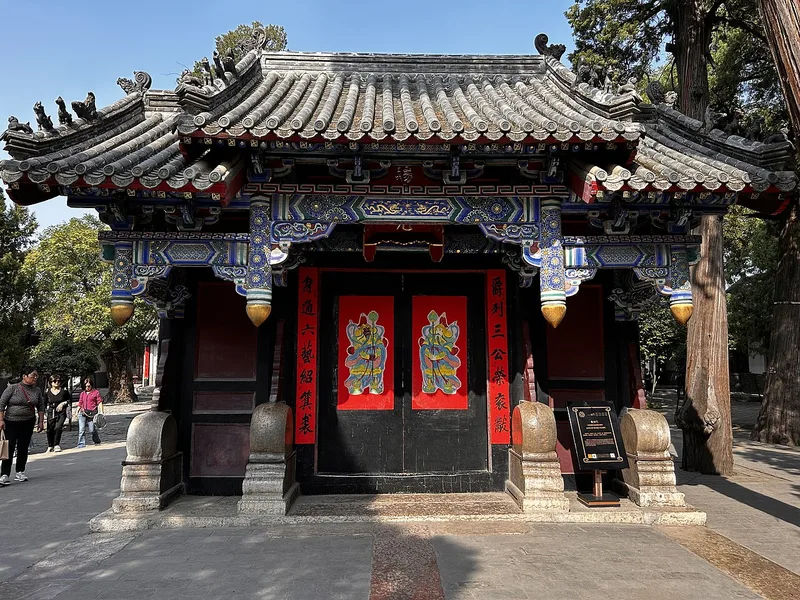
- Tomb of the Sultan of Sulu — Dezhou's signature sight and one of the few tombs of a foreign monarch on Chinese soil. The walled compound with its stelae and spirit way commemorates the Sulu sultan who died here in 1417; his Hui descendants still live nearby.
- Remnant Tang-era city wall — modest surviving fragments in the older part of the city, tied to local historical lore.
- A county-town memorial hall in the Dezhou area honours a locally born Han-dynasty court adviser and preserves stone inscriptions associated with a noted Tang calligrapher who once administered the county.
Temples
- A large Buddhist temple complex in the northern part of the prefecture is one of the bigger such complexes in this part of Shandong, rebuilt in modern times after earlier destruction.
Museums
- Dezhou Museum — a city-run museum on local history, archaeology and folk culture; a sensible orientation stop if arriving without background. Typically closed Mondays; check current hours locally.
Parks and landscape
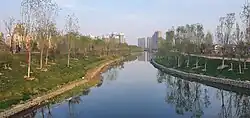
- Changhe (Long River) Park — a large lakeside park that forms the modern city's green spine; pleasant at dusk.
- A reconstructed cultural park themed around Confucian scholarship sits along the river near the city centre.
- Outlying forest and wetland parks along the old course of the Yellow River in the surrounding counties preserve stands of old fruit and mulberry trees; best visited in spring flowering season or the autumn harvest.
Theme parks
A large European-themed amusement park with an adjacent ocean-life attraction operates in one of the outlying counties and is the single biggest tourist draw in the prefecture by visitor numbers — aim for a weekday if visiting.
Walk the riverside park and Confucian-themed garden at dusk. Locals come out for square-dancing, kite-flying and slow strolls — a good way to see Dezhou enjoying itself.
Day trip to the old riverbed forest park in mulberry or fruit-flowering season, when the countryside is at its most photogenic.
Visit a hot-spring resort in the outlying forest-park area, part of the loose belt of spa developments common across inland Shandong.
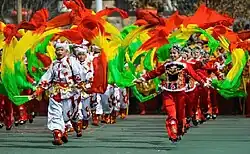
Ask locally about folk performance traditions — Dezhou has a regional Yangko dance and percussion tradition that turns out at festivals; the museum or a hotel front desk is the best source for current dates.
Pilgrimage walk to the Sultan's tomb, combined with the adjacent Hui village and a halal meal afterward — a small but genuinely interesting half-day circuit.
Planning Dezhou? Want these on a customised itinerary?
Ask on WhatsAppWhere to eat?
Dezhou cooking sits at the meeting point of Shandong's Lu cuisine — emphasising seafood, soups, light braises and the use of vinegar — and the city's Hui-Muslim heritage, with its halal beef and lamb dishes. Wheat noodles, flatbreads and steamed buns dominate over rice.
The signature dish is Dezhou braised chicken: a whole chicken poached slowly in a complex spiced stock until the meat falls off the bone, originally developed as travel food for canal-era journeys and now sold everywhere in the city. Other dishes to look for include lamb soup, beef noodle soup in the Hui-Muslim quarter, and sesame flatbreads.
- Budget — chicken-shop outlets sell whole braised birds to take away, and simple stalls near the Sultan's tomb serve Hui-Muslim beef noodles.
- Mid-range — restaurant clusters around the riverside parks serve Shandong home cooking and hot pot at moderate prices.
- Upscale — the city's higher-end hotels offer banquet-style Lu cuisine with private dining rooms.
Hui-Muslim restaurants near the Sultan's tomb are reliably halal and clearly signed. Vegetarians can manage on noodle and tofu dishes; gluten-free travellers will struggle given the wheat-based diet.
Where to drink?
Tea is the everyday drink — green tea and jasmine in summer, roasted teas in winter — and most restaurants pour it free. Local alcoholic specialities include mulberry wine from the riverbed-forest region and the regional Shandong baijiu brands that appear on most restaurant tables. Tsingtao, brewed elsewhere in Shandong, is the de facto local beer.
Coffee culture is modest but growing, with national chains present in the central commercial district. For a traditional teahouse experience, look in the older lanes near the riverside park.
Water safety: don't drink tap water. Bottled water is cheap and widely available; hotels provide kettles or boiled-water flasks.
Planning Dezhou? We’ll book the stays and dining for you.
Ask on WhatsAppWhere to stay?
- Budget — reliable Chinese budget chains have branches near the railway station and in Decheng District.
- Mid-range — mid-market Chinese hotel chains offer comfortable, predictable rooms in the central commercial area.
- Upscale — a hot-spring resort hotel in the outlying forest-park area is the most distinctive upscale option in the prefecture; in the city itself, the highest-tier options are local business hotels rather than international five-stars.
What should you buy?
Dezhou is not a serious shopping destination, but a few local specialities are worth seeking out:
- Dezhou braised chicken — the city's most famous export, a whole chicken poached in a spiced master stock, sold vacuum-packed at train-station kiosks, supermarkets and dedicated shops across town.
- Mulberry products — dried mulberries, mulberry-leaf tea and mulberry wine from the old riverbed forest-park region.
- Hui-Muslim foods — beef and lamb preparations and sesame pastries from the small market area near the Sultan's tomb.
- Traditional handicrafts — paper-cuts and folk art turn up at periodic local markets; a museum gift shop is a more curated (if pricier) alternative.
Department-store prices are fixed; small stalls and markets allow polite bargaining.
Where to go next?
- Jinan — Shandong's provincial capital, famous for its springs and Daming Lake, is a short high-speed rail journey south.
- Tai'an / Mount Tai — the most sacred of China's Five Great Mountains, reachable by high-speed rail via Jinan; an overnight stay to climb at dawn is a classic Chinese travel experience.
- Qufu — the birthplace of Confucius, with its UNESCO-listed temple, cemetery and family mansion, is a further stop south on the rail network.
- Beijing — the simplest onward connection north, on the direct Beijing–Shanghai high-speed line.
- Cangzhou, just over the border in Hebei — an easy half-day or overnight stop to the north.
- Dongying — the Yellow River delta and Bohai coast wetlands lie to the east, reachable by conventional train or via Jinan.
Nearby in Shandong Sheng
More places to explore around Dezhou.


Guide content as of July 2026. Portions adapted from Wikivoyage, CC BY-SA 4.0.

Contact Us
Get in touch with us.
Get in touch
Contact Us
Tell us where you'd like to go and how you like to travel. A real Tripcuro planner — not a bot — will craft an itinerary around you.
- Personalised, hassle-free planning end-to-end
- Transparent pricing, no hidden costs
- 24/7 support for complete peace of mind