
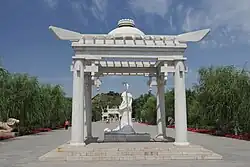
Hohhot
Nei Mongol Zizhiqu, China
Why visit Hohhot?
Hohhot has only been the capital of Inner Mongolia since 1947, but it grew up around a much older religious and trading core founded in the 16th century around the Da Zhao temple. Today it is a major industrial centre and home to two of China's biggest dairy companies, earning it a reputation as a dairy hub. Only a small minority of residents are ethnic Mongols, but Mongolian Buddhism (an offshoot of Tibetan Buddhism) remains visibly alive in the temples of the old city, and a sizeable Hui Muslim community gives the district around the Great Mosque its distinct character of halal signage and lamb-skewer smoke.
The city's character splits roughly into three zones useful for visitors. The old city in the south (Yuquan and Huimin districts) holds the historic temples, the Great Mosque, and the most atmospheric food streets. The new city in the north and east (Xincheng and Saihan districts) is where you'll find the museum cluster, government buildings, big hotels and shopping. Saihan District in the southeast contains Baita Airport and the high-speed rail station Hohhot East. Most travellers use Hohhot as a base for two or three days of city sightseeing before heading to the Xilamuren or Gegentala grasslands and the Kubuqi desert further west.
Climate is sharply continental. Summer (June–August) is warm, green and the only really wet season, and is also peak grassland season. Spring (May, early June) is the city's prettiest moment, with mild days and blossom but possible dust storms blown off the Gobi. Autumn (September) is crisp and dry. Winter (November–March) is brutal, with the steppe brown and grassland tours largely shut down.
Best time to visit: late June to early October, with the Naadam Festival (typically mid-August, featuring traditional Mongolian wrestling, horse racing, and archery) offering the single best reason to time a trip specifically around Hohhot. Avoid December through February if you are not prepared for prolonged sub-zero conditions.
Planning Hohhot? Tell us your dates and we’ll tailor the trip.
Ask on WhatsAppHow do you get there?
By Plane
Hohhot Baita International Airport (HET) sits east of the city centre in Saihan District. It is Inner Mongolia's main hub, with frequent domestic flights to Beijing, Shanghai, Guangzhou, Shenzhen, Xi'an and other major cities, plus international service to Ulaanbaatar (Mongolia). Metro Line 1 runs directly from the airport to the city centre — by far the cheapest and most reliable option. Taxis and airport shuttle buses also serve the centre and major hotels.
By Train
Hohhot has two stations: the central Hohhot Railway Station and the newer high-speed Hohhot East in Saihan District. Both are on the metro. Useful connections include Beijing (around 2.5 hours on the Beijing–Zhangjiakou–Hohhot high-speed line), Baotou (around an hour by high-speed rail), Datong, Yinchuan, and Erenhot (Erlian, on the Mongolian border). Through services toward Ulaanbaatar and Moscow exist on paper; check current operating status before booking. Book through 12306, Trip.com or Ctrip; bring your passport for both purchase and boarding.
By Car / Road
Hohhot sits on the G6 Beijing–Lhasa Expressway and the G7 Beijing–Ürümqi Expressway, making it easy to reach by car or long-distance bus from across northern China — Beijing is a half-day's drive, Baotou around two hours, Datong around four hours. The long-distance bus station is next to the main railway station. Self-drive is straightforward on the expressways but inner-city traffic is congested; most visitors are better off without a car inside Hohhot itself.
- Metro — Two lines and the easiest way to move around. Line 1 runs east–west between Baita Airport and the western suburbs; Line 2 runs north–south; they interchange at Xinhua Square. Trilingual signs and announcements (Mandarin, Mongolian, English).
- Taxis — Plentiful, with a low flag-fall. Hard to flag during shift changes and in bad weather; traffic jams are routine.
- Didi (滴滴出行) — Works as everywhere in China and is the most reliable way to summon a car if you can't find a taxi.
- Buses — Cheap but signage and schedules are Chinese-only and most run only until the early evening in winter.
- Bicycles — Hohhot is flat and broadly bike-friendly. Public share bikes unlock through WeChat or Alipay for a few yuan per ride.
- Walking — Pleasant in the old city around Da Zhao and the Great Mosque, less so along the wide multi-lane avenues of the new city.
Keep your passport on you (occasionally checked at hotels and stations); set up Alipay or WeChat Pay before arriving, as cash is increasingly hard to use; and beware the standard Chinese tourist-area scam of friendly strangers inviting you to a "tea ceremony" or art gallery.
What are the things to do?
Temples & Religious Sites
- Da Zhao Temple (大召寺) — the oldest Buddhist monastery in Hohhot, founded in 1579. A 2.5 m silver Sakyamuni Buddha is its most prized treasure, and the surrounding old-city lanes are the most atmospheric in town.
- Xilitu Zhao (席力图召) — directly opposite Da Zhao. The largest Buddhist temple in the city and the seat of Mongolian Buddhism in Inner Mongolia. Pair it with Da Zhao in a single morning.
- Temple of the Five Pagodas (五塔寺) — an Indian-style temple from 1732, a short walk southeast of Da Zhao. Famous for its many carved Buddha figures and an engraved Mongolian star chart on the rear wall.
- Great Mosque of Hohhot (清真大寺) — Huimin District, a short walk north of Da Zhao. The city's oldest and largest mosque, built in the Qing era in Chinese architectural style with a pagoda-like minaret. The adjacent street is lined with Hui Muslim restaurants and food stalls.
Museums (generally free, bring your passport for entry)
- Inner Mongolia Museum — the flagship. Strong collections on Mongolian history from the Stone Age to modern, dinosaurs (Inner Mongolia is fossil-rich), minerals, space exploration, and steppe wildlife.
- Inner Mongolia Art Museum — in the new city, near the main museum. Closed Mondays.
- Inner Mongolia Museum of Natural History — Saihan District. Closed Mondays.
- Inner Mongolia Science and Technology Museum — behind the Inner Mongolia Museum. Closed Mondays.
- Hohhot Museum — Xincheng District, next to the Hall of the People. Closed Tuesdays.
historic buildings
Tomb of Princess Zhaojun (昭君墓) — south of the city. The likely cenotaphic resting place of the Han princess Wang Zhaojun, who in 33 BCE was sent to marry a Xiongnu chief to secure peace on the northern frontier. Includes a small museum on the Xiongnu.
Da Zhao Temple festivals — worth planning around if your dates flex; several major Buddhist festival dates fall on the lunar calendar through the year.
Day trip to the grasslands — the essential Inner Mongolia experience. The closest accessible grasslands are Xilamuren and Gegentala, both reachable as a long day trip but far better as an overnight in a yurt camp. Expect horse riding, archery, a Mongolian hot-pot or whole-roast-lamb dinner, and folk performances. Most Hohhot hotels and hostels can arrange tours.
Day trip to the desert — Resonant Sand Bay on the edge of the Kubuqi Desert, past Baotou, offers dunes, camel rides, and sand sledding.
People's Park on Zhongshan West Road — a relaxed, free city park with a lake, pedal boats, and a small amusement zone.
Head to the foothills of the Daqing Shan north of the city for an easy escape into open country.
Mongolian throat singing & folk performance — several venues in the new city stage tourist-oriented evening performances; ask your hotel for current recommendations, as venues turn over.
Planning Hohhot? Want these on a customised itinerary?
Ask on WhatsAppWhere to eat?
Hohhot's food culture is a three-way conversation between Mongolian (lamb, dairy, hot pot, hand-grabbed meat), Hui Muslim (halal noodles, lamb skewers, baked breads) and Han Chinese (Shanxi-influenced noodles). Look for green or yellow signage to identify halal restaurants, which form the bulk of the city's small eateries thanks to the substantial Hui community.
Signature dishes to seek out:
Shou ba rou (手把肉) — "hand-grabbed" boiled lamb, eaten off the bone with a knife.
Mongolian hot pot (蒙古火锅) — lighter than Sichuan-style, often clear broth with mutton.
Shao mai (烧麦) — Hohhot's are distinctive: thin-skinned dumplings of lamb and spring onion eaten in the morning with vinegar and brick tea. A local breakfast institution.
Salted milk tea (咸奶茶) with millet, the everyday Mongolian hot drink.
Milk skin and milk tofu (奶皮 / 奶豆腐) — eaten as snacks or with tea.
Roast leg of lamb (烤羊腿) — a banquet centrepiece; whole roast lamb is available with a day's notice at larger restaurants.
Budget — the Muslim Quarter food street around the Great Mosque: lamb skewers, hand-pulled noodles, baked sesame breads, halal throughout.
Budget — local shao mai chains serving the city's defining breakfast dish, with multiple branches across town.
Mid-range — mutton hot-pot chains that originated in Inner Mongolia have several Hohhot branches.
Mid-range — Mongolian-themed restaurants around Xinhua Square and Zhongshan Road, with folk performances; a fun dinner if pricier than they're worth at lunch.
Upscale — long-established halal restaurants with full-banquet whole roast lamb and traditional Hui dishes.
Vegetarians will find life harder than in southern China — many "vegetable" dishes are cooked with lamb fat or stock — but the Buddhist temples and a handful of dedicated vegetarian (素食) restaurants in the new city are reliable.
Where to drink?
- Salted milk tea (咸奶茶) — drink it everywhere; every Mongolian-style restaurant serves it free or for a few yuan.
- Mongolian airag / kumis (马奶酒) — fermented mare's milk, lightly alcoholic and tangy; mostly a grassland-tour experience but available in some city restaurants.
- Inner Mongolian baijiu — strong sorghum spirits appear at every banquet; expect to be toasted repeatedly if you drink with locals.
- Snow Beer (雪花) and Tsingtao dominate the beer market; craft beer is starting to appear in the new city but the scene is small.
- Cafés — Western-style coffee shops cluster around Zhongshan Road and the malls; national chains are well represented for a quick reliable cup.
- Nightlife — concentrated around the central avenues, with KTVs, dance clubs and a handful of foreigner-friendly bars.
Water safety: tap water is not safe to drink — boil it (most hotel rooms have a kettle and water flask) or buy bottled. Ice in established restaurants is generally fine.
Planning Hohhot? We’ll book the stays and dining for you.
Ask on WhatsAppWhere to stay?
Budget
The long-running backpacker fixture near Da Zhao is popular with travellers booking grassland tours, with dorms and private rooms. Rail-station-area chain hotels (Hanting, 7 Days Inn, Home Inn) offer clean, predictable rooms as a fallback.
Mid-range
Reliable mid-market chains (Ji Hotel, Atour and similar) have multiple Hohhot branches, with locations near Xinhua Square, Hohhot East Station, and the museums particularly convenient.
Upscale
International-standard hotels — including a Shangri-La, a Holiday Inn, and a Sheraton — operate in the new city with large rooms, business facilities, and reliable Western breakfasts.
What should you buy?
Souvenirs lean unmistakably steppe-and-dairy. Look for:
- Beef jerky (牛肉干) — air-dried, often spiced with cumin and chili; the regional snack. Vacuum-packed bricks travel well.
- Milk products — milk tea powder, milk skin, milk tofu, milk candy and cheese curds, sold in supermarkets and at the airport.
- Mongolian robes (deel), sashes, leather boots, silver-mounted knives and saddles — sold around Da Zhao and in the old city.
- Cashmere — Inner Mongolia is a leading cashmere producer; check labels carefully and bargain hard.
- Mongolian Buddhist artefacts — prayer wheels, thangkas, malas — in the lanes around Da Zhao and Xilitu Zhao.
The main shopping streets are Zhongshan Road for malls and brands, the old-street area around Da Zhao for souvenirs and traditional goods, and the Muslim Quarter around the Great Mosque for snacks and food gifts. Bargaining is expected at souvenir stalls and markets; fixed-price in malls, supermarkets and chain shops.
Where to go next?
- Xilamuren Grassland — the closest accessible grassland with yurt camps, horse riding and Mongolian banquets. The classic overnight from Hohhot.
- Gegentala Grassland — larger and slightly less touristy than Xilamuren; hosts a summer Naadam Festival.
- Resonant Sand Bay (Xiangshawan) — Kubuqi Desert dunes with camel rides, sand sledding and dune-top resorts.
- Baotou (包头) — Inner Mongolia's heavy-industry city; gateway to the Genghis Khan Mausoleum in Ordos and the Wudangzhao Tibetan Buddhist monastery.
- Datong (大同) — the Yungang Grottoes (UNESCO), the Hanging Monastery, and the wooden pagoda of Yingxian.
- Beijing — the obvious onward connection for international flights and the rest of China.
- Erenhot / Zamyn-Üüd (二连浩特) — the Chinese border town with Mongolia and the overland gateway to Ulaanbaatar by Trans-Mongolian rail.
Nearby in Nei Mongol Zizhiqu
More places to explore around Hohhot.
Guide content as of July 2026. Portions adapted from Wikivoyage, CC BY-SA 4.0.

Contact Us
Get in touch with us.
Get in touch
Contact Us
Tell us where you'd like to go and how you like to travel. A real Tripcuro planner — not a bot — will craft an itinerary around you.
- Personalised, hassle-free planning end-to-end
- Transparent pricing, no hidden costs
- 24/7 support for complete peace of mind