
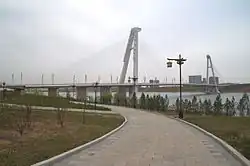
Ordos City
Nei Mongol Zizhiqu, China
Why visit Ordos City?
Ordos City (鄂尔多斯市) is a prefecture-level city on the high, dry Ordos Plateau of western Inner Mongolia, where the Yellow River makes its great northward loop before turning back south. Coal and other mineral wealth transformed the local economy rapidly from the 2000s onward, and much of that money went into building Kangbashi, a purpose-designed new administrative district of oversized plazas, monumental government and cultural buildings, and rows of apartment towers. For years Kangbashi stood largely empty and became internationally famous as the archetypal "Chinese ghost city"; it has since filled in considerably, though the scale of its civic core still feels disproportionate to daily street life.
The older, denser part of the city is Dongsheng, roughly 30 km from Kangbashi, which remains the everyday commercial hub with the bulk of the hotels, restaurants, and bus stations. A third node, sometimes called Altan Xire or Ejin Horo Banner's riverside development, has grown up across the river from Kangbashi. Because the city is genuinely split across these areas, it is worth confirming which district an address, hotel booking, or bus ticket actually refers to before you travel.
Beyond the urban curiosity, travellers come to Ordos for the Genghis Khan Mausoleum, an important pilgrimage and ceremonial site for Mongols (not his actual burial place, which is unknown), and for dune fields on the edge of the Kubuqi Desert, most famously at Xiangshawan ("Singing Sand Bay"). Ordos is also the historic centre of China's cashmere industry.
The climate is harsh continental semi-arid: warm, relatively wet summers (June–August, daytime highs in the mid-to-upper 20s °C) and long, bitterly cold, dry winters (January lows well below freezing, often with strong wind). Spring can bring dust storms blowing off the surrounding deserts. Late spring and autumn (May–June and September–October) are the most comfortable seasons to visit.
Planning Ordos City? Tell us your dates and we’ll tailor the trip.
Ask on WhatsAppHow do you get there?
By Plane
Ordos Ejin Horo Airport (DSN) lies in Ejin Horo Banner, south of Dongsheng and closer to the Genghis Khan Mausoleum area than to Kangbashi. It has regular domestic connections to major Chinese hubs such as Beijing, Shanghai, and Xi'an. Airport shuttle buses and taxis run into Dongsheng and Kangbashi; confirm current shuttle timing and fares locally, as these change often.
Baotou Airport, to the north, and Yulin Airport in neighbouring Shaanxi, to the south, are usable secondary options with onward bus connections into Ordos if flight schedules to DSN don't fit your itinerary.
By Train
Ordos has rail connections to Baotou and on to the regional capital Hohhot, and longer-distance sleeper services toward Beijing. A newer railway station serves central Kangbashi, but note that a number of long-distance services, including trains toward Beijing, terminate in Dongsheng rather than at the Kangbashi-area station — check your ticket carefully and budget time for a transfer between the two if needed. Book through the official China Railway 12306 platform or a booking agent; a passport is required to purchase and board.
By Car / Road
Ordos sits on a network of expressways connecting it to Baotou, Hohhot, and Yulin in Shaanxi to the south, across the Mu Us Desert. Roads are modern dual carriageway in good condition; the main hazards are wind-blown sand in spring and icy conditions in winter. Long-distance buses generally use Dongsheng's bus stations rather than Kangbashi.
The awkward reality of Ordos is that its centres of activity are tens of kilometres apart. A city bus service connects Kangbashi and Dongsheng, though frequency and hours are limited — check current timetables locally rather than relying on old information. Taxis are available in all districts but the distances mean fares between Kangbashi and Dongsheng, or to the airport, add up quickly; agree on the fare or insist on the meter before setting off. Ride-hailing apps (Didi) work well and are generally the easiest way to get around, including between districts.
Within each individual district, walking is pleasant — Kangbashi's ceremonial axis is a few kilometres end to end and makes for an interesting evening stroll when the government and cultural buildings are lit up, and Dongsheng's older grid is compact. Walking between districts is not realistic.
One common point of confusion: asking a taxi driver simply for "Ordos" may be understood as a request for Dongsheng, the historic urban core, rather than the new city. Specify Kangbashi (康巴什) if that is where you want to go.
What are the things to do?
Kangbashi's civic axis — the flagship new-town core: vast plazas, Mongol-warrior and Genghis Khan-themed monuments, and showpiece government and cultural architecture strung along a several-kilometre boulevard. Whatever your view of the underlying urban-planning story, it is a striking and unusual streetscape, especially at dusk when the buildings are lit.
Ordos Museum — a large, architecturally distinctive building on Kangbashi's central axis, generally covering regional palaeontology (the Ordos Basin has produced significant dinosaur fossils), art inspired by the steppe and desert, and the region's Mongol history. State-run city museums in China are typically free or low-cost with ID required for entry; confirm current hours before visiting.
Genghis Khan Mausoleum, Ejin Horo Banner, south of Dongsheng — the principal shrine and pilgrimage site associated with Genghis Khan, built in a Mongol yurt-domed architectural style. It is not his actual burial site, which remains unknown to history. A major destination for ethnic Mongol visitors and the site of periodic ceremonial rites.
Xiangshawan ("Singing Sand Bay") — dunes on the edge of the Kubuqi Desert, one of the region's best-known scenic areas. Heavily developed for tourism, with cable cars, camel rides, and other amusements layered onto genuinely impressive dune scenery — good for a family day out, less so if you want an empty desert experience.
Riverfront development across from Kangbashi — a newer skyscraper cluster with a denser, more lived-in feel than the ceremonial core, worth a look if you're curious to see how the new-city project has continued to evolve.
Walk the Kangbashi axis after dark, when the government, museum, theatre, and library buildings are illuminated — the single most distinctive experience Ordos offers, and one that needs no ticket.
Visit the desert dunes, either at the more developed Xiangshawan or at quieter alternatives nearby, for camel rides and sand activities.
Attend or observe ceremonies at the Genghis Khan Mausoleum, which follow the Mongol ritual calendar; ask locally or through your accommodation about current dates rather than assuming a fixed schedule.
A motorsport circuit operates on the outskirts of the city.
Planning Ordos City? Want these on a customised itinerary?
Ask on WhatsAppWhere to eat?
Food in Ordos follows the broader Inner Mongolian pattern: lamb is central, dairy products are widespread, and wheat noodles and millet fill the role rice plays further south. Dishes to look for include hand-held or hand-grabbed boiled lamb, whole roast lamb (usually a group order at a specialist restaurant), lamb-and-onion dumplings, and salty butter-and-millet milk tea. Halal restaurants are common given the region's Hui Muslim and Mongol population; strict vegetarian eating is possible at noodle shops and Buddhist-leaning restaurants but requires asking specifically for meat-free preparation, since broths are often lamb-based even in vegetable dishes.
Kangbashi and Dongsheng each have general dining districts with a mix of casual noodle and skewer places and more formal Mongolian and Chinese restaurants; a few simple noodle and skewer stalls cluster around bus and rail stations in Dongsheng in the evenings.
Where to drink?
Salty Mongolian milk tea, made with butter and roasted millet, is the everyday hot drink and widely offered, including at hotel breakfasts. At formal meals, Chinese grain spirit (baijiu) is the customary pour, and fermented or distilled mare's- or cow's-milk spirits are a regional specialty and common gift item.
Standalone nightlife is limited, especially in Kangbashi, where hotel bars are often the most reliable evening option; Dongsheng has a somewhat wider spread of casual bars and cafés. As everywhere in China, tap water is not safe to drink — stick to bottled or boiled water, which hotels provide as standard.
Planning Ordos City? We’ll book the stays and dining for you.
Ask on WhatsAppWhere to stay?
Most of the accommodation stock, across all price tiers, is in Dongsheng. Kangbashi has a smaller number of business-oriented hotels relative to its physical scale, and the riverfront development across from it has emerged as a somewhat cheaper alternative that's still reasonably close to the airport.
Budget
National budget chain hotels are represented in Dongsheng, generally offering clean, no-frills rooms with minimal English signage.
Mid-range
Mid-range domestic and international-standard business hotels are available in both Kangbashi and Dongsheng.
Upscale
A handful of higher-end hotels serve business travellers and the Xiangshawan resort area; the desert resort near Xiangshawan itself is a distinctive if touristy overnight option, worth considering if you want to wake up on the dunes rather than in a city hotel.
What should you buy?
Ordos is historically important to China's cashmere industry — the Erdos Group, one of the country's best-known cashmere producers, is headquartered here — and cashmere knitwear, scarves, and yarn are a genuine local specialty, generally cheaper than in coastal Chinese cities. Dongsheng has the larger concentration of retail options; Kangbashi's shopping is thinner.
Other items associated with the wider region include Mongolian-style silver jewellery, felt and leather goods, and dairy products such as milk powder and milk-based spirits. Bargaining is customary at markets and small stalls; fixed prices apply in malls and branded shops.
Where to go next?
- Dongsheng — the historic urban core, roughly 30 km from Kangbashi, useful as a base and a counterpoint to the planned new city.
- Baotou — an industrial Yellow River city to the north, gateway to grasslands and to regional Buddhist monasteries.
- Hohhot — the regional capital, with the Inner Mongolia Museum and access to nearby grasslands.
- Yulin (Shaanxi) — a walled Ming-dynasty city on the southern edge of the Mu Us Desert, reachable by road across the desert from Ordos.
- Yinchuan (Ningxia) — further west, with the Western Xia imperial tombs and Helan Mountain rock art.
- Xi'an — a natural onward step by high-speed rail, for the Terracotta Army and the historic Tang-dynasty capital.
Nearby in Nei Mongol Zizhiqu
More places to explore around Ordos City.
Guide content as of July 2026. Portions adapted from Wikivoyage, CC BY-SA 4.0.

Contact Us
Get in touch with us.
Get in touch
Contact Us
Tell us where you'd like to go and how you like to travel. A real Tripcuro planner — not a bot — will craft an itinerary around you.
- Personalised, hassle-free planning end-to-end
- Transparent pricing, no hidden costs
- 24/7 support for complete peace of mind