
Chifeng
Nei Mongol Zizhiqu, China
Why visit Chifeng?
Chifeng takes its name from the rust-coloured Hongshan ("Red Mountain") that rises just north of the modern city. That mountain lent its name to the Hongshan Culture (roughly 4700–2900 BCE), one of the most important Neolithic cultures in China and the source of the jade carvings that have become a symbol of early Chinese civilization. The region was later a heartland of the Khitan Liao Dynasty, and in the Qing era it was governed through Mongol nobility. Today the prefecture has a mix of Han, Mongol, and Manchu residents, and it is the largest economic centre in eastern Inner Mongolia.
The city itself is workaday — wide boulevards and a brisk grid focused on Hongshan District (the older centre), Songshan District (administrative, with both rail stations and the long-distance bus terminal), and Xincheng District (the "new town" with the museum). The real reasons to come lie outside the city: the volcanic plateau of the Hexigten (Keshiketeng) UNESCO Global Geopark, the wetlands of Dali Lake, the granite spires of the Asihatu Stone Forest, and a string of grassland banners where Mongolian pastoral culture is still lived.
Chifeng's climate is continental semi-arid: long, dry, biting winters and short, warm, surprisingly green summers. The sweet spot is late June to early September, when the grasslands are green and the geopark roads are open; autumn (mid-September to mid-October) is dry, crisp and photogenic. Avoid November through March unless you specifically want winter steppe — most rural sights become inaccessible.
Best time to visit: July–September, or especially September for pleasant temperatures with fewer visitors and golden autumn colour in the forests around the geopark. The regional Naadam festival (horse racing, wrestling, archery) falls in late July or August, though Chifeng's own celebrations are smaller-scale than those in Hohhot or Xilin Gol.
Planning Chifeng? Tell us your dates and we’ll tailor the trip.
Ask on WhatsAppHow do you get there?
By Plane
Chifeng Yulong Airport (CIF) sits southeast of the urban area, with domestic-only service to major hubs including Beijing, Shanghai, and several regional cities. Taxis into central Hongshan or Songshan District take 25–35 minutes; ride-hailing via Didi is the easiest option for foreign travellers with a working Chinese payment method.
By Train
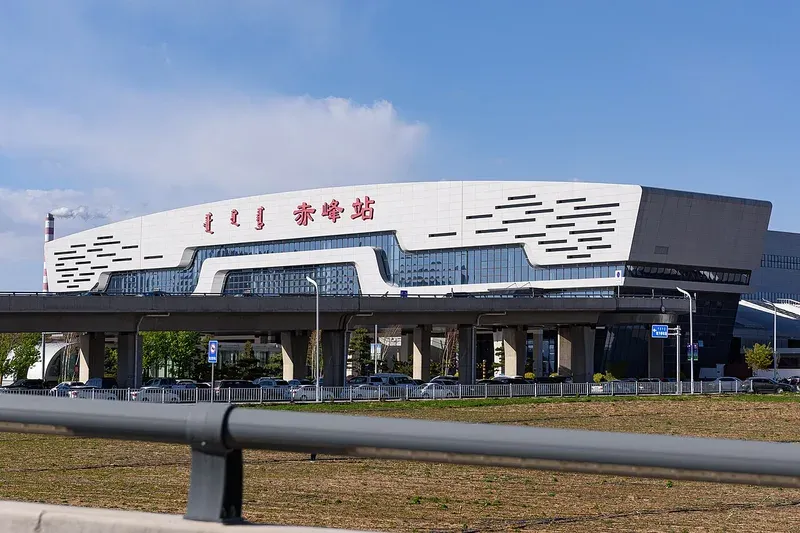
Chifeng has two stations. Chifeng Railway Station, Songshan District, is the main conventional-rail station, handling overnight sleepers and regular services. Chifeng West Station, also in Songshan District, is the high-speed rail station on the Beijing–Shenyang corridor, opened in 2020 and the way most visitors now arrive; Beijing Chaoyang is a few hours away by high-speed rail. Book through the China Railway 12306 app or counter ticket windows; passport required for foreigners.
By Car / Road
Chifeng is well-connected by expressway, with drives of several hours to Beijing and Shenyang. Hohhot is far (around 950 km); flying or connecting via Beijing by rail is faster. Roads inside the prefecture vary: the main expressway and provincial roads are good, but routes into Hexigten Geopark and remote grassland banners are slower two-lane roads. The main long-distance bus hub in Songshan District runs services to Beijing, Hohhot, Shenyang, Tongliao, Xilinhot, and the Hexigten area; check current schedules and fares locally, as these change.
Within the urban area, city buses cover Hongshan, Songshan, and Xincheng Districts for a flat, low fare. Taxis are plentiful and the easiest local transport, with rural surcharges after 22:00. Didi works well, and the app can be switched to English. The city is flat and walkable along the Yingjin River, especially around the Hongshan District riverfront, but the three districts are spread out — expect to taxi between them.
For the prefecture's signature sights (Hexigten Geopark, Asihatu Stone Forest, Dali Lake, Ujimqin grasslands), public transport is impractical. Arrange a car-and-driver through your hotel or a local travel agency, or rent a self-drive vehicle in the city (note that an International Driving Permit alone is not valid in China — a temporary Chinese licence is required).
Watch for the usual taxi-tout scams at the airport and rail station; insist on the meter (打表) or use Didi.
What are the things to do?
Museums & history
- Chifeng Museum — Xincheng District. The single best primer on the region: Hongshan Culture jade (including replicas of the famous C-shaped jade dragon), Khitan Liao ceramics and gold funerary items, and Mongolian folk-life galleries. Free with passport ID; closed Mondays.
- Prince Karaqin's Mansion — Karaqin Banner, southwest of the city. The largest and best-preserved Mongol prince's residence from the Qing era, combining Han courtly architecture with Mongolian motifs.
- Longquan Temple — Karaqin Banner. A Liao-dynasty foundation rebuilt under the Yuan, set in a quiet wooded gully; worth pairing with the Karaqin Mansion as a half-day loop.
Landscapes & parks
Hexigten UNESCO Global Geopark — Hexigten (Keshiketeng) Banner, northwest of Chifeng. A vast park covering volcanic cones, granite peaks, and alpine lakes. Plan at least two nights; accommodation is available inside the park.
Asihatu Stone Forest — within Hexigten Geopark. A high-altitude granite "stone forest" of pillars sculpted by glaciation.
Dali Lake (达里湖 / Dalinor) — Hexigten Banner. A vast alkaline lake on the steppe and an important migratory bird stop. Boat trips, fishing, and lakeside resorts.
Hongshan National Forest Park — Hongshan District. The eponymous "Red Mountain" right in the city — a short hike up rust-red rock for skyline views. Free entry.
Horseback riding on the grasslands — the signature Chifeng experience. The closest accessible grasslands are in the southern part of the prefecture (Karaqin and Wengniute banners) and around Hexigten. Rides range from a one-hour trot to multi-day pack trips with overnight ger stays; most are arranged through hotels or agencies in the city.
Stay in a Mongolian ger (yurt) camp on the grasslands, typically June–September, with riding, archery, and evening cultural programmes.
Soak at a hot-spring resort — the city area has geothermal pools, sauna, and massage facilities, especially welcome after a day on horseback.
Visit a folk culture park in Hongshan District for a walk-through introduction to Mongol, Han, and Manchu folk traditions.
Photograph the Jingpeng Pass — a railway-photography site on the Jitong line, known historically for steam-era horseshoe curves and viaducts; the landscape and infrastructure remain striking even though most steam operations have ended.
Planning Chifeng? Want these on a customised itinerary?
Ask on WhatsAppWhere to eat?
Chifeng's food sits between northeastern Chinese (Dongbei) cuisine and Mongolian pastoral cooking: lamb in many forms, hearty wheat noodles and breads, dairy in the form of milk tea and curds, and a strong braising and roasting tradition. Vegetarian options exist (cold vegetable plates, tofu, mushroom dishes), but the city is unapologetically a meat town. Most kitchens are non-halal, but separate Hui (Muslim) restaurants are easy to spot by Arabic-script signage.
- Hand-grabbed mutton (手抓羊肉) — the quintessential Mongolian dish: chunks of mutton boiled simply in salted water and eaten by hand.
- Mongolian hot pot (蒙古火锅) — a clear, fragrant lamb broth with thin-sliced mutton, mushrooms, and tofu.
- Roasted whole sheep (烤全羊) — a slow-roasted banquet centrepiece; most restaurants need advance notice and will sell by the quarter for smaller groups.
- Fried lamb chops (炸羊排) — battered and deep-fried, dusted with cumin and chilli.
- Braised pork chops (红烧大排) — Dongbei-style pork ribs in a rich soy braise.
- Mongolian-style breads and sour milk curds (奶豆腐) — sold at market stalls, worth trying as a light breakfast.
Where to drink?
- Mongolian milk tea (蒙古奶茶) — the regional staple: a salted tea brewed with brick tea, milk, and sometimes butter or fried millet.
- Local fruit juices — Chifeng's apples and pears go into fresh juices sold at stands and cafés through summer.
- Barley wine and Mongolian-style baijiu — expect to be toasted enthusiastically at any Mongolian-style banquet.
- Fermented mare's milk (马奶酒 / airag) — seasonal (summer), sour and lightly alcoholic; usually offered at ger camps rather than urban restaurants.
Tap water is not potable. Stick to bottled water or the boiled water provided in hotels and on trains.
Planning Chifeng? We’ll book the stays and dining for you.
Ask on WhatsAppWhere to stay?
Budget travellers typically use chain economy hotels in Songshan District near the rail and bus stations — Hanting, 7 Days Inn and similar chains have branches here. Mid-range chain hotels (Jinjiang Inn, GreenTree Inn and similar) operate near the museum in Xincheng District and near Chifeng West Railway Station. At the upper end, a handful of four-star hotels and newer international-brand properties serve business and government travellers in central Hongshan District. For Hexigten Geopark and the grasslands, staying inside the park is the better option: ger camps in summer and simple lodge-style hotels near Asihatu Stone Forest and Dali Lake.
What should you buy?
Chifeng is a good place to look for steppe and Liao-era specialties rather than mass-produced souvenirs, with browsing concentrated around Hongshan District's craft market and the shops near the museum in Xincheng District.
- Hongshan-style red pottery — handmade pieces in local dark-red clay, often modelled on Hongshan and Liao motifs.
- Mongolian cashmere — Inner Mongolia produces some of the world's best cashmere; check fibre-content tags carefully.
- Chifeng apples and seasonal fruit — well-regarded across northern China for being crisp and sweet.
- Mongolian silver jewellery and knife sets — note that ornamental knives cannot be carried in checked luggage on domestic flights without paperwork.
Bargaining is expected at markets and small craft shops — start around 60–70% of the asking price. Department stores and branded cashmere outlets are fixed-price.
Where to go next?
- Hexigten (Keshiketeng) Geopark — the reason most travellers come to Chifeng in the first place; allow at least two nights.
- Wulan Butong Grassland — over the border in Hebei, the most photogenic grassland near Chifeng, famous for autumn colour and horse-herding scenes.
- Tongliao (通辽) — gateway to the Horqin grasslands and nearby Mongol cultural sites.
- Xilinhot (锡林浩特) — the classic Inner Mongolian grassland capital, with the largest summer Naadam festivals in the region.
- Chengde (承德) — the Qing summer capital, with the UNESCO-listed Mountain Resort and outer temples — a natural pairing with Karaqin Prince's Mansion.
- Beijing — the obvious onward gateway for international flights, reachable by high-speed rail.
Nearby in Nei Mongol Zizhiqu
More places to explore around Chifeng.
Guide content as of July 2026. Portions adapted from Wikivoyage, CC BY-SA 4.0.

Contact Us
Get in touch with us.
Get in touch
Contact Us
Tell us where you'd like to go and how you like to travel. A real Tripcuro planner — not a bot — will craft an itinerary around you.
- Personalised, hassle-free planning end-to-end
- Transparent pricing, no hidden costs
- 24/7 support for complete peace of mind