
Sukhbaatar
Selenge, Mongolia
About Sukhbaatar
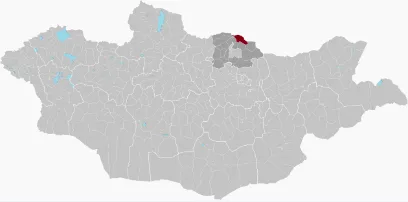
Sükhbaatar (Сүхбаатар) is a town in northern Mongolia, capital of Selenge province and the country's main road and rail gateway toward Russia. It sits at the confluence of the Selenge and Orkhon rivers, close to the border with Russia's Republic of Buryatia, and grew up in the 20th century as a railway and trading town on the Trans-Mongolian line. It shares its name with Damdin Sükhbaatar, the revolutionary hero of Mongolia's 1921 independence, after whom much in the country is named — including, confusingly, the town and a separate province in eastern Mongolia.
For travellers, Sükhbaatar is more a transit point than a sightseeing destination. It is the last significant Mongolian stop for trains heading north to Russia and a hub for road traffic toward the border crossing at Altanbulag. The town has a relaxed, low-rise riverside character, with the broad Selenge River and surrounding farmland setting it apart from the dry steppe further south — Selenge province is one of Mongolia's most fertile agricultural regions. Most international travellers pass through on the Trans-Mongolian railway, often pausing here for border formalities.
The climate is sharply continental. Summers (June–August) are warm and the rivers and green countryside at their best; winters are long and very cold, with deep snow and temperatures well below freezing. Late spring through early autumn is the most comfortable window. The town is small enough to see in a short stop, and the main reasons to linger are the river setting and onward connections to Russia.
Planning Sukhbaatar? Tell us your dates and we’ll tailor the trip.
Ask on WhatsAppHow to reach
By Plane
By Train
Sükhbaatar is on the Trans-Mongolian Railway and is the principal Mongolian border-zone station for trains running between Ulaanbaatar and Russia. International trains and domestic services stop here, and the town handles customs and border formalities for rail traffic toward the Russian frontier. The station is the obvious arrival and departure point for most visitors; book international tickets well ahead, especially in summer, as cross-border trains can be heavily reserved.
By Car / Road
Sükhbaatar is connected by paved road to Ulaanbaatar via Darkhan, roughly 300–350 km to the south — a drive of around five to six hours. It is also close to the Russian border crossing at Altanbulag, about 25 km away, beyond which lies the Russian town of Kyakhta. Long-distance buses and shared vehicles run from Ulaanbaatar and Darkhan; the border road sees regular traffic between the town and Altanbulag.
Sükhbaatar is a small, flat town and easily covered on foot — the centre, the riverside and the railway station are all within walking distance of one another. Taxis (often ordinary cars acting informally as taxis) are available for longer trips, including the run out to the Altanbulag border crossing; agree the fare before getting in, as meters are not standard. There are no ride-hailing apps or formal public transport network of note. Be wary of overcharging on the border route, where drivers know travellers are often in a hurry.
Things to do
Selenge and Orkhon river confluence — The meeting of two of Mongolia's major rivers, giving the town its riverside setting; pleasant for a stroll along the banks.
Town centre and main square — A modest Soviet-era civic centre typical of Mongolian provincial capitals, with administrative buildings and monuments.
Riverside walks — Strolling along the Selenge River is the most pleasant way to pass time in town, especially on a warm summer evening.
Border-crossing logistics — For many travellers the main "activity" is organising the onward journey to or from Russia via Altanbulag and Kyakhta.
Day trip to Altanbulag — The nearby border settlement, with its free-trade zone, is an easy short excursion.
Planning Sukhbaatar? Want these on a customised itinerary?
Ask on WhatsAppFood & Dining
Dining in Sükhbaatar is simple and local. Small canteens (guanz) and modest restaurants serve the Mongolian staples — buuz (steamed mutton dumplings), khuushuur (fried meat pasties), mutton noodle soup and rice dishes — and, given the town's railway and border role, you may also find basic Russian-influenced fare. Choice is limited and prices are low. Vegetarians will find few dedicated options and should expect meat-centred menus.
- Local guanz and canteens (budget) — Simple eateries around the town centre and near the station serving dumplings and noodle soups for a few thousand tögrög.
Cafes & Nightlife
The everyday hot drink is süütei tsai, salty milk tea; Mongolian beer and vodka are sold in shops and bars, and Russian influence means vodka is especially common in this border region. Small bars and cafés around the town centre cater to locals. Tap water is not reliably safe to drink — stick to bottled or boiled water, widely sold in the town's shops.
Planning Sukhbaatar? We’ll book the stays and dining for you.
Ask on WhatsAppPlaces to Stay
Budget — Simple guesthouses and basic hotels in the town centre offer the cheapest beds, suited to travellers pausing between train or border connections.
Mid-range — A small number of mid-range hotels serve the town's railway and border traffic.
Upscale — There is no upscale accommodation in Sükhbaatar; for comfortable hotels look to Darkhan or Ulaanbaatar.
What to buy
Sükhbaatar has the usual provincial-town shops and a market selling everyday goods, food and household items. As a border town it sees cross-frontier trade, and Selenge province is an agricultural region, so local produce is available in season. There is no notable craft or souvenir scene; for cashmere, felt goods and Mongolian souvenirs, Ulaanbaatar offers far more. Bargaining is normal at the open market but not at fixed-price shops.
Go next
- Altanbulag (~25 km north, ~30 minutes) — The border settlement and free-trade zone facing Russia's Kyakhta.
- Darkhan (~120–150 km south, ~2–2.5 hours) — Mongolia's second-largest city and a major industrial centre.
- Amarbayasgalant Monastery (~100–150 km southwest, around 2–3 hours) — One of Mongolia's most beautiful and best-preserved monasteries.
- Ulaanbaatar (~300–350 km south, ~5–6 hours) — Mongolia's capital and main travel hub.
- Kyakhta, Russia (across the border via Altanbulag) — The historic Russian tea-trade town just over the frontier.
Nearby in Selenge
More places to explore around Sukhbaatar.

Portions adapted from Wikivoyage, CC BY-SA 4.0.

Contact Us
Get in touch with us.
Get in touch
Contact Us
Tell us where you'd like to go and how you like to travel. A real Tripcuro planner — not a bot — will craft an itinerary around you.
- Personalised, hassle-free planning end-to-end
- Transparent pricing, no hidden costs
- 24/7 support for complete peace of mind