
Dulaankhaan
Selenge, Mongolia
Why visit Dulaankhaan?
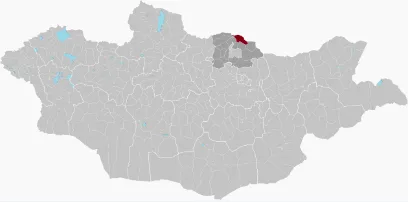
Dulaankhaan (Дулаанхаан) is a small settlement in Selenge province in northern Mongolia, on the rail and road corridor that runs between Darkhan and the Russian border. It is a quiet village rather than a tourist centre, set in the fertile, partly forested countryside of the Selenge basin — one of the more agricultural and green regions of an otherwise steppe-and-desert country. Dulaankhaan is best known within Mongolia as the home of a long-established hunting-bow workshop, where traditional Mongolian composite bows are still handcrafted using age-old techniques of horn, sinew and wood.
For travellers, Dulaankhaan is a place you pass through rather than make a destination of — it sits on the Trans-Mongolian railway and the main northern highway, and most visitors are simply moving between Darkhan, Sükhbaatar and the border. Those with a specific interest in Mongolian crafts and archery may seek out the bow workshop, which gives the village its modest claim to fame. The surrounding landscape of river valleys, farmland and woodland is pleasant but unremarkable by Mongolian standards.
The climate is sharply continental: warm summers (June–August) and long, severe winters with deep snow and very low temperatures. Late spring through early autumn is the comfortable season for any visit. The village is small enough to see in a short stop.
Planning Dulaankhaan? Tell us your dates and we’ll tailor the trip.
Ask on WhatsAppHow do you get there?
By Plane
Limited Information available
By Train
Dulaankhaan lies on the Trans-Mongolian Railway corridor between Darkhan and the Russian border, and trains running this northern line pass through. Check current timetables for which services stop at smaller stations; for most travellers the larger stations at Darkhan and Sükhbaatar are the practical rail gateways, with onward road travel to the village.
By Car / Road
Dulaankhaan is reached by road on the paved highway between Darkhan and Sükhbaatar in northern Selenge province. Darkhan, Mongolia's second-largest city, lies a relatively short drive to the south, and Sükhbaatar and the Russian border are to the north. Shared vehicles, long-distance buses and taxis using the Darkhan–Sükhbaatar corridor pass through; a hired car gives the most flexibility for a brief stop.
Dulaankhaan is a small village and easily covered on foot. There is no formal public transport; ordinary cars act informally as taxis for trips to neighbouring towns, and fares should be agreed in advance as there are no meters or ride-hailing apps. To reach the surrounding countryside or the bow workshop you may need a local guide or a vehicle arranged through your accommodation.
What are the things to do?
Traditional Mongolian bow workshop — Dulaankhaan's notable attraction: a workshop where craftsmen make traditional composite hunting bows by hand, using horn, sinew and wood. Visitors interested in Mongolian craft and archery can see the process.
Selenge basin countryside — The village's setting amid river valleys, farmland and woodland, more verdant than most of Mongolia.
Visit the bow workshop — Watching traditional composite bows being crafted is the main reason a traveller would stop in Dulaankhaan.
Countryside walks — The river valleys and farmland around the village offer gentle walking in the warmer months.
Planning Dulaankhaan? Want these on a customised itinerary?
Ask on WhatsAppWhere to eat?
Dining in Dulaankhaan is basic and local. A small canteen (guanz) or two serve the Mongolian staples — buuz (steamed mutton dumplings), khuushuur (fried meat pasties) and mutton noodle soup. Choice is very limited; for a proper meal, eat in Darkhan, a short drive away, which has a far wider range of restaurants. Vegetarians will find few dedicated options in this meat-centred region.
- Local guanz (budget) — A simple village canteen serving dumplings and noodle soups for a few thousand tögrög.
Where to drink?
The everyday Mongolian hot drink is süütei tsai, salty milk tea; airag (fermented mare's milk) may be available from herders in summer, and Mongolian beer and vodka are sold in the village shops. There is no café or bar scene to speak of. Tap water is not reliably safe — drink bottled or boiled water, sold in the village shops.
Planning Dulaankhaan? We’ll book the stays and dining for you.
Ask on WhatsAppWhere to stay?
Dulaankhaan has minimal accommodation; most travellers stay in Darkhan or Sükhbaatar.
Budget — Basic rooms or a simple guesthouse may be available in the village for travellers needing a stop.
Mid-range — There is little or no mid-range accommodation in Dulaankhaan; the nearest reliable mid-range hotels are in Darkhan.
Upscale — There is no upscale accommodation in or near Dulaankhaan; for comfortable hotels, base in Darkhan or Ulaanbaatar.
What should you buy?
The obvious thing to buy in Dulaankhaan is a traditional Mongolian bow from the village workshop — a genuine, handcrafted item and a distinctive souvenir, though a substantial purchase. Beyond this, the village has only small shops for everyday goods. For general Mongolian souvenirs such as cashmere and felt crafts, the markets of Darkhan or Ulaanbaatar offer far more choice. Bargaining is normal at open markets but not at fixed-price shops or specialist workshops.
Where to go next?
- Darkhan (a short drive south) — Mongolia's second-largest city and a major industrial centre, with hotels, museums and transport links.
- Sükhbaatar (to the north) — The Selenge provincial capital, at the confluence of the Selenge and Orkhon rivers and the rail gateway to Russia.
- Amarbayasgalant Monastery (a few hours' drive) — One of Mongolia's most beautiful and best-preserved monasteries.
- Altanbulag (to the north, near Sükhbaatar) — The border settlement and free-trade zone facing Russia's Kyakhta.
- Ulaanbaatar (several hours south) — Mongolia's capital and main travel hub.
Nearby in Selenge
More places to explore around Dulaankhaan.
Guide content as of May 2026. Portions adapted from Wikivoyage, CC BY-SA 4.0.

Contact Us
Get in touch with us.
Get in touch
Contact Us
Tell us where you'd like to go and how you like to travel. A real Tripcuro planner — not a bot — will craft an itinerary around you.
- Personalised, hassle-free planning end-to-end
- Transparent pricing, no hidden costs
- 24/7 support for complete peace of mind