
Selenge
Mongolia · Province · 8 destinations with guides
Photography coming soonWhy visit?
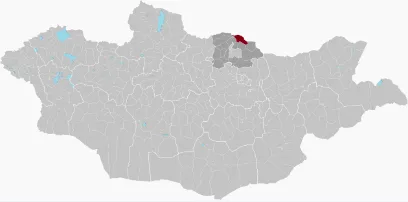
Selenge is the northern gateway province of Mongolia, occupying a swathe of well-watered country along the Russian border where the Orkhon and Selenge rivers — the country's largest river system — flow north toward Lake Baikal. It is named for the Selenge River, and its landscape is gentler and greener than much of Mongolia: river valleys, forested hills on the Siberian fringe, and some of the country's most productive farmland, earning the region a reputation as part of Mongolia's "breadbasket".
What defines Selenge as a travel destination is connectivity and crossroads character. The Trans-Mongolian Railway — the Mongolian leg of the Trans-Siberian — runs straight through the province on its way between Ulaanbaatar and Russia, and the main paved highway north follows the same corridor. For travellers, Selenge is most often experienced in transit: it is the province you cross entering or leaving Mongolia by land from Russia, and the route passes some of northern Mongolia's most rewarding sights.
The provincial capital, Sühbaatar, sits on the Russian border at the confluence of the Orkhon and Selenge rivers and is the first or last Mongolian stop on the Trans-Mongolian line. Nearby lie the third-largest city, Darkhan, and — across into neighbouring territory — the great monastery of Amarbayasgalant, one of the finest in the country. Easy access, river scenery and a major Buddhist monument make Selenge an approachable, often-overlooked corner of northern Mongolia.
When is the best time to visit?
The best months are June to September, when the river valleys and farmland are green and the weather is mild and pleasant. July is festival season — Naadam is celebrated in Sühbaatar, Darkhan and the province's towns — and the long northern daylight makes for relaxed travel. Early autumn brings golden forests on the Siberian fringe and clear skies.
Selenge's northern, river-valley setting makes it somewhat milder and greener than the central steppe, but winters are still long and very cold, with deep snow and hard frost from November into March. Spring is short, windy and dusty. If you are crossing the border by train, any season works for transit, but for actually exploring the province — Amarbayasgalant, the rivers, the countryside — aim for the summer window.
Tell us your dates and we'll shape a Selenge route around them.
WhatsAppHow do you get around?
Selenge is one of the easiest provinces in Mongolia to get around. It is served by the Trans-Mongolian Railway: two trains a day run between Ulaanbaatar and Sühbaatar — a day train (departing UB 10:30, via Darkhan, arriving 20:00) and a night train (departing 21:10, via Darkhan, arriving 05:30) — with return services to the capital. Darkhan and Sühbaatar are both rail stops, making train travel a genuine option within the province.
By road, buses run almost hourly between Ulaanbaatar and Darkhan, and there is a daily bus from UB's Dragon Center that stops in Sühbaatar on its way to the Altanbulag border crossing. From Darkhan, microbuses and shared taxis run throughout the day to Sühbaatar and on to Altanbulag. At the border, foot crossings are not permitted; drivers ferry passengers the short distance to the Russian town of Kyakhta for a small fee, where marshrutka minibuses continue to Ulan-Ude. Within towns, informal taxis are easy to flag — agree the fare first.
Where should you go?
- Sühbaatar — the provincial capital on the Russian border, a Trans-Mongolian rail town at the meeting of the Orkhon and Selenge rivers.
- Darkhan — Mongolia's third-largest city, a Soviet-era industrial hub and major rail and bus junction on the route north.
- Erdenet — the country's second-largest city, built around the vast Erdenet Copper Mine, one of the world's largest.
- Bulgan — the quiet capital of neighbouring Bulgan aimag, a green administrative town on the way north.
- Hutag-Öndör — a small soum town in the river country of northern Mongolia.
- Mörön — capital of Hövsgöl aimag and the gateway to Lake Khövsgöl and the Tsaatan reindeer herders.
- Amarbayasgalant Monastery — one of Mongolia's three largest monasteries, set in the Iven valley near the Selenge River and largely spared in the 1930s purges.
- Lake Khövsgöl — Asia's second-largest freshwater lake by volume, among the most scenic places in the country.
Want the scenic legs and stays booked for you? Just ask.
WhatsAppWhat should you eat?
Selenge's food is mainstream northern Mongolian — mutton and beef as steamed buuz, fried khuushuur, noodle soups and khorkhog, with abundant dairy and salty milk tea. What sets the province apart is agriculture: as part of Mongolia's grain-growing belt, Selenge supplies wheat and flour, and produce such as potatoes and other vegetables is more available here than in the herding heartlands, giving farmhouse meals a slightly fuller table.
Its position on the Russian border also brings Russian influence — bread, preserves and Russian-style dishes appear more readily near the frontier. In Sühbaatar, Modern Nomads, on the east side of Sukhbaatar Square (open 11:00–24:00), is a reliable sit-down restaurant. Vegetarians will fare a little better here than in the steppe provinces thanks to local produce, but should still expect a meat-centred menu.
What is the culture like?
The Naadam Festival in July — wrestling, horse racing and archery — is the main annual event, marked in Sühbaatar, Darkhan and the province's towns. Tsagaan Sar, the lunar new year in late winter, is the major family festival, with feasting and visits to elders. The wider cultural traditions are those of the Khalkh Mongols — morin khuur fiddle music, long song, throat singing, and felt and leather crafts.
Selenge's distinctive cultural anchor is Buddhist: Amarbayasgalant Monastery, built between 1727 and 1736 on the orders of the Manchu Emperor Kang Xi in honour of Zanabazar — the first Jebtsundamba Khutuktu, inventor of the Soyombo script and one of Mongolia's greatest artists. Zanabazar's body was interred there in 1788. The monastery survived the 1937 purges far better than most, retaining 26 of its temples, and remains an active religious site.
Travelling during a festival? We'll plan around the crowds.
WhatsAppWhat are the standout experiences?
- Ride the Trans-Mongolian Railway through Selenge — the Mongolian leg of the Trans-Siberian, crossing the province between Ulaanbaatar and the Russian border.
- Visit Amarbayasgalant Monastery, in the Iven valley about an hour off the Erdenet–Darkhan road — one of Mongolia's three largest monasteries, set amid empty steppe so it feels almost untouched by the modern era.
- Cross the border at Altanbulag/Kyakhta for a classic overland entry to or exit from Russia, continuing toward Ulan-Ude and Lake Baikal.
- Stand at the confluence of the Orkhon and Selenge rivers just outside Sühbaatar, where Mongolia's two largest rivers merge.
- Use Darkhan as a hub to reach Erdenet's giant copper mine or to push on toward Mörön and Lake Khövsgöl.
Top Destinations
Every destination in Selenge with a guide — tap a place for the full guide.
Altanbulag
Altanbulag (Алтанбулаг) is a small border town in Selenge province in…

Amarbayasgalant Monastery
Amarbayasgalant Monastery (Амарбаясгалант хийд), the "Monastery of…
Dulaankhaan
Dulaankhaan (Дулаанхаан) is a small settlement in Selenge province in…
Mandal
Mandal is a small rural settlement in Selenge Province, northern…
Suhbaatar
Sukhbaatar (formerly also spelled Sükhbaatar) is a town in northern…
Sukhbaatar
Sükhbaatar (Сүхбаатар) is a town in northern Mongolia, capital of…
Yeroo
Yeroo is a small settlement in Selenge Province, northern Mongolia…
Zuunkharaa
Zuunkharaa is a small town in Selenge Province, northern Mongolia…
Pair the highlights of Selenge into one easy trip — we'll plan the route.
WhatsApp
Contact Us
Get in touch with us.
Get in touch
Contact Us
Tell us where you'd like to go and how you like to travel. A real Tripcuro planner — not a bot — will craft an itinerary around you.
- Personalised, hassle-free planning end-to-end
- Transparent pricing, no hidden costs
- 24/7 support for complete peace of mind