
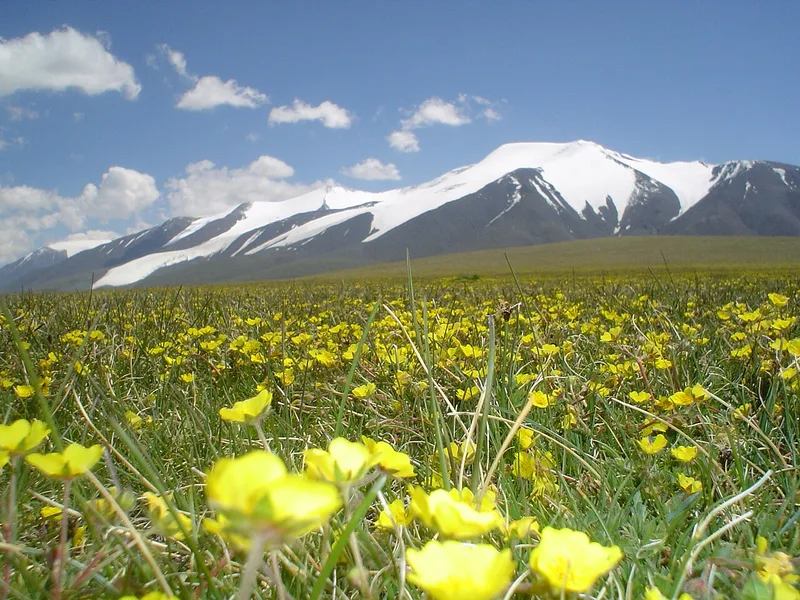
Tsambagarav Uul National Park
Hovd, Mongolia
Why visit Tsambagarav Uul National Park?
Tsambagarav Uul National Park protects a glaciated massif of the Mongolian Altai that straddles the border between Hovd and Bayan-Ölgii provinces in far western Mongolia. Its centrepiece is Tsambagarav Uul, a snow- and ice-capped mountain rising to roughly 4,200 m, one of the highest peaks in the region and a striking landmark visible for great distances across the surrounding steppe and desert basins. The park was established to safeguard this mountain, its glaciers, alpine valleys and the wildlife they shelter.
What makes the park distinctive is the combination of a permanently glaciated high peak with the cultural landscape around it. The lower slopes and valleys are summer pasture for Kazakh and Uriankhai herders, whose gers dot the meadows and who still practise eagle hunting and traditional crafts. The high country is habitat for snow leopard, ibex, argali sheep and a rich birdlife including raptors. For travellers the park offers serious mountaineering and trekking, accessible alpine scenery, and the chance to experience western Mongolia's herding cultures in a spectacular setting — all far from the crowds.
The climate is severe and high-altitude: cold for much of the year, with snow and ice persisting on the upper mountain permanently. The practical season is June to early September, when the valleys are green, the passes are clear and the herders are at their summer camps; weather can turn quickly even in summer, and nights are cold at altitude. Winter brings deep snow and extreme cold, suitable only for well-equipped expeditions. There are no towns inside the park — the realistic bases are Khovd city to the south or the village of Bayannuur and the Bayan-Ölgii sums to the north.
Planning Tsambagarav Uul National Park? Tell us your dates and we’ll tailor the trip.
Ask on WhatsAppHow do you get there?
By Plane
The nearest airports are Khovd Airport (IATA: HVD), about 6 km south of Khovd city, and Ölgii Airport (IATA: ULG) in Bayan-Ölgii — both served by flights from Ulaanbaatar on Hunnu Air and AeroMongolia. From either airport a taxi runs on the local rate of around ₮500 per km into the respective city, where you arrange a 4WD and driver for the park.
By Car / Road
The park is reached overland, most commonly from Khovd city to the south or from the Ölgii direction to the north — the mountain sits roughly between the two, near the Khovd–Bayan-Ölgii provincial boundary. Routes follow unpaved steppe and mountain tracks, and a 4WD vehicle with an experienced local driver is essential; allow several hours from either Khovd or Ölgii depending on the trailhead. Most visitors hire a jeep or furgon (4×4 UAZ van) at the central market in Khovd or Ölgii, or arrive on a guided trekking or climbing tour. There is no scheduled bus to the park; shared vehicles leaving for the surrounding sums can get travellers close, but reaching the valleys and base camps needs a private vehicle.
There is no public transport, no roads to speak of within the park, and no ride-hailing. Once at a trailhead or base area, getting around means walking, trekking and climbing, often with pack horses or camels arranged through local herders to carry gear. A local guide is strongly recommended — for route-finding on the mountain, for crossing rivers and passes, and for arranging contact with herding families. The 4WD that brought you typically waits at a base camp or returns on an agreed date. Distances are large and the terrain demanding; plan logistics and resupply before setting out.
What are the things to do?
Mountains and glaciers
- Tsambagarav Uul — The glaciated main peak, roughly 4,200 m, with permanent ice and snow; the dominant sight of the park and a serious mountaineering objective.
- Glaciers and alpine valleys — The high cirques and glacier tongues, with meltwater streams, alpine meadows and dramatic ridgelines, are the scenic heart of the park.
Landscape and wildlife
Summer pasture valleys — Green herder valleys on the lower slopes, dotted with Kazakh and Uriankhai gers and grazing livestock, framed by the snow peak above.
Wildlife habitat — The park shelters snow leopard, ibex, argali sheep and raptors; sightings of the cats are rare, but ibex and birds of prey are regularly seen.
Mountaineering — Climbing Tsambagarav Uul is the park's flagship challenge, a glaciated ascent for experienced, properly equipped parties, usually with a guide.
Trekking — Multi-day treks through the alpine valleys, between herder camps and up to glacier viewpoints, are the main draw for most visitors.
Horse riding — Ride through the summer pastures with local herders, a fine way to cover ground and reach the high meadows.
Cultural visits — Stay with Kazakh or Uriankhai herding families; in season you may see eagle hunters and their birds.
Wildlife watching and photography — The glaciers, herder camps and big skies make superb photography, and patient watchers may spot ibex and raptors.
Planning Tsambagarav Uul National Park? Want these on a customised itinerary?
Ask on WhatsAppWhere to eat?
There are no restaurants within Tsambagarav Uul National Park. Visitors bring their own food and cook with their group, or eat with herder families when a homestay is arranged. Provisions should be bought in Khovd or Ölgii.
- Self-catering — Carry staples, trekking food and a stove; this is essential for any multi-day trip into the mountains.
- Homestay meals — Herder families serve home-style fare: mutton, milk tea, buuz (steamed dumplings), and Kazakh dishes such as beshbarmak in Kazakh camps.
- Dining in town — For restaurants, return to Khovd or Ölgii, both of which have canteens and eateries.
Vegetarians should plan ahead and carry their own food; meat-free and gluten-free options are not available in the park. Kazakh herder households generally keep halal food.
Where to drink?
There is nowhere to buy drinks within the park. Mountain streams and glacier meltwater are generally cleaner than lowland water but should still be treated — boil, filter or use purification tablets. Carry enough water for each day's trekking. Herder families may offer süütei tsai (salty milk tea) and, in summer, airag (lightly alcoholic fermented mare's milk); Kazakh families serve strong tea. For cafés and bars, you will need to be in Khovd or Ölgii.
Planning Tsambagarav Uul National Park? We’ll book the stays and dining for you.
Ask on WhatsAppWhere to stay?
- Budget: Camping with your own tent is the standard way to stay in the park — on alpine meadows or at base camps; it is free but you must be self-sufficient and practise leave-no-trace. Informal herder homestays in the summer pasture valleys offer a bed in a ger with meals, typically around ₮25,000–60,000 per person per night, arranged through a guide.
- Mid-range: Seasonal tourist ger camps operate in the wider region around Khovd and Ölgii in summer, offering gers with beds and shared facilities; they are outside the park itself and close in the cold months.
What should you buy?
There are no shops, markets or craft stalls within the park — buy all food, water, fuel and trekking supplies in Khovd or Ölgii before setting out; both have central markets (Khovd's is closed Thursdays). Kazakh and Uriankhai herder families may sell handmade items — embroidered felt, woollens, leatherwork — and buying directly supports them. Ölgii in particular is known for fine Kazakh embroidery and crafts. Prices are modest and bargaining is gentle.
Where to go next?
- Khovd (several hours by road) — The provincial capital, with the airport, market, museum and hotels.
- Ölgii (several hours by road) — The Kazakh-majority capital of Bayan-Ölgii, base for eagle hunting and the Altai Tavan Bogd.
- Khar Us Lake National Park (near Khovd) — A vast reed-fringed lake and one of Mongolia's great birdwatching wetlands.
- Altai Tavan Bogd National Park (Bayan-Ölgii) — Mongolia's highest peaks, glaciers and alpine lakes near the Russian and Chinese borders.
- Mönkhkhairkhan (Altai sum, Hovd) — Another high glaciated Altai peak and Uriankhai herding country.
Nearby in Hovd
More places to explore around Tsambagarav Uul National Park.

Guide content as of May 2026. Portions adapted from Wikivoyage, CC BY-SA 4.0.

Contact Us
Get in touch with us.
Get in touch
Contact Us
Tell us where you'd like to go and how you like to travel. A real Tripcuro planner — not a bot — will craft an itinerary around you.
- Personalised, hassle-free planning end-to-end
- Transparent pricing, no hidden costs
- 24/7 support for complete peace of mind