
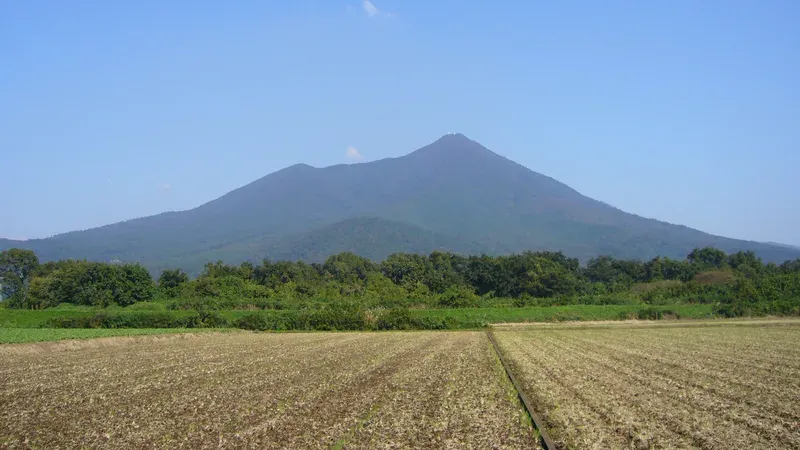
Mount Tsukuba
Ibaraki, Japan
Why visit Mount Tsukuba?
Mount Tsukuba (筑波山, Tsukuba-san) is a twin-peaked mountain rising 877 m above the flat Kanto Plain in southern Ibaraki Prefecture, about 60 km northeast of central Tokyo. Although modest in height, it has a long-standing reputation in Japanese culture, paired with Mount Fuji in the old saying "Fuji in the west, Tsukuba in the east." It is one of the few major mountains in Japan that is not volcanic, instead formed of granite and gabbro, and it is famously included in lists of Japan's notable peaks despite being the shortest of them. The two summits each carry a name and a deity: Nantai-san (男体山, 871 m), the "male body," and Nyotai-san (女体山, 877 m), the "female body."
Mount Tsukuba sits within Suigo-Tsukuba Quasi-National Park and is administered by the city of Tsukuba, best known on the plain below for Tsukuba Science City. The mountain itself is a long-revered place of worship centred on Tsukubasan Shrine, whose history of veneration is said to stretch back well over a thousand years. Visitors come for half-day hikes, panoramic views over the Kanto Plain (clear winter days reach as far as Tokyo's skyline and Mount Fuji), and the relaxed shrine-and-onsen atmosphere of the lower slopes.
The mountain is a year-round destination. Spring brings plum blossoms at the Tsukuba Bairin plum grove on the southern slope and fresh greenery; autumn foliage from late October into November is the busiest season. Winter days, though cold, often deliver the clearest long-distance views, and the mountain occasionally sees light snow. Summer hikes are humid and best started early. The area splits between the lower shrine town around the cable car base and the upper ridge linking the two peaks.
Planning Mount Tsukuba? Tell us your dates and we’ll tailor the trip.
Ask on WhatsAppHow do you get there?
By Plane
The nearest major airport is Narita International Airport (NRT), roughly 60–70 km to the southeast. There is no direct public transport to the mountain; most travellers reach Tsukuba city first and continue by bus. Tokyo's Haneda Airport (HND) is a similar distance to the southwest and connects via Tokyo and the Tsukuba Express.
By Train
There is no railway station at the mountain itself. The usual gateway is Tsukuba Station, the northern terminus of the Tsukuba Express line, reached from Akihabara in Tokyo in about 45 minutes by rapid service. From Tsukuba Station, direct Kanto Railway buses run to Tsukubasan Shrine (about 35–40 minutes). Alternatively, Tsuchiura Station on the JR Joban Line is served by buses heading toward the mountain.
By Car / Road
By car from Tokyo, take the Joban Expressway to the Tsuchiura-Kita interchange, then follow prefectural roads toward the mountain — roughly 1 hour 30 minutes in light traffic. From Tsukuba city centre it is about 30–40 minutes. Paid parking is available near the shrine, the cable car base and the ropeway base; lots fill quickly during autumn-foliage weekends.
The mountain is explored on foot, by cable car and by ropeway. The Tsukubasan Cable Car climbs from the Miyawaki base station near the shrine to a station just below the Nantai-san summit; the Tsukubasan Ropeway ascends from the Tsutsujigaoka base to a point near the Nyotai-san summit. A walking ridge trail links the two upper stations, making a cable-car-up, ropeway-down loop straightforward. Kanto Railway buses connect Tsukuba Station with the shrine area and the ropeway base. There are no ride-hailing apps in regular use; taxis can be arranged from Tsukuba and Tsuchiura stations. The mountain trails are well marked but steep and rocky in places — proper footwear is essential.
What are the things to do?
Tsukubasan Shrine (筑波山神社) — The historic shrine at the foot of the mountain, dedicated to the deities of the two peaks; an atmospheric complex of halls and ancient trees, and the traditional starting point for the climb. The upper sub-shrines stand at each summit. Free to enter the precincts.
Nyotai-san summit (女体山, 877 m) — The higher of the two peaks, offering the finest panorama over the Kanto Plain. A small summit shrine and dramatic granite outcrops crown the top.
Nantai-san summit (男体山, 871 m) — The "male" peak, reached easily from the cable car upper station, with its own summit shrine and wide views.
Strange Rocks of the ridge trail — Between the two summits, the path passes a series of named granite formations (such as Benkei Nanamodori and the Gama-ishi "toad rock"), each with a local legend.
Tsukuba Bairin (筑波梅林) — A hillside plum grove on the southern slope with thousands of plum trees and a long-distance viewpoint; spectacular when the blossoms open in late February and March.
Hike the classic trails — The Miyukigahara course (from the shrine up toward Nantai-san) and the Shirakumobashi course are the two main ascent routes, each taking roughly 1.5–2 hours; combine with the cable car or ropeway for a half-day outing.
Cable car and ropeway sightseeing — A relaxed way to gain the ridge without the climb, popular with families and in autumn foliage season.
Night views and seasonal illuminations — The ropeway runs special evening services at certain times of year, when the lights of the Kanto Plain spread out below.
Plum and foliage festivals — The Tsukuba Plum Festival in late winter and autumn-leaf viewing in November are the headline seasonal events.
Day trip to Tsukuba Science City — Combine the mountain with the science museums and research facilities on the plain below.
Planning Mount Tsukuba? Want these on a customised itinerary?
Ask on WhatsAppWhere to eat?
Food on the mountain centres on simple, hearty fare aimed at hikers and day-trippers — soba and udon noodles, sansai (mountain vegetable) dishes, and grilled rice cakes are typical. Restaurants cluster around the shrine, the cable car base and the upper stations.
- Mountain-side soba and udon shops (budget) — Several casual noodle restaurants near the shrine and base stations serve hot soba, tempura sets and tea, generally in the ¥800–1,500 range.
- Cable car / ropeway summit restaurants (mid-range) — The upper stations have dining areas with curry rice, noodle sets and light meals enjoyed with the view.
- Shrine-town restaurants (mid-range) — A handful of established eateries near Tsukubasan Shrine serve set lunches featuring local vegetables and tofu.
Vegetarians can usually find sansai soba and vegetable dishes; strict vegetarians should confirm dashi stock. Halal and gluten-free options are very limited — self-catering or eating in Tsukuba city is advisable.
Where to drink?
Hot green tea and amazake (a sweet, low- or non-alcoholic fermented rice drink) are popular after a cold hike, and vending machines for soft drinks are found at the base and summit stations. Local sake from Ibaraki breweries is sold in the souvenir shops. Mountain teahouses serve tea and seasonal sweets. Tap water in Japan is safe to drink throughout the area.
Planning Mount Tsukuba? We’ll book the stays and dining for you.
Ask on WhatsAppWhere to stay?
Most visitors day-trip from Tokyo or Tsukuba city, but the foot of the mountain has a small cluster of inns and an onsen resort area.
- Budget: Guesthouses and minshuku in the shrine town and in Tsukuba city offer simple rooms from roughly ¥4,000–7,000 per person; options near the station in Tsukuba are the most reliable.
- Mid-range: Onsen ryokan on the lower slopes around the Tsukubasan Onsen area provide tatami rooms with hot-spring baths and dinner, typically ¥12,000–20,000 per person with two meals.
- Upscale / heritage: A few well-regarded hot-spring inns near the shrine offer premium rooms, kaiseki dinners and panoramic baths; rates rise above ¥25,000 per person with meals.
What should you buy?
The shrine approach and the cable car and ropeway base stations have souvenir shops selling local snacks and mountain-themed goods. Look for Tsukuba's frog (gama) motifs — the toad is a mascot of the mountain, tied to the local "gama no abura" (toad oil) folk medicine once hawked here. Fukurai senbei rice crackers, plum-based sweets and locally grown produce make good gifts. Tsukuba city's shops below stock Ibaraki specialities. Prices are fixed; bargaining is not customary in Japan.
Where to go next?
- Tsukuba (city centre, ~35–40 min by bus) — Science City museums, the Geological Museum and JAXA's space exhibits.
- Tsuchiura (~40 min by bus/train) — Lakeside city on Lake Kasumigaura, known for its summer fireworks competition.
- Lake Kasumigaura (~1 hr) — Japan's second-largest lake, with cycling routes and birdlife.
- Mito (~1.5 hr) — Ibaraki's capital, home to Kairakuen, one of Japan's three great gardens.
- Kasama (~1.5 hr) — Pottery town with the Kasama Inari Shrine and craft galleries.
Nearby in Ibaraki
More places to explore around Mount Tsukuba.
Guide content as of May 2026. Portions adapted from Wikivoyage, CC BY-SA 4.0.

Contact Us
Get in touch with us.
Get in touch
Contact Us
Tell us where you'd like to go and how you like to travel. A real Tripcuro planner — not a bot — will craft an itinerary around you.
- Personalised, hassle-free planning end-to-end
- Transparent pricing, no hidden costs
- 24/7 support for complete peace of mind