
Murshidabad
West Bengal, India
About Murshidabad
Murshidabad (MOOR-shih-dah-bahd) is a historic town on the banks of the Bhagirathi River in central West Bengal. It was named after Nawab Murshid Quli Khan, who shifted the capital of Bengal here in 1717 and ruled as the first independent Nawab of Bengal, Bihar and Odisha. At its height the town was a flourishing centre of trade and silk weaving, and historians estimate Murshidabad once contributed a substantial share of India's economy. After the pivotal Battle of Plassey in 1757 — fought a short distance away — the British East India Company gained the upper hand, and in 1773 the capital was moved to Calcutta.
What survives today is a quiet provincial town scattered with the ruins and restored monuments of that Nawabi golden age: palaces, mosques, imambaras, cannons and cemeteries, many within walking distance of one another along the riverbank. The headline attraction is the Hazarduari Palace, the "Palace of a Thousand Doors", now one of India's largest site museums. Murshidabad is best treated as a slow heritage destination — tourist infrastructure is modest, but the density of history is exceptional.
For orientation, the town divides loosely into the central Hazarduari tourist complex; Lalbagh and North Murshidabad with its monuments and palaces; Motijhil and South Murshidabad, the denser residential and commercial belt; and West Murshidabad on the opposite bank of the Bhagirathi. The cool, dry winter months of November to February are by far the most pleasant for sightseeing; summers are very hot and the monsoon (June–September) brings heavy rain.
Planning Murshidabad? Tell us your dates and we’ll tailor the trip.
Ask on WhatsAppHow to reach
Murshidabad is well connected to Kolkata by both rail and road.
By Plane
By Train
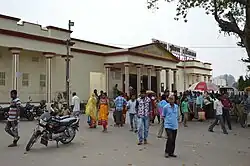
Murshidabad Junction lies on the Ranaghat–Lalgola line of the Kolkata Suburban Railway, with a branch line crossing the Bhagirathi to Azimganj Junction. Three express trains run from Kolkata directly to Murshidabad — the Bhagirathi Express, the Hazarduari Express and the Dhano Dhanye Express — alongside local trains. From Howrah, you can take the Ganadevata Express, Balurghat Express, Malda Town Intercity Express or other Azimganj-bound trains to Azimganj, then continue to Murshidabad by ferry or road. Book reserved tickets in advance for the express services, especially in winter.
By Car / Road
Murshidabad is about 200 km north of Kolkata, a journey of roughly five to six hours by road via Baharampur (Berhampore), the district headquarters about 12 km south. Regular long-distance buses run from Kolkata, and Volvo coach services operate on the Kolkata–Baharampur route. From Baharampur, autos and hired cars cover the short remaining stretch.
Within Murshidabad, autorickshaws are the everyday workhorse, and cars can be hired for the day to string together the scattered monuments. For short hops between the riverside sights — and as an experience in itself — horse-drawn carriages (tanga) wait near the Hazarduari complex. There are no fixed rates for any of these, so agree a fare before setting off and bargain firmly. The core Hazarduari area is compact and pleasant to explore on foot.
Things to do
Hazarduari complex
- Hazarduari Palace — the "Palace of a Thousand Doors" (900 real, 100 false), built by Duncan Macleod in 1837 for Nawab Humayun Jah. Now one of the largest site museums of the Archaeological Survey of India, with 20 galleries displaying weapons, European oil paintings, marble statues, manuscripts, farmans and royal palanquins. Open 9AM–5PM.
- Nizamat Imambara — a vast Shia congregation hall directly opposite the palace on the riverbank, built in 1847 and stretching some 680 feet. Its central quadrangle holds the Madina Mosque.
- Clock Tower (Ghari Ghar) — standing between the palace and the Imambara, built by Sagar Mistri with a heavy bell at its top.
- Bachchawali Tope — an enormous old cannon between the palace and Imambara, weighing over 7,600 kg, decorated with brass inlay.
- Tripolia Gate and Dakshin Darja (South Gate) — grand arched gateways to the Quila Nizamat, both crowned with a nahabatkhana and high enough for an elephant with a howdah to pass.
- Mosques of the complex — the five-domed Chawk Masjid (1767), the three-domed Safed Masjid (White Mosque, 1756–57) and Zurud Masjid (Yellow Mosque), both built by Siraj-ud-Daulah, near the riverbank.
- Wasif Ali Manzil — a beautifully restored later Nawabi palace, with the ruins of the Begum Mahal behind it.
Lalbagh and North Murshidabad
- Katra Masjid — built by Murshid Quli Khan in 1723; the Nawab is buried beneath its entrance staircase. Damaged in the 1897 earthquake but well maintained.
- Jahan Kosha Cannon ("Destroyer of the World") — a huge cannon near the Katra Masjid, said to have been brought from Dhaka.
- Kathgola Palace — the palace garden of the Singhdugar family with its ornate Adinath Digamber Jain temple (1873), a small zoo and stucco work.
- Jafarganj Cemetery — the burial ground of the Nawabs Nazim from Mir Jafar to Humayun Jah, holding around 1,100 graves over some 3.5 acres.
- Nimak Haram Deorhi (Traitor's Gate) — the surviving gateway to Mir Jafar's vanished palace.
- Nashipur Palace — a 19th-century palace with Ramachandra and Lakshmi-Narayana temples within its compound.
- House of Jagat Seth — the restored home-turned-museum of the powerful Jagat Seth banking family, with an adjoining Jain temple.
- Fauti Masjid — an evocative abandoned mosque, its construction halted in 1740 with only two of its planned five domes finished.
Motijhil and South Murshidabad
Motijhil — the horseshoe-shaped "Pearl Lake", excavated by Nawazesh Mohammad and once the seat of Warren Hastings; now a park with toy-train rides. The nearby Jama Masjid is the lake area's only surviving Nawab-era monument.
Take a boat on the Bhagirathi — country boats and ferries ply the river; the crossing to Azimganj and the views of the riverside palaces and mosques are the classic Murshidabad experience.
Ride a heritage tanga — circle the Hazarduari complex by horse-drawn carriage, an unhurried way to absorb the Nawabi quarter.
Visit Plassey (Palashi) — the 1757 battlefield that changed the course of Indian history lies about 50 km south, an easy half-day trip.
Time your visit to a festival — during Muharram the Nizamat Imambara comes alive with Shia commemorations, and Bera Utsav on the Bhagirathi is a distinctive local river festival.
Planning Murshidabad? Want these on a customised itinerary?
Ask on WhatsAppFood & Dining
Murshidabad's food is rooted in Bengali home cooking with a distinct Nawabi and Muslim layer — biryani, kebabs and rich meat curries alongside the usual rice-and-fish staples. Eateries cluster near the Hazarduari complex and, with far more choice, in Baharampur. Look for the local chhanabora, a soft syrup-soaked sweet that is a regional speciality, and the area's celebrated mangoes in summer.
- Hotel Samrat (Baharampur) — a long-standing mid-range restaurant serving Bengali, Mughlai and tandoori dishes.
- WBTDC Tourist Lodge restaurant — reliable Bengali thalis near the monuments.
- Stalls around Hazarduari — simple eateries for rice, fish curry, luchi and tea between sightseeing.
Cafes & Nightlife
The everyday drink is cha (tea), sold at countless roadside stalls, and you will also find fresh lime soda, lassi and seasonal aam pora shorbot (roasted green-mango drink) in the hot months. As a town with a strong Muslim heritage, alcohol is not a prominent part of public life; licensed outlets are limited and mostly found in Baharampur. Stick to bottled or filtered water and avoid untreated tap water and ice from uncertain sources.
Planning Murshidabad? We’ll book the stays and dining for you.
Ask on WhatsAppPlaces to Stay
- Budget — simple guesthouses and lodges cluster around the Hazarduari area and in Baharampur, typically from around ₹600–1,200 a night. Manjusha, the WBTDC tourist lodge, offers a reliable budget-to-mid option close to the monuments.
- Mid-range — Baharampur has several mid-range hotels (around ₹1,500–3,000) with air-conditioning and in-house restaurants, a comfortable base for day trips into Murshidabad's monument zone.
- Upscale / heritage — Murshidabad has limited upscale accommodation; the better-appointed hotels are in Baharampur. Travellers seeking comfort generally choose the best mid-range properties there.
What to buy
Murshidabad's signature product is its silk. The town has been famous for silk weaving since Nawabi times, and the surrounding district — especially around Baharampur and the weaving village of Islampur — is known for fine silk saris, including the corded garad and Murshidabad silk. The town is also associated with traditional sheherwali ivory-style carving heritage and brassware. Bargaining is expected in the markets; buy saris from established showrooms in Baharampur for reliable quality.
Go next
- Baharampur (Berhampore) — 12 km; the district headquarters with the best hotels, restaurants and shopping, plus the Barrackpore Cantonment church and silk markets.
- Plassey (Palashi) — about 50 km; the historic 1757 battlefield with a memorial.
- Mayapur — around 100 km south; the international ISKCON headquarters on the Ganga, a major pilgrimage centre.
- Malda — roughly 100 km north; gateway to the medieval ruins of Gour and Pandua.
- Kolkata — about 200 km; the state capital, easily reached by express train for onward connections.
Nearby in West Bengal
More places to explore around Murshidabad.
Portions adapted from Wikivoyage, CC BY-SA 4.0.

Contact Us
Get in touch with us.
Get in touch
Contact Us
Tell us where you'd like to go and how you like to travel. A real Tripcuro planner — not a bot — will craft an itinerary around you.
- Personalised, hassle-free planning end-to-end
- Transparent pricing, no hidden costs
- 24/7 support for complete peace of mind