

Ayodhya
Uttar Pradesh, India
About Ayodhya
Ayodhya, on the banks of the Sarayu river in the Awadh region of Uttar Pradesh, is one of Hinduism's holiest cities — the legendary birthplace of Lord Rama and the setting for much of the epic Ramayana. The name means "invincible" in Sanskrit, and in ancient times the city was also known as Saketa. Rama's triumphant return from fourteen years of exile is the origin story of Diwali, and his just rule, Rama Rajya, remains a Hindu byword for ideal governance. The guide also covers Faizabad, Ayodhya's twin city, which served as capital of the 18th-century Oudh State before the seat moved to Lucknow.
Ayodhya's modern history has been dominated by the long Ram Janmabhoomi dispute over a site associated with Rama's birth. After decades of conflict, India's Supreme Court awarded the site for a Hindu temple, and the Ram Mandir was consecrated in January 2024. The temple's opening transformed Ayodhya into one of India's busiest pilgrimage destinations, accompanied by major new infrastructure — a redeveloped airport, an upgraded railway station and broad new approach roads. Expect large crowds, an intensely devotional atmosphere and a city still very much under construction.
The best months to visit are October to March, when the weather is cool and pleasant; this also brings the spectacular Deepotsav around Diwali, when the ghats are lit with hundreds of thousands of lamps. April to June is very hot, and Ram Navami (March–April) draws enormous crowds. The monsoon (July–September) is humid and can raise the Sarayu's level. The temple core lies in the west of the city, with ghats strung along the river to the east.
Planning Ayodhya? Tell us your dates and we’ll tailor the trip.
Ask on WhatsAppHow to reach
By Plane
Maharishi Valmiki International Airport Ayodhya Dham (IATA: AYJ), close to NH 27 and NH 330, opened in late 2023 and has scheduled flights from major Indian cities. The airport is a short drive from the temple area; prepaid taxis, app cabs and autorickshaws serve arrivals. For wider connections, Lucknow's Chaudhary Charan Singh International Airport (about 130 km away) remains a useful alternative.
By Train
Ayodhya is served by Ayodhya Junction (extensively rebuilt as Ayodhya Dham Junction) and Ayodhya Cantt in Faizabad. Trains run from Delhi, Lucknow, Varanasi, Prayagraj and Gorakhpur. Notable services include the Vande Bharat Express linking Lucknow and Gorakhpur, the Saryu Yamuna Express from Amritsar, and the Marudhar Express from Varanasi. Several dedicated pilgrim and express trains have been added since the temple opened. Book through IRCTC well in advance around Diwali and Ram Navami, when demand is extreme.
By Car / Road
Approximate road distances: Lucknow 130 km, Gorakhpur 140 km, Prayagraj 160 km, Varanasi 200 km, Delhi 636 km. Drive times from Lucknow are around 3 hours on improved highways. State and private buses run frequently from Lucknow, Gorakhpur and Delhi, and are also available from Varanasi and Prayagraj. New widened approach roads (the Ram Path and associated corridors) ease access into the temple area, though traffic is heavy on festival days.
Ayodhya's core is compact and best explored on foot, especially the temple area and the riverside ghats — much of the Ram Janmabhoomi precinct is a pedestrian zone with security checks. For longer hops, between Ayodhya and Faizabad or out to the airport and station, autorickshaws, cycle rickshaws, e-rickshaws and shared tempos are plentiful and cheap. App-based cabs operate but coverage can be patchy on festival days. Agree fares before boarding. During major festivals expect road closures, diversions and dense crowds; allow extra time and keep belongings secure.
Things to do
The Ram Janmabhoomi precinct
- Ram Mandir — the colossal new temple in the western part of the city, built on the site traditionally held to be Rama's birthplace and consecrated in January 2024. The principal pilgrimage focus of Ayodhya; entry is free but involves security checks, and queues can be very long, especially around Ram Navami.
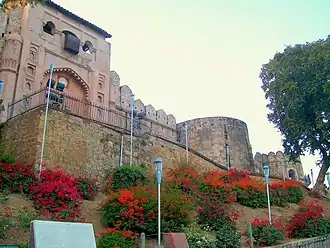
- Hanuman Garhi — a hilltop temple to Hanuman in the centre of town, shaped like a four-sided fort with circular bastions; pilgrims traditionally visit here before the Ram Mandir.
- Kanak Bhawan (the "Palace of Gold", near Hanuman Garhi) — a temple housing images of Rama and Sita wearing gold crowns, also called Sone-ka-Ghar.
- Nageshwarnath Temple (on the riverbank, east of town) — a Shiva temple said to have been founded by Kush, Rama's son; open roughly 5–11AM and noon–8PM.
- Treta ke Thakur — a temple at the spot where Rama is said to have performed the Ashwamedha Yagna, with idols reportedly carved from a single block of black sandstone.
Riverside & gardens
- Ram ki Paidi — a sweeping series of ghats on the Sarayu, the stage for the Deepotsav lamp festival at Diwali; atmospheric at dusk.
- Lakshman Ghat — the ghat associated with Rama's brother Lakshmana.
- Mani Parbat (Kami Ganj) — a former Buddhist vihara turned Hindu site, dotted with small shrines, with fine city views from the top terrace.
Faizabad (Mughal-era monuments)
- Bahu Begum ka Maqbara — an elegant tomb, still one of Faizabad's tallest buildings.
- Gulab Bari — the "garden of roses", the mausoleum of the Oudh ruler Shuja-ud-Daula set in a rose garden.
Ayodhya is a place of pilgrimage rather than recreation, and its great experiences are devotional. Take a dawn or dusk parikrama — a circumambulation of sacred sites — ranging from the day-long Antargrahi route to the longer Panchkoshi circuit; the immense Chaturdashi Kosi Parikrama circles the city in 24 hours once a year. Watching the evening Sarayu aarti at the ghats, with chanting and floating lamps, is a highlight. If your visit coincides with Ram Lila season (around Vijayadashami in late September–October), the cycle-play re-enactment of the Ramayana is performed with song and kathak dance. The Sravan Jhula Mela sees temple idols placed on swings, and Deepotsav at Diwali is a once-in-a-lifetime spectacle of lamps along the river.
Planning Ayodhya? Want these on a customised itinerary?
Ask on WhatsAppFood & Dining
Ayodhya's food is almost entirely vegetarian, satvik and free of onion and garlic in keeping with its temple character; meat and alcohol are essentially absent from the holy core. Expect simple, hearty North Indian and Awadhi vegetarian fare — thalis, kachoris, puri-sabzi, and plenty of sweets.
- Pilgrim bhandaras and dharamshala kitchens — many temples and guesthouses serve simple, inexpensive satvik meals to visitors.
- Local kachori and jalebi stalls near Hanuman Garhi — good for a cheap, fresh breakfast.
- Hotel restaurants in the newer mid-range and upscale properties offer multi-cuisine vegetarian menus and thalis in cleaner, air-conditioned settings.
- For a wider choice of restaurants, Faizabad has more conventional dining options a short ride away.
Strict vegetarians and those avoiding onion and garlic are exceptionally well catered for; travellers wanting meat dishes should look toward Faizabad.
Cafes & Nightlife
Ayodhya is a dry, devotional city — alcohol is not part of the experience and is best not sought out near the temples. The drinks to enjoy are local and non-alcoholic: masala chai, fresh lassi, sugarcane juice, thandai, nimbu pani (lime water) and seasonal fruit juices from street vendors. Tea stalls cluster around the ghats and temple approaches. Drink only bottled or filtered water, and treat river water as for ritual use only, not for drinking.
Planning Ayodhya? We’ll book the stays and dining for you.
Ask on WhatsAppPlaces to Stay
- Budget: Numerous dharamshalas, ashrams and pilgrim guesthouses around the temple area offer very simple rooms from roughly ₹500–1,200; the UP Tourism property Pathik Niwas Saket near Ayodhya Junction is a reliable budget-to-mid choice.
- Mid-range: A wave of new and upgraded hotels has opened since the temple's consecration, with comfortable rooms broadly in the ₹3,000–7,000 range; book ahead, as availability is tight on festival dates.
- Upscale / heritage: Newer business-class and branded hotels in and around Ayodhya provide air-conditioned comfort and multi-cuisine dining, typically ₹8,000 and upward; Lucknow's luxury hotels are an option for those treating Ayodhya as a day trip.
What to buy
Ayodhya's shopping is overwhelmingly devotional. Pilgrims pick up Ram-nama cloth and shawls printed with the name of Rama, rudraksha beads, tulsi prayer malas, brass and metal idols, framed religious images and prasad sweets. Stalls cluster densely around Hanuman Garhi, the Ram Mandir approach and the ghats. Small souvenirs and pooja items are inexpensive; mild bargaining is acceptable in the bazaar stalls, though prices for ritual items are often modest and fixed. Faizabad's older markets offer everyday goods and local sweets.
Go next
- Faizabad (adjacent) — Ayodhya's twin city, with Oudh-era tombs and gardens.
- Lucknow (130 km, ~3 hr) — the Nawabi capital, famed for Awadhi cuisine and chikankaari.
- Gorakhpur (140 km, ~3 hr) — gateway to the Gorakhnath Temple and onward travel to Nepal.
- Prayagraj (160 km, ~3.5 hr) — the sangam of the Ganges and Yamuna, host of the Kumbh Mela.
- Varanasi (200 km, ~5 hr) — India's holiest city, with its riverside ghats and evening aarti.
- Shravasti (~110 km, ~2.5 hr) — an important Buddhist pilgrimage site associated with the Buddha.
Nearby in Uttar Pradesh
More places to explore around Ayodhya.

Portions adapted from Wikivoyage, CC BY-SA 4.0.

Contact Us
Get in touch with us.
Get in touch
Contact Us
Tell us where you'd like to go and how you like to travel. A real Tripcuro planner — not a bot — will craft an itinerary around you.
- Personalised, hassle-free planning end-to-end
- Transparent pricing, no hidden costs
- 24/7 support for complete peace of mind