
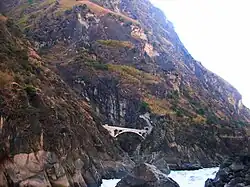
Tiger Leaping Gorge
Yunnan Sheng, China
About Tiger Leaping Gorge
Tiger Leaping Gorge (虎跳峡, Hǔ Tià o Xiá) is one of the deepest river canyons in the world, carved by the upper Yangtze (here called the Jinsha River, 金沙江) as it knifes between Jade Dragon Snow Mountain (5,596 m) to the south and Haba Snow Mountain (5,396 m) to the north. From river to ridge the vertical drop exceeds 3,000 m, and legend has it that a hunted tiger once escaped pursuers by leaping the river at its narrowest point — a 25-metre channel marked today by Tiger Leaping Stone. For most travellers the gorge is not a sight to look at but a two-day trek to walk through: a high path that traces the northern wall of the canyon, threading Naxi farming hamlets, terraced fields, pine forest, and the famously knee-burning 28 Bends switchback.
The trek runs roughly 22 km between Qiaotou (Changsheng Village) at the western end and Walnut Grove / Tina's Guesthouse at the eastern end, gaining about 900 m. It is among the most rewarding multi-day walks in China and is well within reach of any reasonably fit walker who does not mind heights — there are exposed sections, but the trail itself is wide and well-trodden. A single open-ended ticket (¥45 as of early 2024) covers the trail; side paths down to the river and the Tiger Leaping Stone carry small extra fees (typically ¥10–15 each).
Climate is mild year-round thanks to the sheltering peaks, with annual averages of 13–20 °C. Spring (March–May) is the prime window — wildflowers, clear skies, daytime highs to 20 °C. Autumn (mid-September to November) is equally good: dry, sunny, crisp. Winter is cold at dawn and dusk (down near freezing) but daytime hiking is pleasant. Avoid the summer rainy season (June to early September): heavy rain can close the gorge, trigger landslides, and make the exposed sections genuinely dangerous. Layers, sun protection and broken-in boots are essential in every season.
Planning Tiger Leaping Gorge? Tell us your dates and we’ll tailor the trip.
Ask on WhatsAppHow to reach
By Plane
The nearest airport is Lijiang Sanyi International Airport (LJG), about 28 km south of Lijiang Old Town and roughly 130 km / 2.5–3 hours by road from Qiaotou (the trailhead). From LJG, an airport shuttle bus runs to Lijiang city for ¥20 (about 40 minutes), or a taxi costs ¥80–100. From Lijiang Old Town / bus station, continue to Qiaotou by bus (see below). The next-nearest option is Shangri-La (Diqing) Airport (DIG), about 100 km north of the gorge.
By Train
Lijiang Railway Station is the practical rail gateway; it sits in the south of Lijiang and is connected to Kunming, Dali and Shangri-La by frequent CRH (high-speed) services on the Lijiang–Shangri-La and Dali–Lijiang lines. From the station, a taxi to Lijiang's main bus station costs around ¥15; avoid the touts in the parking lot quoting ¥400–500 for a direct ride to Qiaotou.
Coming from Shangri-La, the train to Lijiang takes about 1 hour 20 minutes, but for the gorge it is usually quicker to take a Shangri-La–Lijiang bus and hop off at Qiaotou (see below).
By Car / Road
- From Lijiang (≈100 km, 2–2.5 hours): Buses to Qiaotou (桥头) leave from Lijiang's main bus station southwest of the Old Town every 30–60 minutes through the morning, ¥24–33. Bring your passport for ticketing. Make sure your ticket reads Qiaotou — buses sold as "Tiger Leaping Gorge" sometimes take you past the trailhead to the south-side viewing road. From the Old Town, city bus no. 13 runs to the bus station.
- From Shangri-La / Zhongdian (≈100 km, 2 hours): Any Kunming-, Dali- or Lijiang-bound bus passes Qiaotou; departures roughly hourly, around ¥30. Ask the driver to stop at Qiaotou.
- Guided/private: Lijiang agencies sell two-day gorge packages from around ¥500 covering transport, one night's lodging and entry fees (food extra).
- Alternative back route via Haba: A longer but quieter road links the gorge to Shangri-La via Haba village — scenic, good tarmac, suited to cycling and possible camping stops.
The trail itself starts not in Qiaotou proper but in Changsheng Village (长胜æ?‘) about 3 km uphill — hitch, walk, or take a minivan. The first signposted guesthouse, Trekking Tour Starting Point Family House (高路徒æ¥èµ·ç‚¹æ°‘å±…), sits right at the trailhead.
This is a walking destination — once you are on the high trail, your feet are your transport. A single-lane paved road runs along the river at the bottom of the gorge, and minivans shuttle between Qiaotou, Tina's Guesthouse (the practical "end" of the high trail) and Walnut Grove for ¥20–50 per seat; drivers congregate outside guesthouses and at the Tina's junction. Hitchhiking on this road is straightforward.
On the trail, local Naxi men with horses or mules wait at the foot of the 28 Bends and other steep sections. Expect to be quoted ¥150–300 to be ridden up the switchbacks regardless of where you board; bag-only transfers run around ¥50. Bargain politely and agree the price before you mount. There is no Didi or ride-hailing inside the gorge.
Mobile payment by Alipay / WeChat Pay is accepted at virtually every guesthouse, snack stall and ticket booth, so cash is largely optional. The few ATMs in Qiaotou generally only accept Chinese-issued cards — withdraw what you need in Lijiang or Shangri-La before you come. Mobile signal is patchy on the high trail; expect dead zones between villages.
Common annoyances: optional side paths (the descent to Tiger Leaping Stone, the ladder back up, viewpoints near Zhang's Guesthouse) carry small fees of ¥2–15 collected by villagers; pay or skip, but don't argue. Ignore anyone trying to charge you to stand on a particular rock for a photo — there is always a free vantage point a short walk on.
Things to do
Tiger Leaping Stone (虎跳石), Middle Gorge. The legendary 25 m-wide channel where the tiger is said to have leapt the Jinsha River — a roaring, churning bottleneck at the deepest point of the canyon. Reached by stone steps down from either Tina's or Zhang's Guesthouse. Path fee ¥15 each side; ¥10 to descend to the stone itself. Open daylight hours.
28 Bends (二å??å…«é?“æ‹?), Upper Gorge. Not a sight in the museum sense but the trek's defining viewpoint: 28 tight switchbacks climbing to roughly 2,670 m, with a panorama opening over the gorge and Jade Dragon Snow Mountain. Best in clear morning light; covered by the Â¥45 trail ticket.
Tiger Leaping Stone viewing area (south side, drive-in). For non-hikers, a paved road from the west enters the gorge along the south bank and ends at a car park, from where wooden walkways descend to Upper Tiger Leaping Stone. Reachable by special Lijiang bus (08:30 / 09:30, ¥24–33 outbound; returns 14:30 / 15:30, around ¥50).
Jade Dragon Snow Mountain (玉龙雪山), 5,596 m. Forms the southern wall of the gorge and dominates every western view from the high trail. The cable-car and glacier park entrance is on the Lijiang side. Park ticket ~¥130; cable car ~¥120 (verify on arrival).
Haba Snow Mountain (哈巴雪山), 5,396 m. The northern wall. Accessible by road or foot from Walnut Grove to Haba Village at its base; serious climbers use Haba as a non-technical 5,000 m peak with a guide.
Hidden Waterfall above Walnut Grove. A little-marked side trail (yellow arrows) leads through bamboo to a cascade and pools just outside Walnut Garden village. Not on most maps; ask at Sean's or Woody's. Free.
Naxi villages along the trail — Nuoyu, Bendiwan, Walnut Grove. Stacked stone houses, terraced corn and walnut orchards, working farms. Wander rather than tick off; respect that these are lived-in homes, not exhibits.
Hike the high trail (Qiaotou / Changsheng → Walnut Grove). The headline experience: roughly 22 km, two days, ~900 m of cumulative climb, with the 28 Bends as the crux on day one. A common rhythm is Changsheng → Naxi Family Guesthouse (lunch) → Halfway Lodge (overnight) → Tina's / Walnut Grove (day two).
Descend to the river at Middle Gorge. From Tina's or Zhang's Guesthouse, drop to the riverbank via the Tianti ("Heavenly Ladder") or Teacher Zhang's trail — steep, sometimes slippery, vertiginously beautiful. Best done as an out-and-back on the morning of day two before continuing to Walnut Grove or returning to Lijiang.
Walk the river-level path from Middle Gorge to Walnut Grove. A separately ticketed (¥15) cliffside path follows the Jinsha downstream from the last hut before Tiger Leaping Stone. Some consider this the most dramatic single section of the entire gorge — sheer rock above, white water below.
Continue on to Haba Village. From Walnut Grove, push east on foot or by road to Haba (a half-day) for quieter villages, Haba Snow Mountain treks, and an alternative exit toward Shangri-La.
Stargaze from Halfway Lodge. The terrace at Halfway has one of the best night skies in Yunnan — on a clear, moonless night the Milky Way sits directly above Jade Dragon's summit.
Day-trip the south rim without hiking. Take the morning Lijiang bus to the south-side parking lot, walk the boardwalks to Upper Tiger Leaping Stone, return on the afternoon bus.
Planning Tiger Leaping Gorge? Want these on a customised itinerary?
Ask on WhatsAppFood & Dining
Trail food is unfussy and reliable: every guesthouse runs a kitchen serving a mix of Yunnanese, Naxi, and the standardised "backpacker menu" of pancakes, fried rice, omelettes, banana fritters and apple pie. Expect ¥25–45 for a main, ¥15–25 for breakfast. Signature local items to try: baba (粑粑) — Naxi flatbread, savoury (ham, scallion) or sweet (sugar, walnut); stir-fried local mushrooms in late summer; walnut cake in and around Walnut Grove; and Yunnan ham (�腿) with steamed rice.
- Naxi Family Guesthouse kitchen, Nuoyu Village (budget, ¥25–40). The traditional lunch stop on day one — Naxi baba, fried rice, and a sunny courtyard to peel off boots. Vegetarian options on request.
- Halfway Lodge / Tea Horse Guesthouse, Bendiwan (mid-range, ¥30–50). The famous terrace view comes with respectable yak meat stir-fry, ginger chicken and apple pie. Reliable banana pancakes for breakfast.
- Tina's Guesthouse restaurant, mouth of Middle Gorge (mid-range, ¥30–50). Big menu, fast service, the de facto pit stop for trekkers regrouping after the descent. Western breakfasts, decent coffee.
- Sean's Spring Guesthouse, Walnut Grove (mid-range, ¥30–55). Hearty, generous portions — chicken hot pot, walnut-stuffed flatbreads, and one of the few bars on the trail. A long-standing trekker hangout.
- Woody's Guesthouse kitchen, Walnut Grove (mid-range, ¥25–45). Quieter, family-run alternative to Sean's; good vegetable dishes and Naxi-style fried potatoes.
Vegetarians are easily catered for; halal food is not reliably available on the trail (Hui restaurants exist in Lijiang and Shangri-La instead).
Cafes & Nightlife
Tap water in the gorge is not safe to drink — boil it or filter it. Every guesthouse provides hot water thermoses in rooms for tea, and bottled water (¥5–10) is sold throughout. Refilling from boiled-water flasks rather than buying bottles is the standard low-waste approach.
The local hot drink is Yunnan pu'er tea (普洱), served loose-leaf in glasses by the pot at every guesthouse for ¥10–20. Yak butter tea (酥油茶) appears on menus closer to the Tibetan-influenced east end of the trail toward Haba and Shangri-La. For caffeine, instant coffee is universal; brewed coffee is reliable at Tina's, Halfway and Sean's.
Alcohol is low-key: cold Dali Beer (大�啤酒) and Tsingtao at ¥10–15 a bottle, plus local baijiu (白酒) in small jugs — often homemade, very strong, offered with food by guesthouse owners. Sean's Spring Guesthouse is the trail's de facto bar, with cold beer, occasional bonfires and a pool table; the vibe is sociable rather than rowdy. Drink less than you would at sea level — the highest sections of the trail sit above 2,600 m.
Planning Tiger Leaping Gorge? We’ll book the stays and dining for you.
Ask on WhatsAppPlaces to Stay
The high trail is dotted with family-run guesthouses every 1–3 hours of walking, so it is rarely necessary to book ahead outside Chinese national holidays (Spring Festival, May Day, October Golden Week). Rates rise in peak season and drop noticeably in winter. Most guesthouses now accept WeChat Pay and Alipay; rooms are simple (twin beds, shared or basic en-suite bathrooms, hot showers usually but not always).
Budget
- Naxi Family Guesthouse, Nuoyu Village — the classic first-night option about 1.5–2 hours in from the trailhead; dorm beds around ¥40–60, twin rooms ¥80–120. Warm welcome, good baba.
- Tea Horse / Halfway Guesthouse, Bendiwan — legendary terrace view of Jade Dragon Snow Mountain; dorm ¥50–70, twin from ¥120–180. Book if you want the view rooms in peak season.
Mid-range
- Tina's Guesthouse, mouth of Middle Gorge — practical, hotel-like rooms with hot showers and reliable Wi-Fi, doubles ¥180–280. The bus pick-up point back to Lijiang.
- Sean's Spring Guesthouse, Walnut Grove — long-established Naxi family-run hostel-hotel; doubles ¥150–250, dorm ¥50–70. Social common room and bar.
Upscale / heritage
What to buy
This is not a shopping destination — pack what you need in Lijiang. That said:
- Trail snacks and water are sold at every guesthouse and at small kiosks roughly hourly along the trail (Snickers ¥10–15, water ¥5–10, instant noodles ¥10–15). Prices climb with altitude; the highest points cost noticeably more.
- Walnuts and walnut products from Walnut Grove — the village is named for its groves, and roasted walnuts, walnut cakes and pressed oil are sold by households along the main lane.
- Naxi-style textiles and embroidery, sometimes hung outside guesthouses; quality and price vary. For better selection and prices, shop in Lijiang Old Town or Shuhe.
- Hiking essentials (rain ponchos ¥10–20, walking sticks ¥10–30, basic blister plasters) are stocked at Naxi Family Guesthouse and Halfway Lodge if you forgot something — but don't rely on technical kit being available.
Bargaining is not really a thing on the trail — prices are low and largely fixed. Pay what is asked or move on.
Go next
- Lijiang (丽江) — 100 km / 2.5 hours by bus. UNESCO-listed Naxi old town of canals and tiled roofs; the natural rest stop after the trek.
- Shangri-La / Zhongdian (é¦™æ ¼é‡Œæ‹‰) — 100 km / 2 hours by bus. Tibetan-Yunnanese plateau town at 3,200 m, with Songzanlin Monastery and grassland landscapes.
- Haba Village (哈巴�) — 25 km / 1–2 hours east of Walnut Grove by road or a long day on foot. Base for non-technical ascents of Haba Snow Mountain (5,396 m).
- Baishuitai (白水�) — about 100 km east via Haba. Otherworldly white travertine terraces sacred to the Naxi Dongba religion; reachable on the long route to Shangri-La.
- Dali (大�) — 200 km / 3 hours by high-speed train from Lijiang. Erhai Lake, Bai minority villages, and the old city walls — a softer, lakeside counterpart to Lijiang.
- Jade Dragon Snow Mountain (玉龙雪山) — 60 km / 1.5 hours from Lijiang. Cable car to 4,500 m+ glacier viewing platform; pair with the Blue Moon Valley lakes.
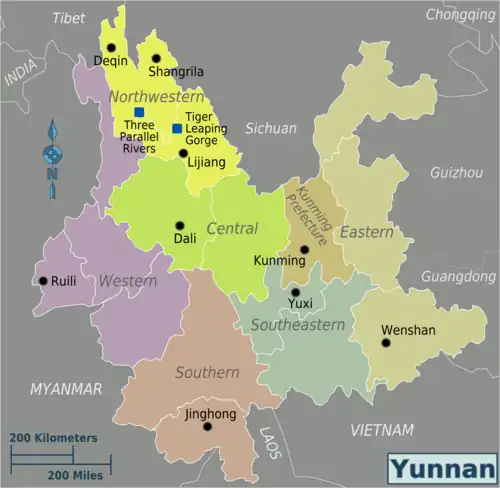
Nearby in Yunnan Sheng
More places to explore around Tiger Leaping Gorge.

Portions adapted from Wikivoyage, CC BY-SA 4.0.

Contact Us
Get in touch with us.
Get in touch
Contact Us
Tell us where you'd like to go and how you like to travel. A real Tripcuro planner — not a bot — will craft an itinerary around you.
- Personalised, hassle-free planning end-to-end
- Transparent pricing, no hidden costs
- 24/7 support for complete peace of mind