
Yuncheng
Shanxi Sheng, China
About Yuncheng
Yuncheng (è¿?城; Yùnchéng) sits in the southwestern corner of Shanxi Province, wedged between the Yellow River and the Zhongtiao Mountains, on the border with Shaanxi and Henan. The city's identity is inseparable from two facts: it grew up around the Salt Lake (Yancheng, ç›?æ± ), one of China's oldest continuously worked salt sources, and it is the hometown of Guan Yu — the Three Kingdoms general deified as Guandi, the god of loyalty, righteousness, and (eventually) wealth. Legend places Emperor Shun, Yu the Great, and the early Zhou court in this landscape, and Yuncheng leans hard into its branding as the "First Capital of Chinese Civilization" and "Source of Virtue and Filial Piety." For visitors, this translates into an unusually dense cluster of temples, palace complexes, and Yuan-dynasty murals within an hour or two of the city centre — a stop most foreign itineraries miss, but a serious draw for anyone interested in early Chinese religion, art history, or the Three Kingdoms cycle.
The climate is temperate continental with sharp seasonality. July and August are hot (highs around 32–33°C) and account for most of the year's rainfall — short, heavy bursts rather than long wet spells. Winters are cold and dry (January lows around –5°C) with little snow. Spring brings rapid warming but also dust storms blowing in from the loess plateau. The sweet spots are mid-April to early June and mid-September to late October, when skies are clear, temperatures sit in the high teens to mid-twenties, and the Salt Lake's mineral colours are at their most photogenic.
The city is laid out around the broad east–west axis of Hedong Street (河东街) and Hongqi Street (红旗街), with the railway station to the north and the Salt Lake forming the southern edge of the urban area in Yanhu District (�湖区). Most hotels, restaurants, and the museum sit in or near Yanhu District; the major out-of-town sights — Yongle Palace, Puzhou's Pujiu Temple, Guangong's family temple at Changping — are scattered across the surrounding counties and need a half- or full-day trip each.
Planning Yuncheng? Tell us your dates and we’ll tailor the trip.
Ask on WhatsAppHow to reach
By Plane
Yuncheng Guandi Airport (YCU) lies about 10 km northeast of the city centre, roughly a 15-minute drive. Domestic-only, with flights to Beijing, Shanghai, Guangzhou, Chengdu, Chongqing, Kunming, and a handful of other Chinese cities; schedules thin out in winter. A taxi to the city centre runs roughly ¥30–40 on the meter. Airport shuttle buses meet major arrivals and run to the railway station area for around ¥15.
By Train
Yuncheng Railway Station (�城站) in the city centre handles regular-speed services, while Yuncheng North Station (�城北站) on the Datong–Xi'an high-speed line is the one most travellers want. From Yuncheng North, high-speed trains run to Xi'an (about 1 hr 10 min), Taiyuan (about 2 hr), Beijing West (about 5 hr), and Zhengzhou (about 2 hr 30 min via Xi'an or direct routings). Book through the 12306 app or Trip.com a few days ahead for weekend and holiday travel; second-class seats sell out first. Yuncheng North is roughly 15 km from the centre — taxi ¥40–50, or take bus route 66.
By Car / Road
The G5 (Beijing–Kunming) and G55 (Erenhot–Guangzhou) expressways both pass close to Yuncheng, making it an easy drive from Xi'an (about 240 km, 3 hours), Taiyuan (about 380 km, 4–4.5 hours), Luoyang (about 220 km, 2.5–3 hours), and Zhengzhou (about 350 km, 4 hours). Roads are in good condition and tolled. Long-distance coaches serve all these cities plus Linfen, Hancheng, and smaller Shanxi towns from the Yuncheng Central Bus Station (�城汽车站) near the railway station — useful if you're heading to Ruicheng County for Yongle Palace, which is best reached by the Ruicheng-bound bus from this terminal.
Within central Yuncheng most things are within a ¥10–15 taxi ride. The starting fare is ¥6 for the first 2 km. Didi (滴滴出行) works throughout the city and is usually cheaper than flagging a cab; you'll need a Chinese mobile number and Alipay or WeChat Pay set up. City buses cost ¥1–2 flat fare (have coins or use a transit QR code in Alipay); useful routes include bus 11 from the railway station to Jiezhou Guandi Temple, and buses 14, 15, 77, and 88 to the museum. Shared bikes (Meituan, Hello) are widely available for short hops and unlock via Alipay. The central grid is flat and walkable. For the out-of-town sights — Yongle Palace, Jiezhou Guandi Temple, Pujiu Temple — chartering a taxi or Didi for a half day (typically ¥300–400) saves a lot of bus-juggling. The usual China scams apply: ignore touts at the railway station offering "private" cars to attractions, and confirm meter use before getting in any cab.
Things to do
Temples and historical complexes
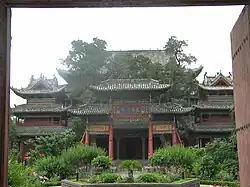
- Jiezhou Guandi Temple (解州关�祖庙) — 145 Wuyi Road, Haizhou Town, Yanhu District. The most important Guandi temple in China and in many ways the spiritual centre of Yuncheng. Founded by imperial decree in 589 (Sui dynasty), expanded across Tang, Song, Ming, and Qing; the surviving complex is laid out like a small palace, with the Chongning Hall (1718) as the main shrine to Guan Yu and the Ming-era Spring and Autumn Building behind it. April–November 08:00–18:00, December–March 09:00–17:00. ¥60 (Apr–Nov) / ¥50 (Dec–Mar). Bus 11 from Yuncheng Railway Station.
- Yongle Palace (永�宫) — 78 Yongle Street North, Ruicheng County, about 68 km south of Yuncheng. The largest surviving Yuan-dynasty Taoist temple in China, built between 1247 and 1358 to honour the immortal Lü Dongbin. Famous for its Yuan murals — particularly the Chaoyuan Tu in the Hall of the Three Pure Ones, considered one of the supreme achievements of Chinese religious painting. The entire complex was relocated brick-by-brick and mural-by-mural between 1959 and 1964 to make way for the Sanmenxia Reservoir. 08:00–18:00, ¥60. Take a Ruicheng-bound bus from Yuncheng Central Bus Station, then a local taxi (~¥10) for the last 3 km.
- Changping Guandi Family Temple (常平关�家庙) — about 10 km south of central Yuncheng in Changping village, Guan Yu's birthplace. Smaller and less polished than Jiezhou but more atmospheric, with a Guan family well, ancestral hall, and quiet courtyards.
- Pujiu Temple (普救寺) — in Yongji, about 60 km southwest. Setting of the classical Yuan-dynasty romance The Story of the Western Wing (西厢记) and home of a striking square-section brick pagoda whose acoustic "ringing frog" effect is a small marvel of Tang-Jin engineering.
Lakes and landscapes
- Yuncheng Salt Lake (�城�湖) — the southern edge of the city. Roughly 130 km² of working and historic salt pans, divided into a patchwork of pink, jade, and rust-coloured evaporation ponds that look genuinely otherworldly from the air or the lakeshore boardwalks. The "Salt Lake Scenic Area" (�湖景区) on the north shore is the main visitor zone — boardwalks, salt-harvest exhibits, a small hot-spring spa using brine, and viewing platforms that get especially photogenic at sunrise and sunset. Most visitors come for the colours in May–June and September.
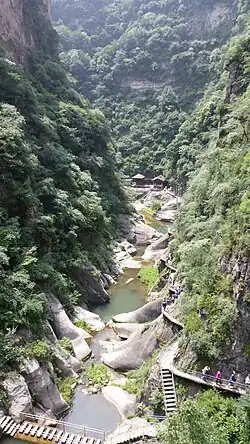
- Wufeng Mountain Scenic Area (五�峰) — in Yongji, southern Yuncheng. A Taoist holy mountain in the Zhongtiao range with cliff paths, pavilions, and big Yellow River views; a good break from temple-hopping.
Museums and city sights
Yuncheng Museum (�城�物馆) — Intersection of Yuxi Road and Weinan Street, Yanhu District. A surprisingly strong regional museum with halls on Hedong (the old name for the region), salt-industry history, and local archaeology including paleolithic and Neolithic finds from the Salt Lake basin. Tue–Sun 09:00–17:00 (no entry after 16:00), closed Mondays. Free, passport required at the entry desk. Bus 14, 15, 77, or 88.
Stork Tower (鹳雀楼) — in Yongji on the Yellow River, about 75 km southwest. A modern reconstruction (2002) of the Tang-dynasty tower made famous by Wang Zhihuan's eight-line poem "Climbing Stork Tower" — every Chinese schoolchild knows the verse, and the tower draws domestic visitors for that reason alone. Worth combining with Pujiu Temple.
Walk the Salt Lake at golden hour. The boardwalks in the Salt Lake Scenic Area are designed for slow, photo-heavy strolls. Sunrise gives you the pink algae blooms at their most saturated; sunset puts the Zhongtiao Mountains in silhouette behind the ponds.
Spend a half day on Yongle Palace. Even if you're not particularly interested in Taoism, the Yuan murals reward unhurried looking — bring a small torch (the halls are dim and flash is prohibited) and budget at least two hours inside the complex.
Do the Guan Yu pilgrimage circuit. Pair Jiezhou Guandi Temple with the family temple at Changping and a stop at the Guan Yu statue overlooking the Salt Lake. It's a complete day, and it's the closest thing Yuncheng has to a defining experience.
Soak in a brine hot spring. Several spas on the Salt Lake's north shore use the lake's mineral water; the Death Sea Tourist Resort (ä¸å›½æ»æµ·) is the best-known and lets you float in highly saline pools the way you would in the Levant.
Day trip to the Yellow River. Pujiu Temple, Stork Tower, and the Yellow River Iron Oxen at Puzhou (�代蒲津渡���物馆 — four enormous Tang-dynasty iron bulls excavated from the old river crossing) can be combined into a single full-day driver-and-car trip from the city for ¥400–500.
Catch a local Puju opera performance. Puju (蒲剧), the regional Shanxi opera style, originated in this corner of the province; the Yuncheng Cultural Centre and city parks occasionally host weekend performances — ask your hotel to check listings.
Planning Yuncheng? Want these on a customised itinerary?
Ask on WhatsAppFood & Dining
Yuncheng cooking belongs to the broader Shanxi tradition — noodle-heavy, vinegar-forward, and built around wheat rather than rice — but with southern Shanxi quirks: more mutton, more lake-influenced salting, and noticeable influence from neighbouring Shaanxi (Xi'an-style flatbreads and paomo) and Henan. Signature things to try:
- Yangrou paomo (羊肉泡�) — crumbled flatbread soaked in mutton broth, more associated with Xi'an but a staple here too.
- Wenxi zhachuan (闻喜煮饼) — a deep-fried, sesame-coated sweet pastry from neighbouring Wenxi County; the local equivalent of a regional doughnut.
- Yuncheng-style daomian (刀削�) — knife-shaved noodles in mutton or tomato-egg broth.
- Lake-salt-cured river fish — a local specialty using Salt Lake brine as a cure.
- Linfen-style suangtang jiaozi — sour-soup dumplings, widely available.
Specific recommendations:
- Budget — Lao Yuncheng Daoxiaomian (��城刀削�), several outlets around Hongqi East Street. Bowl of hand-shaved noodles with mutton broth ¥15–20; standing room only at lunch.
- Budget — Nanfeng Night Market (�风夜市), near Nanfeng Square. Skewers, grilled flatbread, stir-fried clams, and cold noodles; ¥40–60 for two with beer.
- Mid-range — Hedong Lao Fandian (河东è€?é¥åº—), Hongqi West Street. Reliable Shanxi standards — vinegared potato slivers, mutton hotpot, jiaozi — in a sit-down room. Â¥80–120 per person.
- Mid-range — Yuncheng Yanhu Yu Zhuang (�城�湖鱼庄) on the north shore of the Salt Lake. Lake and Yellow River fish prepared a dozen ways; ¥120–180 per person.
- Upscale — the dining rooms at the Yuncheng Hotel (�城宾馆) and the Crowne Plaza Yuncheng are the safest bets for a banquet-style meal with English-speaking staff; ¥250–400 per person.
Vegetarians manage well on noodle shops (ask for bu yao rou, ��肉) and on the standard Shanxi cold-dish repertoire (vinegared shredded potato, tiger-skin peppers, cold tofu, cucumber salad).
Cafes & Nightlife
Shanxi is vinegar country before it's anything else, and the local Shanxi laochencu (山西�陈醋) — aged dark vinegar from nearby Qingxu — is drunk diluted in hot water as a digestive in some households; you'll see small bottles for sale everywhere. For something stronger, Fenjiu (汾酒), Shanxi's flagship clear sorghum spirit, is the default baijiu at any banquet table; expect to be toasted with it if you eat with locals. Local beers (Yanjing, Snow) cost ¥5–10 in restaurants; craft beer is essentially absent. Teahouses are quieter here than in southern China, but Jin tea (Shanxi-grown green and yellow teas) appears on most restaurant menus.
Cafés have arrived — Luckin Coffee and Manner have outlets near Nanfeng Square — and a small independent scene clusters along Xuefu Street near the university. Tap water is not drinkable; stick to bottled water (¥2–3 for 500 ml at any convenience store) or the boiled water dispensers in every hotel room.
Planning Yuncheng? We’ll book the stays and dining for you.
Ask on WhatsAppPlaces to Stay
- Budget — Hanting Hotel Yuncheng Railway Station (汉åºé…’店), near the main railway station. Chain budget-business standard; doubles Â¥150–220. Reliable, no English at the desk.
- Budget — 7 Days Inn Yuncheng Nanfeng Square, central. Doubles ¥160–230; passport check-in confirmed but expect a slow process.
- Mid-range — Atour Hotel Yuncheng (亚朵酒店), on Hongqi East Street. Contemporary mid-tier business hotel with the best beds in this price band; doubles ¥350–500.
- Mid-range — Yuncheng Hotel (�城宾馆), Hedong East Street. State-owned, slightly dated rooms but large, central location and a good Shanxi restaurant on site; doubles ¥380–550.
- Upscale — Crowne Plaza Yuncheng, near the Salt Lake. The city's only true international-chain upscale property; doubles from ¥700, suites ¥1,200+. English-speaking staff, executive lounge, and the most reliable airport pickup arrangements.
- Upscale / resort — Yuncheng Salt Lake Hot Spring Resort (�城�湖温泉度�酒店), on the lake's north shore. Brine hot-spring villas and rooms with direct lake views; doubles from ¥600, villas ¥1,500+.
What to buy
Yuncheng isn't a shopping destination so much as a place to pick up specific local goods. Salt Lake products — bath salts, mineral mud, salt soaps — are sold in the Salt Lake Scenic Area shops and at supermarkets in town; they make light, transportable gifts. Daokou shaobing and Wenxi peanut cakes are common edible souvenirs from county-level specialty shops. Guan Yu memorabilia is everywhere around the Jiezhou temple complex; quality varies wildly, so look for hand-carved wood pieces from the small workshops on Wuyi Road rather than mass-produced figurines. The main commercial streets — Hedong East Street and the area around Nanfeng Square (�风广场) — have department stores and the usual Chinese mall brands. Bargaining is expected at scenic-area stalls and tourist markets (start at 40–50% of the asked price); it's not the norm in shops with marked prices.
Go next
- Pingyao (平�) — about 320 km north, 2.5 hr by high-speed rail. UNESCO-listed Ming/Qing walled town and the single most visited heritage site in Shanxi.
- Xi'an (西安) — about 240 km southwest, 1 hr 10 min by high-speed rail. Terracotta Army, city walls, and the eastern end of the Silk Road.
- Luoyang (洛阳) — about 220 km east, 1.5 hr by high-speed rail. Longmen Grottoes and a strong Tang-Song historical core; combines naturally with Yuncheng for a "early dynasties" itinerary.
- Mount Hua (�山) — about 200 km southwest in Shaanxi, 1.5 hr by train to Huashan North. One of the Five Great Mountains of China, famously vertiginous.
- Hancheng (韩城) — about 100 km west across the Yellow River in Shaanxi. Birthplace of historian Sima Qian and home to the well-preserved Dangjiacun village.
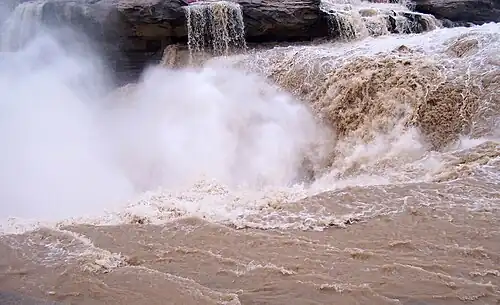
- Linfen (临汾) — about 160 km north, 50 min by high-speed rail. The Hukou Waterfall on the Yellow River (about 2 hr further west by car) is the main draw — Asia's largest yellow-water cataract.
Nearby in Shanxi Sheng
More places to explore around Yuncheng.
Portions adapted from Wikivoyage, CC BY-SA 4.0.

Contact Us
Get in touch with us.
Get in touch
Contact Us
Tell us where you'd like to go and how you like to travel. A real Tripcuro planner — not a bot — will craft an itinerary around you.
- Personalised, hassle-free planning end-to-end
- Transparent pricing, no hidden costs
- 24/7 support for complete peace of mind