
Yangquan
Shanxi Sheng, China
About Yangquan
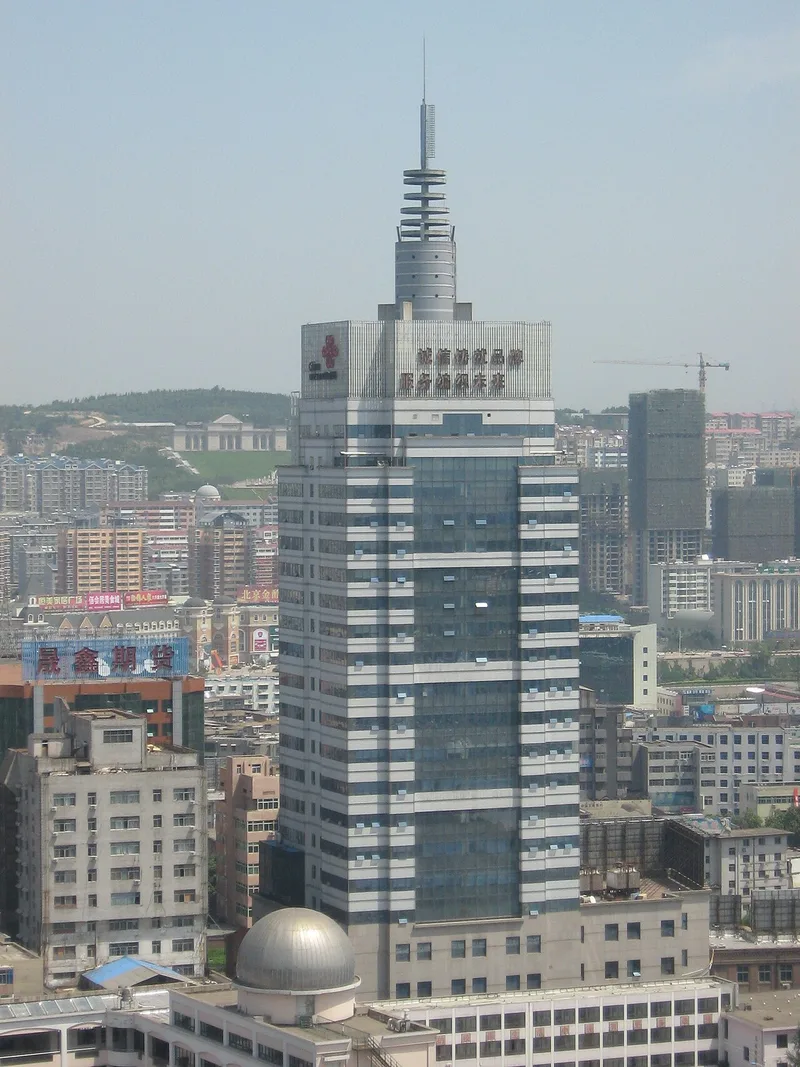
Yangquan (阳泉; Yángquán) is a mid-sized prefecture-level city tucked into the rugged Taihang Mountains in eastern Shanxi Province, roughly halfway between the provincial capital Taiyuan and the Hebei plain. Long known as "the city built on coal and iron," Yangquan grew in the 20th century around heavy industry, but its surroundings — deep gorges, terraced hillsides, fortified mountain passes and centuries-old temple villages — give it an appeal that surprises most visitors arriving from the more polished tourist circuits of Pingyao or Datong. It is one of the easiest jumping-off points for the dramatic Niangzi Pass section of the Great Wall and for the cluster of waterfalls and karst caves along the Hebei border.
The city sits at around 650–900 m elevation, and the climate is decisively continental. Summers (June–August) are warm and humid by Shanxi standards, with daytime highs around 28–30 °C and the year's heaviest rainfall — July alone averages 134 mm and the hillsides turn lush green, which is the best season for waterfalls and forest parks. Winters are dry, dusty, and cold, with January highs of just 3 °C and overnight lows around −8 °C. Spring is windy and prone to dust; autumn (mid-September to late October) is the sweet spot: clear skies, golden foliage on the Taihang ridges, and cool but pleasant daytime temperatures.
Yangquan's built-up area is compact and centred on Cheng District (城区), the commercial core along Beidajie and Xinhua East Street, where you'll find most hotels, restaurants and the city museum. Kuang District (矿区) to the west is the older industrial quarter, while Jiao District (郊区) wraps around the city and contains most of the parks and scenic areas. The county-level units of Pingding and Yu County (Yuxian), east and north respectively, hold most of the headline sights — Niangzi Pass, Guguan Great Wall, and the Yuxian Caves all lie 30–60 km from the city centre.
Planning Yangquan? Tell us your dates and we’ll tailor the trip.
Ask on WhatsAppHow to reach
By Plane
Yangquan has no commercial airport of its own. The two practical options are:
- Taiyuan Wusu International Airport (TYN), about 100 km west. Domestic flights connect to all major Chinese cities and a handful of regional international routes (Seoul, Bangkok, Singapore in normal seasons). From the airport, the easiest onward route is a taxi or Didi to Taiyuan South Railway Station (太原�站, ~30 min, around ¥80–100) and then a high-speed train to Yangquan North.
- Shijiazhuang Zhengding International Airport (SJW), about 140 km east in Hebei, has a similar domestic network plus more flights to the coastal hubs. It is directly served by the Shi-Tai high-speed line, so a single train ride brings you to Yangquan North in around an hour.
A direct airport-to-Yangquan shuttle bus runs from Taiyuan Wusu several times a day (around ¥70, 2 hours); schedules shift seasonally, so confirm at the airport ground transport desk.
By Train
- Yangquan Railway Station (阳泉站) sits in the city centre and handles conventional (slow) trains. Frequent services run on the Shi-Tai line to Taiyuan (cheapest option, around ¥20–30 in hard seat, 1h30–2h), Shijiazhuang (from ¥25, ~2h), and overnight services to Beijing, Xi'an and Shanghai. Useful if you want to arrive downtown without an onward taxi.
- Yangquan North Railway Station (阳泉北站), about 15 km north of the city in Pingding County, is the high-speed (G/D-series) stop on the Shijiazhuang–Taiyuan line. Fastest trains from Taiyuan South take just 35 minutes (¥37–45); Shijiazhuang is from 37 minutes; Beijing West is 2h30–3h (¥119–143 second class); Shanghai Hongqiao around 11–12 hours. Bus 501 and frequent shuttle taxis (¥30–40) link Yangquan North with the city centre.
Book through 12306.cn or apps like Trip.com / Ctrip. Holiday windows (Spring Festival, the October Golden Week) sell out 15 days ahead — the maximum advance booking period.
By Car / Road
The G5 Beijing–Kunming Expressway (also signed as the Jingkun) skims past Yangquan, and the G20 Qingyin Expressway crosses the area east–west, making road approaches straightforward:
- From Taiyuan: ~110 km, 1h20 via the G20. Roads are modern, four-lane, and well-maintained.
- From Shijiazhuang: ~120 km, 1h30 via the G20 east. The mountain stretch through Niangzi Pass is scenic.
- From Beijing: ~370 km, 4–5 hours via the G4/G5 corridor.
Long-distance buses leave from Taiyuan East Bus Station and Shijiazhuang Yunhe Bus Station roughly hourly during the day (¥50–70 from either; 2–3 hours). Yangquan's main bus station is on Xinhua East Street, walking distance from most hotels.
Yangquan is easy to navigate without a car. The city has no metro, but a dense public bus network (around 30 routes, ¥1–2 flat fare, exact change or Yikatong/Alipay QR) covers all of Cheng District and reaches Yangquan North Station, the museum, and most parks. Useful routes include Bus 10, 102, and 703 (all pass the Yangquan Museum) and Bus 501 (city centre to Yangquan North high-speed station).
Taxis are plentiful and cheap by Chinese standards — flagfall is around ¥7 for the first 2 km, then ¥1.50/km. A ride across the central districts rarely tops ¥20. Didi Chuxing is the dominant ride-hailing app and works reliably; you'll need a Chinese phone number and a payment method linked to WeChat Pay or Alipay. English is essentially absent from drivers, so have your destination written in Chinese characters.
The city centre is walkable along Beidajie and the Taohe River promenade, but distances to the surrounding scenic areas (Niangzi Pass, Guguan Great Wall, Yuxian Caves) really require a car or a chartered taxi — expect to pay ¥300–500 for a full-day driver depending on itinerary. Hotel front desks can arrange this.
Watch for the usual mainland scams: unmetered taxis touting at the railway stations (insist on the meter or use Didi), and "tea ceremony" or "art gallery" approaches from English-speaking strangers — virtually unheard of in Yangquan but worth knowing for transit stops in Beijing or Shanghai.
Things to do
Mountains and scenic areas
- Niangzi Pass (娘å?å…³; NiángziguÄ?n). The most famous fortified pass on the eastern Shanxi–Hebei border, said to have been garrisoned in the 7th century by a Tang dynasty princess and her female troops — hence the name "Ladies' Pass." A walled village clings to the cliff above the Mian River, with watchtowers, a restored gate, and stone-paved lanes. Combined ticket around Â¥45; daily 08:00–18:00. About 45 km southeast of Yangquan in Pingding County.
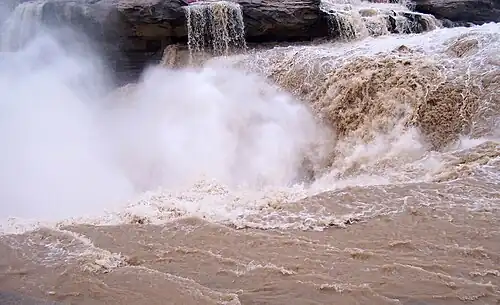
- Niangziguan Waterfall (娘å?关瀑布). A 30 m cascade pouring directly from limestone cliffs into the Mian River, just below the pass village. Best after summer rains; included with the Niangzi Pass ticket.
- Guguan Great Wall (固关长城; GùguÄ?nchángchéng). A 15 km restored Ming dynasty section that predates the better-known Badaling near Beijing by roughly a century. Far quieter than its tourist-circuit cousins. Ticket around Â¥50; daily 08:00–17:30. About 35 km east of the city.
- Guan Mountain (å† å±±; GuÄ?nshÄ?n). A 1,130 m peak in Pingding County with a complex of Confucian academies and pavilions; the Guanshan Academy here was active from the Yuan through Qing dynasties.
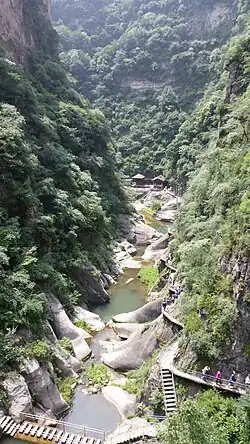
- Zang Mountain Scenic Area (è—?å±±; ZángshÄ?n). A dramatic valley with hanging temples, a "ghost cliff" plank walkway, and a legend tied to a Spring and Autumn era Zhao clan refugee. Ticket around Â¥60; around 50 km north in Yu County.
- Shinaoshan Mountain Forest Park (狮脑山公å›; ShÄ«nÇŽoshÄ?ngÅ?ngyuán). The site of the 1940 Battle of Shinaoshan in the Hundred Regiments Offensive, with a war memorial at the summit and city views. Free.
Parks
- Nanshan Park (å?—山公å›; NánshÄ?n GÅ?ngyuán), Xinhua East Street. The central urban park, terraced into a hillside with pavilions, a small pagoda, and locals practising taichi in the early morning. Free; open daily.
Caves and waterfalls
- Yuxian Caves (盂县溶洞). A network of karst caverns in Yu County with illuminated stalactite chambers. > TODO: confirm current operating status and ticket pricing.
- Shuilian Dong Waterfall (水帘洞瀑布). A "water curtain" cascade over a cave mouth, picturesque in summer.
- Liangjiazhai Hot Springs (æ¢?家寨温泉; LiángjiÄ?zhà i WÄ“nquán). A village hot-spring complex in Yu County, around 70 km north of the city — modest infrastructure but genuinely rural.
Temples and culture
Yaolin Temple (è?¯æž—寺; Yà olÃnsì). A small Buddhist temple in a wooded valley, less touristed than the famous Shanxi sites at Wutaishan.
Yangquan Museum (阳泉市�物馆), 1 Taobei Middle Street, Cheng District. Local history with an emphasis on the Niangzi Pass region, Hundred Regiments Offensive, and Yangquan's coal-and-iron industrial heritage. Tue–Sun 08:30–11:30 and 14:00–18:00 (winter), 08:30–11:30 and 14:30–18:30 (summer); closed Mondays. Free; bring ID. Buses 10, 102, 703, and the airport shuttle all stop nearby. ☎ +86 353 2565339.
Walk the Niangzi Pass ramparts at sunrise. The village inside the gate opens early; arriving before the day-trip buses from Shijiazhuang means you'll have the watchtower walk to yourself. Pair it with breakfast at one of the noodle stalls just outside the south gate.
Hike a quiet stretch of the Guguan Great Wall. Unlike Badaling, you can walk a kilometre here without seeing another visitor. Wear grippy shoes — many sections are unrestored.
Soak at Liangjiazhai Hot Springs. Best as part of an overnight trip up to Yu County; combine with Zang Mountain the next day.
Trace the Hundred Regiments Offensive route. Yangquan was the focal point of this 1940 Eighth Route Army campaign against Japanese forces. The Shinaoshan memorial, the Yangquan Museum's wartime gallery, and a small ridge of restored battlefields make a half-day military-history loop for those interested.
Day-trip to Pingyao. The UNESCO-listed Ming dynasty walled city is roughly 2h30 by road or a high-speed train change through Taiyuan; doable but tight in a single day.
Sample Shanxi noodle culture in a working-class lunch hall. Yangquan is unpretentious, and a lunchtime visit to a noodle shop on Beidajie — ordering a bowl of daoxiao mian (knife-shaved noodles) with vinegar and chilli — is itself the experience.
Planning Yangquan? Want these on a customised itinerary?
Ask on WhatsAppFood & Dining
Yangquan eats like the rest of Shanxi: noodles, vinegar, stewed lamb, millet and corn carbs, and a deep bench of pickles. The signature local quirks are Yangquan-style guokui (éƒå?£; a thick crusted flatbread baked against the inside of a cylindrical oven), piande (æ“€piande, a hand-pinched flat noodle), and black tofu (黑豆è…?) made with mineral-rich Taihang water. Most restaurants serve generous portions; a full meal with beer for two runs Â¥60–120 at neighbourhood places, Â¥200–400 at hotel restaurants.
- Knife-shaved noodle (刀削�) shops on Beidajie — budget, ¥10–18 per bowl. Look for shopfronts where you can see the cook shaving ribbons of dough into a boiling vat. Order with tomato-and-egg (番茄鸡蛋) or braised pork (打�) topping. No reservations, open for lunch and dinner.
- Yangquan Roast Lamb (阳泉烤全羊)-style night stalls near the rail station — budget-mid, ¥40–80 per person. Skewered lamb (羊肉串) with cumin and chilli is the regional standard; pair with cold beer.
- The Arctic Ocean Hotel Chinese restaurant, 80 North Street — mid-range, ¥120–200 per person. Reliable Shanxi standards (pian noodles, vinegar-braised ribs, smoked tofu) in a comfortable sit-down setting. > TODO: confirm current opening hours.
- Shanxi Quanmei International Hotel restaurant, Southend of West Street — upscale, ¥200–400 per person. The most polished hotel dining in town, with a banquet-style Shanxi menu and private rooms popular for business meals.
Vegetarians are reasonably catered for through noodles, tofu dishes, and the Shanxi staple of cold vegetable side plates (凉è?œ) — say "wÇ’ chÄ« sù" (我å?ƒç´ , "I eat vegetarian") and stress "no meat broth" (ä¸?è¦?肉汤). Halal (清真) noodle and lamb restaurants exist along Beidajie; look for green signs in Arabic script. Gluten-free is genuinely difficult in a wheat-belt city like this — millet-based dishes and rice are your best bet.
Cafes & Nightlife
Shanxi is not a wine or cocktail province; it's a vinegar-and-baijiu province. The local drinking culture revolves around mid-strength baijiu (白酒) at meals and tea in between.
- Fenjiu (汾酒) is Shanxi's most famous baijiu, distilled in Xinghuacun about 200 km west; it's available everywhere, with a 500 ml bottle of the standard "Bofen" running ¥40–60 and the older-aged versions climbing well past ¥500. Easier-drinking than the heavier sauce-style baijius from Guizhou.
- Local beer is dominated by Yanjing and Tsingtao, both around ¥4–8 a bottle in restaurants.
- Tea, often jasmine or local mountain green tea, is automatic at most sit-down meals and free of charge.
- A small but growing number of café-style spots sit along Xinhua East Street and around the museum — most are domestic chains (Luckin, Manner) plus independent shops serving pour-overs for ¥25–35.
Yangquan has a low-key nightlife scene: a handful of KTV (karaoke) parlours and beer halls cluster near Beidajie, but there is no bar street comparable to Taiyuan's. Hotel bars in the four-star properties stay open until midnight.
Water safety: tap water is not safe to drink. Every hotel room provides a kettle and bottled or boiled water; restaurants serve hot or bottled water by default. Stick to sealed bottled water (¥2–3 for 500 ml) when out and about.
Planning Yangquan? We’ll book the stays and dining for you.
Ask on WhatsAppPlaces to Stay
Budget
- 7 Days Inn Yangquan Beidajie Branch (7天酒店阳泉北大街店) — chain economy hotel in the centre; clean, predictable, fast Wi-Fi. Doubles from around ¥160.
- Hanting Hotel Yangquan Railway Station (汉åºé…’店阳泉ç?«è½¦ç«™åº—) — handy if you have an early conventional-train departure. Doubles from around Â¥180. > TODO: confirm current branch address.
Mid-range
- The Arctic Ocean Hotel (阳泉北冰洋大酒店), 80 North Street (北大街80�). Four-star hotel with rooms with free internet, business centre, gift shop, beauty salon and ticket office. Chinese restaurant, bar and room service. Listed doubles from ¥268, often discounted to around ¥220 including breakfast. ☎ +86 353 4239999, fax +86 353 4234343.
- Yangquan Yumin Hotel (阳泉裕民大酒店) — solid four-star alternative on Xinhua East Street, walking distance to the museum and Nanshan Park. > TODO: confirm current rates.
Upscale
- Shanxi Quanmei International Hotel (山西泉美国际大酒店), Southend of West Street (�大西街). Four-star property with free in-room internet, business centre, currency exchange, gift shop, beauty salon, ticket office, Chinese restaurant, and room service. Listed doubles from ¥680, frequently discounted to around ¥350 including breakfast.
- Yangquan Bafang Hotel (阳泉八方大酒店) — another upper-tier option used by business travellers visiting the local coal and steel industries. > TODO: confirm current pricing and star rating.
What to buy
Yangquan isn't a shopping destination in the Beijing or Xi'an sense, but a few local specialities are worth bringing home:
- Shanxi mature vinegar (山西�陈醋). The province's signature export; Yangquan supermarkets and the Beidajie shopping strip stock all the major brands (Donghu, Shuita). A 500 ml bottle of decent aged vinegar is ¥20–40.
- Pingding black pottery (平定黑陶). Hand-thrown ceramic ware with a deep, almost metallic black finish — produced in nearby Pingding County since at least the Tang dynasty. Look for it in the small craft section at the Yangquan Museum gift area or in shops along Xinhua East Street.
- Iron and stoneware tea sets. A small carry-over of the city's foundry tradition; cast-iron teapots in particular are good value compared with prices in Beijing tourist markets.
- Local jujubes and walnuts. Shanxi mountain agriculture; sold loose at the Beidajie Market by weight (¥20–40/jin).
Bargaining is normal at outdoor markets and small craft stalls (expect to settle around 60–70% of the opening price), but supermarkets, department stores, and chain hotels are strictly fixed-price. Most shops accept WeChat Pay or Alipay; cash is still welcome but international credit cards are rarely usable outside top-tier hotels.
Go next
- Taiyuan — 100 km west, 35 min by high-speed train. Shanxi's capital, with the Jinci Temple complex and the excellent Shanxi Museum.
- Pingyao — 200 km southwest, around 2h30 by car or via a train change in Taiyuan. UNESCO-listed Ming dynasty walled city; the headline cultural day-trip of the province.
- Shijiazhuang — 120 km east, from 37 min by high-speed train. Hebei's capital and a transit hub for onward travel into the North China plain.
- Wutai Shan — 230 km north, around 3h30 by road. One of China's four sacred Buddhist mountains, with a cluster of working monasteries.
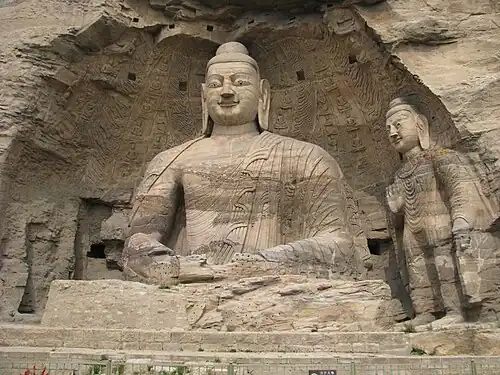
- Datong — 380 km north, around 3 hours by high-speed train via Taiyuan. The Yungang Grottoes and Hanging Monastery are the headliners.
- Beijing — 370 km east, 2h30–3h by high-speed train. Easy onward connection for international flights or the wider tourist circuit.
Nearby in Shanxi Sheng
More places to explore around Yangquan.
Portions adapted from Wikivoyage, CC BY-SA 4.0.

Contact Us
Get in touch with us.
Get in touch
Contact Us
Tell us where you'd like to go and how you like to travel. A real Tripcuro planner — not a bot — will craft an itinerary around you.
- Personalised, hassle-free planning end-to-end
- Transparent pricing, no hidden costs
- 24/7 support for complete peace of mind