
Qufu
Shandong Sheng, China
Why visit Qufu?
Qufu (曲阜 Qūfù) is a small but profoundly significant city in southwestern Shandong Province, China. Known as the "Holy City of the East," it is the birthplace and lifelong hometown of Confucius (孔子, 551–479 BC), the philosopher whose teachings shaped Chinese civilisation for over two millennia. The city's Confucius Temple, Confucius Cemetery, and Kong Family Mansion — collectively called the "Three Holes" (三孔, Sān Kǒng) — form a UNESCO World Heritage Site that draws scholars, pilgrims, and tourists from around the world.
Qufu has more than 2,500 years of recorded history. After Confucius' death, his direct descendants lived here for generations, receiving titles from successive dynasties. The hereditary title "Duke Yansheng" (衍圣公), bestowed from the Song Dynasty onwards, made the Kong family one of the oldest aristocratic lineages in Chinese history — a status that persisted until the mid-20th century. Emperors from the Han Dynasty onward made pilgrimages to Qufu, decorating its temples with stone tablets (steles) inscribed in Chinese, Mongolian, and Manchu. These steles, often mounted on giant stone tortoises called bixi (赑屃), are among the city's most distinctive features.
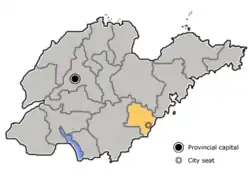
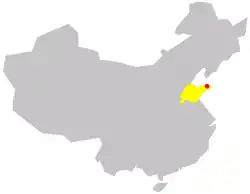
Qufu lies in southwestern Shandong under the jurisdiction of Jining City. The city has a temperate monsoon climate with hot, humid summers (July highs around 32 °C) and cold, dry winters (January lows around –6 °C). Annual rainfall is 820–850 mm, concentrated in July and August. The best times to visit are spring (April–May) and autumn (September–October), when temperatures are moderate and rainfall is less frequent. Beyond its Confucian heritage, Qufu has a vibrant Hui Muslim community centred in the Xiguan district outside the west gate.
Planning Qufu? Tell us your dates and we’ll tailor the trip.
Ask on WhatsAppHow do you get there?
By Plane
The nearest airport is Jining Da'an Airport (JNG), located in Yanzhou District about 30 minutes by road from downtown Qufu. It offers domestic flights from Beijing, Shanghai, Guangzhou, Chengdu, Qingdao, and Shenyang. Bus J963 connects the airport to Qufu. Taxis from the airport to Qufu cost approximately ¥150–200.
By Train
Qufu is well served by high-speed rail. Qufu East Railway Station (曲阜东站) sits a few kilometres southeast of the city centre and is served by G-series and D-series trains on the Beijing–Shanghai high-speed line. Journey times are approximately 2 hours from Beijing and 3 hours from Shanghai, with additional direct services to Jinan, Nanjing, Qingdao, and Tianjin. The K01 bus (¥1) connects Qufu East Station to the city centre and the Three Holes scenic area.
On the conventional Beijing–Shanghai mainline, the closest station is Yanzhou Railway Station (兖州站), about 15 km west of Qufu. Taxis from Yanzhou to Qufu cost around ¥40; buses run every 20 minutes until approximately 18:00–19:00 for about ¥6. Qufu Railway Station (曲阜站) handles a handful of slow trains daily on a branch line.
By Car / Road
Qufu is about 2 hours by bus from the provincial capital Jinan via the G3 Beijing–Taipei Expressway. Regular buses also run from Tai'an (1 hour), Qingdao (5 hours), and other major Shandong cities. Qufu Bus Station (曲阜客运站) is on Yulong Road, 2–3 km west of the historic centre; a city bus connects it to the south gate of the old city wall.
The historic walled city is compact — roughly a mile across — and most major sites (Confucius Temple, Kong Family Mansion, Yan Hui Temple) are walkable on foot within it. The modern visitor centre is outside the southern gate.
Qufu has a small, inexpensive local bus system running along the east-west street south of the walled city, useful for reaching outlying sites such as Shou Qiu and the railway station. On local buses, press the stop button in advance to signal the driver.
Rickshaws, bicycle taxis, and regular taxis are plentiful — expect to be approached constantly if you stand still. From the walled city to the Confucius Cemetery (about 2 km north), a taxi or scenic-area sightseeing bus (around ¥20/person) is recommended. Shared bicycles and electric scooters can be found near tourist areas like Wuma Temple Street for short hops. Ride-hailing apps (Didi) work in Qufu.
What are the things to do?
The walled historic centre and its surroundings contain most of Qufu's major attractions. Foreign tourists can gain free admission to the Three Holes sites if they memorise 5 or more verses of Confucius' Analects in any language (Chinese citizens must memorise 30).
Confucius Temple (孔庙, Kǒngmiào) — The oldest, largest, and most important Confucian temple in East Asia. The vast complex spans 16 hectares with 466 halls and rooms, modelled on the layout of the Imperial Palace. Highlights include the Dacheng Hall (Hall of Great Perfection), the Apricot Altar where Confucius taught, and dozens of stone steles dating from the Han to the Qing dynasties. Allow 2–3 hours.
Kong Family Mansion (孔府, Kǒng Fǔ) — Adjacent to the temple, this grand complex of 463 rooms combined government offices and private residences for the Kong family over centuries. It reflects the unique political and cultural status of the Duke Yansheng's household.
Confucius Cemetery / Konglin (孔林, Kǒng Lín) — About 2 km north of the old city, this 200-hectare forest cemetery contains the graves of Confucius and more than 100,000 of his descendants spanning over 2,000 years. Ancient trees and thousands of stone steles line the pathways. The tomb of Confucius is marked by a simple stone mound.
Yan Hui Temple (颜庙) — Dedicated to Confucius' favourite disciple, located within the walled city.
Confucius Museum (孔子博物馆) — A modern museum on Confucius Avenue (bus D55 or J963) displaying artefacts, manuscripts, and ritual objects related to Confucius and the Kong family.
Nishan Holy Land (尼山圣境) — A major cultural complex about 25 km south of the city, built on the hill traditionally identified as Confucius' birthplace. Features a 72-metre-tall Confucius statue and a large-scale evening light show.
Shou Qiu (寿丘) — Song Dynasty–era sites associated with the mythical Yellow Emperor, about 4 km east of the old city.
Xiguan Mosque & Muslim Quarter — The Hui Muslim neighbourhood outside the west gate, with a mosque and a lively market.
- Attend the Confucius Memorial Ceremony (祭孔大典) held annually on 28 September, Confucius' birthday, featuring elaborate ritual dances, music, and offerings at the temple.
- Take a calligraphy or Confucian classics class — several cultural centres near the Three Holes offer short workshops in Chinese calligraphy, the Six Arts (六艺), and readings from the Analects.
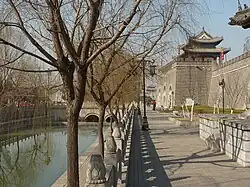
- Walk the Ming-era city wall — the restored wall and moat encircle the old city and provide a pleasant stroll.
- Day trip to Nishan Holy Land — combine the Confucius birthplace with the evening water-screen light show (seasonal).
- Explore the Xiguan night market — local street food and handicrafts in the Muslim quarter.
Planning Qufu? Want these on a customised itinerary?
Ask on WhatsAppWhere to eat?
Qufu cuisine blends Shandong (Lu) cooking traditions with Confucian banquet heritage. The most famous local banquet is the Confucius Family Feast (孔府菜, Kǒngfǔ cài), a multi-course meal once served to visiting emperors — try it at upscale restaurants near the temple.
Signature dishes: braised sea cucumber with scallion, fried tofu with shrimp sauce, "poetic" dumplings (诗礼银杏, silver apricot from the Confucius family's own tree), and bǎzi ròu (把子肉, soy-braised pork belly). The local staple breakfast is jiān bǐng (煎饼, savoury grain crêpes).
Budget: Small noodle and dumpling shops along the streets south of the walled city serve meals for ¥15–30. The Xiguan Muslim quarter has halal lamb skewers and flatbreads.
Mid-range: Restaurants near the south gate offer Confucius Family-style set menus for ¥80–150/person.
Upscale: The Queli Hotel and the Confucius Grand Hotel both serve elaborate multi-course Confucian banquets (¥200–500/person). Vegetarian options are available on request.
Where to drink?
Shandong is known for Tsingtao Beer (青岛啤酒) and Qufu Laojiao (曲阜老窖), a local baijiu. Tea culture is present but less dominant here than in southern China. Several teahouses near the temple serve traditional Chinese teas. Water quality is generally safe for brushing teeth but visitors should drink bottled or boiled water. Small cafés near the tourist areas serve standard coffee and cold drinks.
Planning Qufu? We’ll book the stays and dining for you.
Ask on WhatsAppWhere to stay?
Budget: Guesthouses and hostels near the south gate of the walled city run ¥60–150/night. Qufu International Youth Hostel is a popular backpacker choice with dorm beds from around ¥50.
Mid-range: Comfortable three-star hotels within or near the old city cost ¥200–400/night. Home Inn and Hanting Express both have locations near the Three Holes.
Upscale / heritage: Queli Hotel (阙里宾舍), located between the temple and the mansion, is the most storied hotel in town (¥500–800/night). The Shangri-La Qufu offers modern luxury with rates from ¥600/night.
What should you buy?
Qufu's signature souvenirs are connected to Confucian culture: miniature stone steles, calligraphy scrolls and brushes, copies of the Analects, and traditional woodblock prints. The streets around the Three Holes and Wuma Temple Street are lined with souvenir shops. Carved inkstones (砚台) and Weifang-style kites are also popular. Bargaining is expected at smaller stalls and markets; prices in the main scenic-area shops are generally fixed.
Where to go next?
- Tai'an & Mount Tai (泰安, ~75 km, 1 hour by bus) — China's most sacred mountain, a UNESCO World Heritage Site with spectacular sunrise hikes and ancient temples.
- Jinan (济南, ~150 km, 2 hours by bus or 1 hour by high-speed train) — the provincial capital, famed for its artesian springs, Daming Lake, and Baotu Spring Park.
- Zoucheng (邹城, ~15 km, 30 min by bus) — home to Mencius Temple and Mansion, a smaller-scale companion to Qufu's Confucian sites.
- Weifang (潍坊, ~200 km, 2.5 hours by car) — famous for its annual international kite festival and traditional woodblock New Year prints.
- Qingdao (青岛, ~400 km, 5 hours by bus or 3 hours by high-speed train) — a coastal city with German colonial architecture, Tsingtao Brewery, and beaches.
Nearby in Shandong Sheng
More places to explore around Qufu.


Guide content as of June 2026. Portions adapted from Wikivoyage, CC BY-SA 4.0.

Contact Us
Get in touch with us.
Get in touch
Contact Us
Tell us where you'd like to go and how you like to travel. A real Tripcuro planner — not a bot — will craft an itinerary around you.
- Personalised, hassle-free planning end-to-end
- Transparent pricing, no hidden costs
- 24/7 support for complete peace of mind