
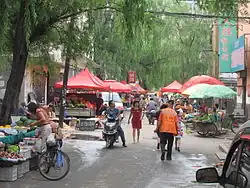
Jilin City
Jilin Sheng, China
Why visit Jilin City?
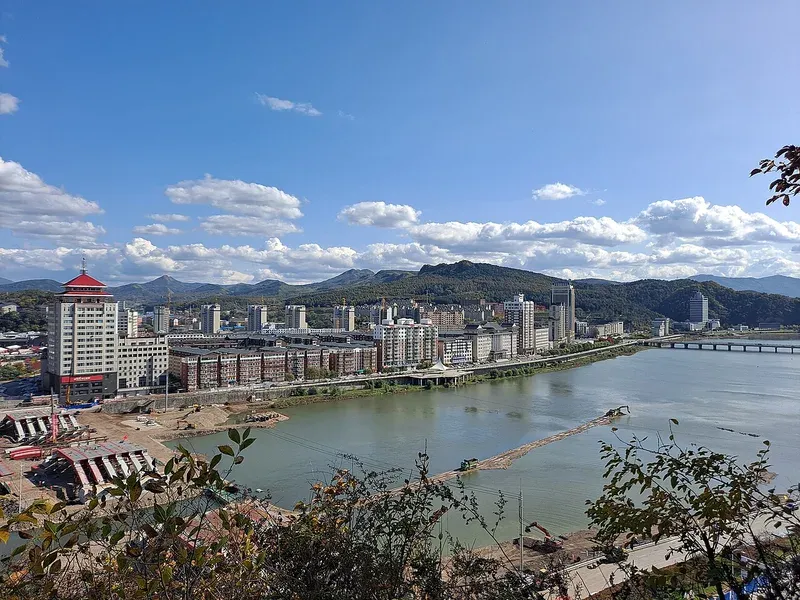
Jilin City (吉林市) is the second-largest city in Jilin Province and one of the more appealing destinations in China's Manchurian northeast. Bisected by the broad, slow-moving Songhua River, historically known as the Sungari, Jilin has a more human scale than the sprawling industrial capitals around it. Originally a Qing-era fortress and shipbuilding centre, it suffered heavy damage during the Russian occupation in the closing days of World War II and was rebuilt in the decades that followed. Today it is a city of around a million people with a working industrial economy, a handful of well-kept temples and museums, and one striking natural drawcard: the wusong (rime ice) that forms on the willows lining the Songhua in deep winter.
Climatically, Jilin is a city of extremes. Winters are long, dry and brutally cold — January daytime highs hover well below freezing and nights drop far lower — but this is paradoxically the best time to visit, when ice-rimmed trees and skiing at nearby Beidahu are at their peak. Summers (June–August) are warm, humid and wet, with most of the year's rainfall packed into July and August. Spring and autumn are short but pleasant; late September and early October, with crisp air and turning leaves, are ideal for hiking around Songhua Lake.
The city is compact and easy to orient. The old core sits in a bend of the Songhua on the north bank; south of the river is the modern commercial spine, anchored by several civic squares. Beishan Park rises on the western edge of the old city; Longtan Mountain sits in the eastern suburbs; and Songhua Lake lies a short distance southeast. Many travellers also use Jilin as a staging point for the long trip south to Changbaishan National Nature Reserve.
Planning Jilin City? Tell us your dates and we’ll tailor the trip.
Ask on WhatsAppHow do you get there?
By Plane
The nearest airport is Changchun Longjia International Airport (CGQ), about 65 km west of Jilin City. Domestic flights connect to Beijing, Shanghai, Guangzhou and many other Chinese cities, with a handful of international routes. From the airport, a high-speed train to Jilin City takes roughly half an hour and is the cheapest and fastest option; an airport coach and taxis are also available.
By Train
Trains arrive at Jilin Railway Station on the north side of the old city. High-speed (D-class) trains have dramatically cut journey times across the northeast, connecting Jilin City with Changchun (under an hour), Harbin, Shenyang, Dalian, Beijing and Yanji. Book a few days ahead in winter (peak rime-ice season) and around national holidays.
By Car / Road
Long-distance buses connect Jilin City with Harbin, Tonghua, Yanji and other regional destinations, though the high-speed train is faster and more comfortable on shared routes. Self-driving is feasible on the expressway network linking Jilin with Changchun, Harbin and Shenyang, but winter conditions on smaller roads are serious — leave it to confident cold-weather drivers.
Jilin's city bus network is cheap and covers most urban routes with a flat fare. Buses can get crowded at rush hour. Taxis are plentiful and use the meter without prompting in most cases. Didi ride-hailing works well and is useful at night or in heavy snow.
The riverside paths along the Songhua are pleasant for walking in shoulder seasons, but winter chill makes longer walks punishing without proper gear. For Songhua Lake and the eastern suburbs, plan around bus schedules or hire a taxi for the day.
What are the things to do?
Museums
- Jilin City Museum — a broad introduction to the city's natural and human history, with a notable meteorite exhibition relating to a large historical meteorite shower in the region.
- Jilin City Manchu Museum — a focused look at Manchu history and culture in the region where the Qing dynasty's founders originated.
- Jilin Navy Barracks Museum — the story of the Qing-era river navy stationed here, a useful corrective to the assumption that Manchurian history is purely terrestrial.
Temples and religious sites
- Jilin Wen Miao (Confucian Temple) — one of the larger Confucian temples in Manchuria, with an exhibition on the Qing imperial examination system.
- Catholic Church of Jilin — an active parish near the city centre with a spare, light-filled interior.
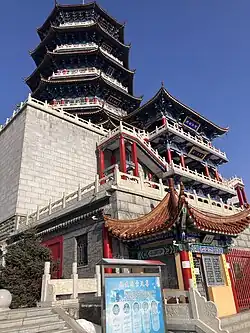
- Xuandi Temple — one of the larger Taoist temple complexes in Jilin Province, largely rebuilt to historical plans after Cultural Revolution-era destruction.
Parks and squares
- Beishan Park ("North Hill Park") — the classic city park: lotus ponds in summer, ice-rimmed branches in winter, boating lakes, and a scatter of small temples and pavilions across low forested hills.
- Longtan Mountain Park ("Dragon Pool Mountain Park") — built on the ruins of an ancient city associated with the Korean kingdom of Goguryeo, with easy hill walks and lookouts over the Songhua.
- Several civic squares along the riverfront serve as the symbolic heart of the modern city and are popular for skating and people-watching.
Lakes and nature
Songhua Lake — a long, fjord-like reservoir southeast of the centre, formed by a hydropower dam. Beautiful for boat cruises in summer and a base for ice-fishing and skiing in winter.
Ice-rimmed trees (wusong) along the Songhua — in January and February, warm hydroelectric outflow meeting deep-cold air condenses on the willows lining the riverbanks, coating them in fine ice crystals. Locally counted among China's great winter natural spectacles. Arrive at first light, before the sun knocks the ice off the branches.
See the wusong (rime ice) at dawn. Roughly mid-December to late February, on cold clear mornings. Walk the riverside promenade before mid-morning — the ice on the willows is at its most dramatic in the first hour of light and often gone by midday.
Ice Lantern Festival — carved ice lanterns and illuminated sculptures appear across riverside parks each winter.
Ski at Beidahu — a well-regarded resort a short distance southeast of the city, with a long snow season.
Skate or take a sleigh on the Songhua in deep winter, when sections of the river freeze hard enough for organised skating and ice carts.
Walk the old city grid north of the river for an unhurried half-day wander among small mosques, neighbourhood temples and dumpling shops.
Boat or hike at Songhua Lake in the warmer months.
Day-trip onward to Changbaishan — Jilin is a common staging point for the long trip south to Changbai Mountain National Nature Reserve and Tianchi (Heaven Lake).
Planning Jilin City? Want these on a customised itinerary?
Ask on WhatsAppWhere to eat?
Jilin's food is solidly Northeast Chinese (dongbei cai) — generous portions, plenty of stewing and braising, a heavy hand with garlic and pickled cabbage — overlaid with Manchu and Korean influences from the surrounding region. Signature dishes worth ordering at least once: guo bao rou, the Northeast's sweet-sour battered pork; xiao ji dun mogu, chicken stewed with wild mushrooms and glass noodles; suan cai bai rou, pickled-cabbage and pork-belly stew that comes into its own in winter; di san xian, the trio of potato, eggplant and green pepper; and freshwater fish from the Songhua, usually steamed or braised whole. Korean-Chinese influence also shows in good cold noodles and grilled meats found in nearly every block.
Old-city dumpling and noodle streets north of the river are a good budget option; Dongbei home-style restaurants around the main squares serve the classic dishes above at moderate prices; and hotel restaurants offer more refined multi-course meals for a special night out.
Vegetarian options are limited but workable: di san xian, stir-fried greens, mapo tofu and cold cucumber salads are on most menus. Halal food is well established thanks to the Hui Muslim community — look for signage around the old-city mosque area. Gluten-free is genuinely difficult given the centrality of wheat noodles, dumplings and soy sauce.
Where to drink?
Local drinks tilt toward what the climate calls for. In winter, hot baijiu — usually a Northeast sorghum spirit — appears at virtually every dinner, often served warm in small cups. Harbin Beer and Snow dominate the beer lists, both cheap and widely available. Locally distilled ginseng wine is more a souvenir than an everyday drink.
Non-alcoholic standbys include hot soy milk at breakfast stalls, sea-buckthorn juice (a Northeast specialty, tart and bright orange), and the full national menu of bubble teas and coffee chains, both increasingly present in the malls along the main commercial avenue.
Tap water is not safe to drink anywhere in Jilin. Stick to bottled, boiled or filtered water — every hotel room provides a kettle and thermos, and most restaurants serve hot water by default.
Planning Jilin City? We’ll book the stays and dining for you.
Ask on WhatsAppWhere to stay?
Jilin City has a range of accommodation: simple guesthouses near the railway station, national budget chains (Hanting, 7 Days Inn and similar), established mid-range chains (Atour, Vienna Hotel and similar) near the main squares, and a small number of international-standard upscale hotels (Crowne Plaza and similar brands have been reported operating in the city, with riverside views over the wusong-coated trees in winter).
What should you buy?
Jilin is not primarily a shopping city, but a few categories are worth seeking out:
- Songhua inkstones — carved from the distinctive green-banded Songhua stone quarried in the region, historically prized by Qing emperors. Buy from established stores rather than street stalls.
- Northeast specialty foods — dried tofu, pine nuts from the Changbai forests, wild mushrooms and smoked sausage.
- Ginseng and other Changbai herbal products — Jilin Province is a centre of Chinese ginseng cultivation. Buy from licensed pharmacies rather than market stalls if taking it home.
- Winter gear — if underdressed for the deep cold, shops around the railway station and larger malls stock affordable down jackets, fur-lined hats and insulated boots.
Bargaining is normal at street stalls and souvenir shops but not in malls or chain stores.
Where to go next?
- Changchun — a short high-speed rail hop. The provincial capital, with the former Manchukuo Imperial Palace and the FAW automotive heritage.
- Changbaishan National Nature Reserve — several hours south by bus or train transfers. China's highest volcanic massif, crowned by the crater lake of Tianchi on the North Korean border.
- Harbin — a couple of hours by high-speed rail. Russian-Manchurian architecture and the world-famous winter Ice and Snow Sculpture Festival — a natural winter pairing with Jilin's wusong.
- Shenyang — a couple of hours by high-speed rail. The first Qing capital, with the Mukden Palace and the imperial Qing tombs.
- Yanji — several hours by train. Capital of the Yanbian Korean Autonomous Prefecture, with a strong Korean-Chinese food scene.
- Dalian — several hours by high-speed rail. Northeast China's coastal city, with beaches and seafood.
Nearby in Jilin Sheng
More places to explore around Jilin City.

Guide content as of July 2026. Portions adapted from Wikivoyage, CC BY-SA 4.0.

Contact Us
Get in touch with us.
Get in touch
Contact Us
Tell us where you'd like to go and how you like to travel. A real Tripcuro planner — not a bot — will craft an itinerary around you.
- Personalised, hassle-free planning end-to-end
- Transparent pricing, no hidden costs
- 24/7 support for complete peace of mind