

Wuyuan
Jiangxi Sheng, China
About Wuyuan
Wuyuan (婺�) is a county in northeast Jiangxi Province, administratively part of Shangrao city, that has become one of China's most celebrated rural tourism destinations. Tucked into rolling hills on the cultural fringe of historic Huizhou (most of which lies across the border in Anhui), the county is famous less for the county seat itself than for the cluster of ancient villages scattered through the surrounding countryside — whitewashed Huizhou-style houses with black tiled roofs, carved wooden lintels, stone bridges, and narrow canal-laced lanes set against terraced rice paddies and tea plantations. The villages, many dating to the Ming and Qing dynasties, are routinely marketed as "the most beautiful countryside in China," and while that's a tourism-board slogan, the landscape lives up to it for much of the year.
The headline season is early spring (mid-March to mid-April), when the rapeseed (canola) flowers bloom in vast yellow terraces — Jiangling Village is the iconic photo spot, and prices and crowds spike accordingly. Late autumn (early to mid-November) is the second peak, when the red maples and persimmon trees around Huangling Village turn the hillsides crimson and villagers lay out chillies, corn, and chrysanthemums to dry on rooftop racks (a practice known as 晒秋, shà iqiū). Summers are hot, humid, and prone to thunderstorms; winters are damp and chilly but quiet. Avoid Chinese national holidays (May 1, October 1 week) unless you actively enjoy being herded.
A practical note from Wikivoyage that bears repeating: this is industrial-scale rural tourism, not undiscovered village life. Tour buses arrive in waves, most villages charge admission through a single operating company, and the standard pitch — sandalwood combs, "ancient" snacks, rice wine — is repeated village to village. The pleasure here lies in staying overnight after the day-trippers leave (most are gone by 6PM) and in seeking out the less-marketed villages on the western route.
The county is loosely organised into three touring lines that locals and drivers use:
- Eastern Line (东线) — Likeng (Small), Wangkou, Jiangwan, Xiaoqi, Jiangling, Huangling. Most popular, easiest by public bus.
- Northern Line (北线) — Qinghua, Sixi Yancun, Tuochuan, Dazhang Shan. Quieter, more authentic feel.
- Western Line (西线) — Fucun, Wenggong Mountain. Least visited.
The county seat, Wuyuan town (紫阳镇), is a workaday transport hub with little charm of its own. Sleep in the villages whenever possible.
Planning Wuyuan? Tell us your dates and we’ll tailor the trip.
Ask on WhatsAppHow to reach
By Plane
By Train
Wuyuan Railway Station (婺�站) sits on the Hefei–Fuzhou high-speed line and is the most convenient way in. Direct G- and D-trains run from Shanghai (around 4 hours), Beijing, Guangzhou, Hangzhou, Fuzhou, Xiamen, Hefei, Huangshan, and Nanchang. From Shangrao the high-speed run is roughly 25 minutes and costs about ¥40 — much faster than the old bus route (3½ hours, ¥54).
Book on 12306 (the official China Railway site/app) or via Trip.com. During the rapeseed-flower peak (late March to early April), G-train seats from Shanghai and Hangzhou can sell out a week ahead — buy early.
The station is several kilometres north of Wuyuan town. Taxis and ride-hails to the town centre or directly to a village like Likeng or Jiangwan run roughly ¥30–80 depending on distance; agree the price before getting in if the meter isn't used.
By Car / Road
The nearest sizeable city by road is Jingdezhen (about 85 km, around 2 hours), with regular buses from Licun Bus Station to Wuyuan North Bus Station. Longer-distance coaches connect Wuyuan with Nanchang, Huangshan, Hangzhou, Quanzhou, and Shanghai (two daily, 9:30AM and 6:45PM, ~7 hours, ¥180); a single daily bus to Hangzhou at 9:20AM takes about 5 hours for ¥103.
Long-distance coaches arrive at the new bus station (south of town), but most short-distance village buses leave from the Old North Bus Station. If you arrive at the new station and want the eastern villages, take a local bus (Â¥1) or taxi (~Â¥10) to the old station to transfer.
Driving yourself is uncommon for foreign visitors (Chinese licence required), but the G56 Hangzhou–Ruili Expressway passes near Wuyuan and roads to the major villages are paved and well signed. Hiring a driver for the day (¥200–250 per minivan) is the most efficient way to combine multiple villages on one line.
Public transport within the county is patchy and slow. The main routes:
- New North Station → Qinghua Village — ¥6, ~30 minutes.
- Old North Station → Small Likeng / Wangkou / Jiangwan / Xiaoqi — eastern-line shuttles, ¥5–15, 15 minutes to over an hour depending on stop.
- Old North Station → Sixi/Yancun / Qinghua → Dazhang Shan — western/northern-line buses, infrequent.
Motorcycle taxis swarm the bus stations and village entrances — the local rate is roughly ¥1 per 2 minutes of travel (Wuyuan town to Small Likeng is about ¥10). Always confirm the price before mounting. Regular taxis cost four to five times as much.
For visiting more than one village in a day, hiring a minivan driver (¥200–250/day) through your guesthouse is by far the most efficient option. Be prepared to buy your driver lunch — it's the local norm.
Scams and annoyances: Do not let taxi or motorcycle drivers help you find accommodation, and don't let them follow you into a village to "introduce" a hotel. The guesthouse will pad your rate to pay the driver's commission. Pre-book or walk in cold.
Tickets: Most villages are bundled under one ticketing company. A single-entry ticket is ¥60; the 5-day all-villages pass (¥210, students ¥105 with ID) covers most scenic spots including Dazhang Shan but excludes Big Likeng and Huangling, which are operated separately and ticketed on the gate (Huangling is ¥140).
Things to do
Eastern Line villages
- Small Likeng (���/��) — The most photographed of the Wuyuan villages: a tight warren of whitewashed houses, narrow lanes, and intersecting canals crossed by tiny stone bridges. Teahouses with canal views, Buddhist temples, and active farmhouses sit alongside the ubiquitous sandalwood-comb stalls. Heavily touristy by day; lovely at dawn and after 6PM when the day-trippers leave. Included on the ¥210 pass.
- Wangkou (汪å?£) — A linear village along a river bend, known for the Qing-era Yu Family Ancestral Hall (ä¿žæ°?å®—ç¥ ) with intricate wood carvings. Included on the Â¥210 pass.
- Jiangwan (江湾) — Skip the polished "main street" near the road and walk into the old quarter, where elderly residents sit out on stone steps in the alleyways. An hour is enough. Included on the ¥210 pass.
- Xiaoqi (晓起) — A pair of villages: Lower Xiaoqi is tacky and stall-lined, but cross the rice paddies to Upper Xiaoqi for a quieter, more atmospheric wander. A teahouse on the right as you enter Upper Xiaoqi serves food. Included on the ¥210 pass.
- Jiangling (江å²) — The classic rapeseed-flower terraces photo spot, at its peak from mid-March to early April. Outside of bloom season, mostly empty fields. Included on the Â¥210 pass.
- Huangling (ç¯?å²) — Hilltop village famous for shà iqiÅ« (autumn drying racks of red chillies, yellow corn, and orange persimmons on the rooftops). Reached by cable car or sightseeing vehicle, or on foot. Ticket Â¥140, not included in the Â¥210 pass. +86 793 7346698. About 26 km east of Small Likeng.
Northern Line villages
- Qinghua (清�) — A working town with the much-photographed Caihong Bridge (彩虹桥, "Rainbow Bridge"), a covered wooden bridge originally Song-dynasty. The bridge is the main reason to come — the surrounding town is unremarkable. Included on the ¥210 pass.
- Sixi Yancun (�溪延�) — A paired village complex of tall grey walls, narrow maze-like streets, and tumble-down Ming/Qing buildings. Because the ticket gate is set well back from the village itself, daily life carries on more authentically here than in Likeng. An ancient stone bridge in Sixi is more atmospheric than Qinghua's. Included on the ¥210 pass.
Other villages and sights
Big Likeng (大鄣山/大��) — Northwest of Small Likeng. Operated by a different company, so not on the ¥210 pass — separate ticket on the gate.
Fucun Town (浮�) — Western Line, lightly visited.
Wenggong Mountain (文公山) — Western Line, lightly visited.
Dazhang Shan (大鄣山) — A spectacular mountain area absent from many guidebooks. Soaring peaks and a series of crashing green waterfalls, including a claimed 240 m drop (claim probably exaggerated, scenery genuinely impressive). Cable car not yet operational at last report — count on about 3 hours up and down on foot along paved stone steps. Tea shop near the top. Included on the ¥210 pass.
Wunvzhou Resort (婺女洲) — A purpose-built Huizhou-themed cultural and entertainment complex opened in July 2022, combining live performances, family attractions, F&B, and shopping in new-built "old" Huizhou architecture. Ticket ¥100. Useful if travelling with children or in poor weather; not a substitute for the real villages.
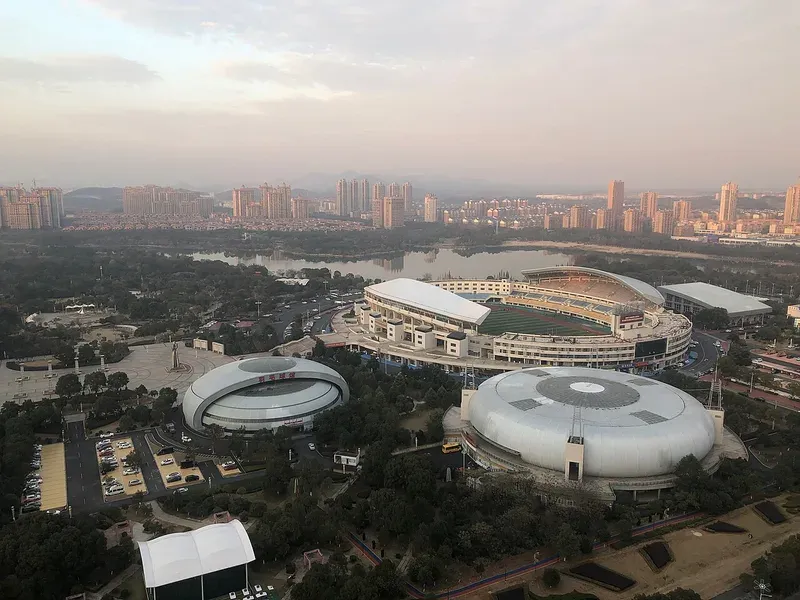
Wuyuan River Stadium — A modern 41,500-seat stadium hosting sporting events and occasional concerts. Worth knowing if a fixture coincides with your visit; not a sight in itself.
Village hopping with a hired driver. The signature Wuyuan experience: bundle 3–4 villages on the eastern or northern line into one day (~¥200–250 for the minivan, plus your pass).
Stay overnight in a village. Almost all tour groups have cleared out by 6PM. Walking the lanes of Small Likeng or Sixi after dark — by torchlight, since street lighting is minimal and everything shuts by 10PM — is the closest you'll get to the "old village" idea you came for.
Sunrise / sunset photography. Jiangling for rapeseed at golden hour in spring; Huangling for the drying racks on autumn mornings; Xiaoqi for rice paddies year-round.
Hike Dazhang Shan. Allow most of a day for the round trip on foot. Bring water.
Bamboo rafting. Several of the rivers around the villages (and a miniature version on the creeks of Small Likeng) offer hired rafts. Prices are negotiable; agree before stepping on.
Help in a rice paddy. Wikivoyage's tongue-in-cheek suggestion is genuine: outside the most touristy zones, farmers are unfussed about a curious visitor lending a hand. Bring rolled-up trousers and a thank-you cigarette/snack.
Tea tasting. Wuyuan is a recognised green tea region (Wuyuan lücha, 婺�绿茶) — teahouses in the villages will brew a pot for the price of a few yuan and a chat.
Planning Wuyuan? Want these on a customised itinerary?
Ask on WhatsAppFood & Dining
Wuyuan cooking is a regional variant of Huizhou cuisine (徽�) — earthy, oil-rich, fond of preserved meats and freshwater fish, often steamed in bamboo or clay pots. The county seat itself has little worth eating at; eat in the villages, ideally at your guesthouse, and ideally before 7PM, after which kitchens start closing.
Signature dishes to look for:
- Hézhēng (�包红鲤鱼) — Wuyuan's famous red carp, traditionally steamed whole. The fish is a local specialty raised in village ponds.
- Qīngzhēng héfà n (清蒸�包) — steamed local fish in lotus-leaf pouches.
- Húshì yÄ«pÇ?nguÅ? (糊豆è…?) — a thick, savoury "paste" tofu soup with minced pork and dried shrimp; humble village food.
- ZhúsÇ”n xiÄ?nròu (竹笋鲜肉) — fresh bamboo shoots stir-fried with pork.
- Wuyuan steamed vegetables — seasonal greens steamed with a little lard and chilli oil.
Specific recommendations:
- Brook Hotel (æºªè¾¹å®¢æ ˆ), Small Likeng — Nice food and the only English menu we know of in the whole county. Mid-range prices, reliable quality. Also where many travellers organise drivers.
- Guangming Teahouse (光明茶楼), Small Likeng — Walk up the canals to near the "top" of the village; the terrace has a fine view back down the water. Tea, simple noodles, dumplings, light meals.
- Upper Xiaoqi teahouse — On the right as you enter Upper Xiaoqi from the rice paddy crossing. Simple village fare, scenic setting.
- Your guesthouse kitchen — Almost any village guesthouse will cook a home-style meal on request (ask in the afternoon, not at 7PM). Typically ¥30–60 per person for a multi-dish dinner with rice.
Cafes & Nightlife
Tea is the local drink — village teahouses pour pots of local green tea for a few yuan, and tea farms north of the county sell directly. Try a side-by-side of Wuyuan green and the nearby Huangshan Maofeng if a teahouse will indulge you.
Rice wine (米酒) — locally brewed, slightly sweet, low-alcohol; served warm in winter from village kitchens. Most guesthouses will sell or share a jug.
Beer — Tsingtao and local Jiangxi brands are sold in restaurants, guesthouse kitchens, and teahouses. No proper bars or cafés in the villages, and the entire county effectively shuts at 10PM — this is not a nightlife destination.
Water safety — Tap water across China should be considered unsafe to drink unboiled. Bottled water is sold cheaply (¥2–3 per 500 mL) at village stores; hotels and guesthouses provide a hot-water kettle and thermos.
Planning Wuyuan? We’ll book the stays and dining for you.
Ask on WhatsAppPlaces to Stay
Budget
- Village guesthouses (民宿), Small Likeng / Xiaoqi / Sixi — Plentiful and signed in English in the more touristy villages. Simple rooms, shared or basic en-suite bathrooms. Off-season rates ¥100–120; expect 2–3× that during rapeseed-flower season and national holidays. Walk in or pre-book on Ctrip / Trip.com (note that listed photos sometimes flatter the reality).
- Wuyuan town budget hotels (near the bus stations) — Chain budget options like Hanting (汉åº) and 7 Days Inn (7天) cluster near the new bus station and railway shuttle stop. Useful only if you arrive late; otherwise push on to a village. > TODO: current room rates.
Mid-range
- Brook Hotel (æºªè¾¹å®¢æ ˆ), Small Likeng — Comfortable rooms in a canal-side traditional building, with the only English-menu restaurant in the county and a reliable driver-booking service. > TODO: current room rates — historically in the low- to mid- hundreds of yuan.
- Upper Xiaoqi and Sixi Yancun mid-range guesthouses — Several restored Huizhou courtyard houses have been converted into boutique-leaning mÃnsù; quieter and more atmospheric than Small Likeng. > TODO: specific properties' current rates and names vary year to year.
Upscale / heritage
- Skywells / restored Huizhou mansions — A handful of high-end jingpin mÃnsù (ç²¾å“?民宿) occupy restored Ming/Qing mansions with skywell courtyards, especially around Yancun, Sixi, and Huangling. Rates typically several hundred to over a thousand yuan a night in season. > TODO: specific named properties — the boutique scene turns over rapidly and recommendations should be checked on current booking sites.
- Huangling Village resort hotels — On-site accommodation operated by the Huangling scenic-area company gives you the rooftop terraces to yourself after the cable car shuts. Bookable via Trip.com. > TODO: current rates.
What to buy
The villages are saturated with stalls selling much the same things; quality varies. Worth looking for:
- Wuyuan green tea (婺�绿茶) — a well-regarded Jiangxi green tea; sealed tins from a reputable shop travel well.
- Sandalwood combs — the regional bestseller, hawked relentlessly in every village. Compare prices across stalls and bargain hard.
- Inkstones (æ™ç š, Shèyà n) — She inkstones, a famous Chinese "Four Treasures of the Study" item, are quarried in this region. Real ones are heavy, finely carved, and not cheap; cheap ones are tourist fakes.
- Lacquerware and Huizhou wood carvings — small carved panels, screens, and decorative pieces.
- Local preserved foods — dried bamboo shoots, dried mushrooms, smoked tofu, and (in autumn) candied persimmons.
Bargaining is expected in village stalls and informal shops — start at roughly 40–50% of the asking price. Fixed prices apply in modern shops at the stations and in the Wunvzhou Resort.
Go next
- Jingdezhen (景德镇) — ~85 km / 2 hr by bus or ~30 min by high-speed train. China's "porcelain capital" for over a millennium; visit the Ancient Kiln Folk Customs Museum, the Imperial Kiln ruins, and the Taoxichuan ceramics quarter.
- Huangshan / Tunxi (黄山/屯溪) — ~130 km / 1½–2 hr by high-speed train. The Yellow Mountains' iconic granite peaks and pine trees, plus the Huizhou-architecture town of Tunxi and the UNESCO villages of Xidi and Hongcun across the provincial border.
- Sanqingshan (三清山) — ~150 km via Shangrao. A Taoist-sacred granite peak with dramatic spires and walkways, reachable by combining a Wuyuan–Shangrao train with onward local transport, or by hiring a Gin Shan-based driver for a Wuyuan round trip (~¥150/person if 3 or more).
- Shangrao (上饶) — ~25 min by high-speed train. Mostly a transit hub but the natural launchpad for Sanqingshan and Lingshan.
- Nanchang (�昌) — ~2 hr by high-speed train. Jiangxi's capital; visit the Tengwang Pavilion, the August 1 Uprising memorial sites, and try Nanchang-style rice noodles (米粉).
- Wuyishan (æ¦å¤·å±±) — ~2 hr by high-speed train south into Fujian. A UNESCO World Heritage mountain landscape of red sandstone cliffs, river rafting on the Nine-Bend Stream, and the home of Da Hong Pao oolong tea.
Nearby in Jiangxi Sheng
More places to explore around Wuyuan.

Portions adapted from Wikivoyage, CC BY-SA 4.0.

Contact Us
Get in touch with us.
Get in touch
Contact Us
Tell us where you'd like to go and how you like to travel. A real Tripcuro planner — not a bot — will craft an itinerary around you.
- Personalised, hassle-free planning end-to-end
- Transparent pricing, no hidden costs
- 24/7 support for complete peace of mind